
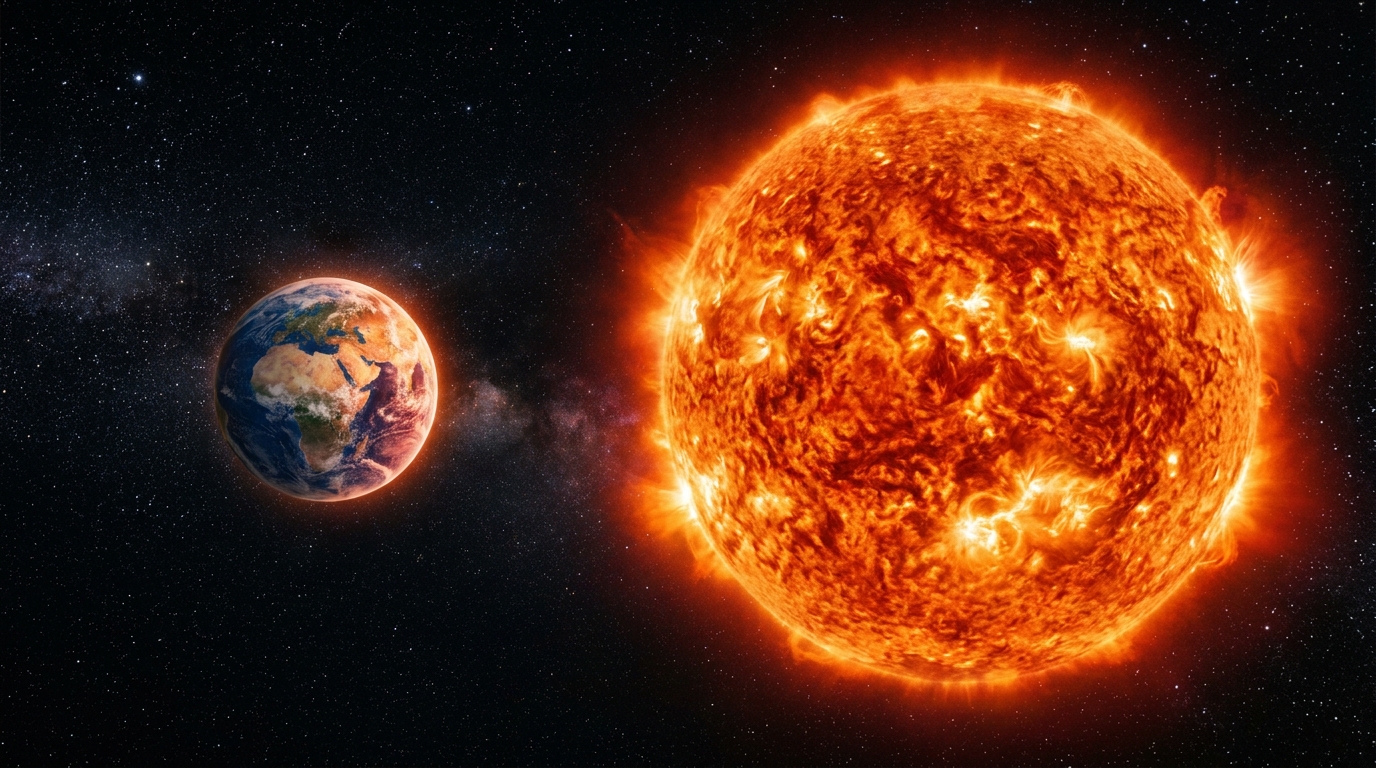
In a future so distant that it nearly defies our ability to imagine it, the Sun will become Earth’s greatest threat. The star that enabled the emergence and evolution of life will eventually turn into a red monster capable of upending the entire solar system.
According to stellar evolution models, in about a billion years the Sun will begin to exhaust its hydrogen and enter a new phase of its life. It will swell gradually into a red giant, causing a massive increase in the radiation reaching Earth. The oceans could disappear, the atmosphere would be profoundly transformed, and our planet would become uninhabitable. Ultimately, Earth itself could even be swallowed by the expanding Sun.
After this spectacular phase, the Sun will shed its outer layers and end its life as a cold, dim white dwarf. But the threat would not be limited to our star: on even longer timescales, the Universe will enter a period when new stars gradually stop forming.
Facing this cosmic destiny, a vertiginous question arises: could a civilization sufficiently advanced preserve Earth without leaving its solar system?
One theoretical scenario explores this possibility by imagining a colossal survival strategy based on engineering at planetary and solar scales.
A Giant Sunshield to Protect Earth from the Aging Sun
The first challenge would be to reduce the energy received from the Sun as it becomes a red giant.
One proposed solution would be to build a vast space shade capable of blocking part of the solar radiation. It could be positioned at the L1 Lagrange point, a region located between Earth and the Sun where gravitational forces allow a structure to remain relatively stable.
But a red giant would be so immense that a simple screen placed there would have to be gigantic. To limit the dimensions required, another approach would be to use a counterweight situated at the L1 point, connected by an extremely long cable to a screen placed closer to Earth, just beyond the Moon’s orbit.
Resources could come from the solar system itself. A portion of the dwarf planet Ceres could supply enough material to manufacture a carbon cable several million kilometers long, while a fraction of the Moon’s mass could serve to construct a colossal aluminum screen capable of maintaining a permanent artificial shadow on Earth.
Credit: © Gabriel Harry
Jupiter Would Become Humanity’s Backup Energy Plant
However, blocking sunlight would raise a major problem: how to provide Earth with the energy needed for life?
The envisioned answer lies in Jupiter. The gas giant contains vast reserves of hydrogen and helium, essential ingredients for fusion reactions.
The concept relies on a remarkable idea: using Jupiter’s natural conditions to facilitate fusion. On Earth, the main hurdle remains the confinement of plasma at extreme temperatures. No known material can withstand the required stresses for extended periods.
Jupiter could supply part of this pressure naturally. Reactors placed thousands of kilometers beneath its atmosphere could tap into the hydrogen and helium-4 to produce substantial energy.
This power could then be transmitted to Earth via immense space infrastructures capable of transferring energy across the solar system.
Altering the Earth’s Orbit to Escape the Future Red Giant
Even shielded by a sunshield and powered by an artificial energy source, Earth would remain endangered: its current orbit would place it too close to the Sun when it becomes a red giant.
Thus, its orbit would need to be gradually adjusted to move it far enough away from the aging star.
A first theoretical method would be to use asteroids as “gravitational towships.” By repeatedly guiding a massive object near Earth, the exchange of gravitational energy could slowly raise Earth’s orbital velocity and push it away from the Sun.
This approach would, however, be extremely risky: a trajectory error during a flyby could trigger a catastrophe.
A second, more controlled solution would involve extracting matter from Jupiter and directing a beam of particles near Earth to produce a similar mechanical effect, but in a steadier and more predictable manner.
Over extremely long timescales, this tiny but steady thrust could suffice to alter Earth’s orbit.
Keeping Earth’s Core Warm with Antimatter
Even if Earth remained shielded from the Sun’s death, another problem would arise: its internal activity would eventually slow down.
The heat emanating from the planet’s interior currently fuels plate tectonics, volcanism, and the recycling of elements essential to life. Without this geological activity, Earth would gradually become a far less dynamic world.
An even more speculative scenario proposes using antimatter as a source of artificial heat. Controlled quantities could be enclosed in containers filled with molten iron and then sent deep beneath the surface.
When these materials reach the planet’s inner regions, annihilation between matter and antimatter would release an immense amount of energy in the form of heat.
According to this hypothesis, producing a few kilograms of antimatter per day could theoretically sustain enough geological activity to prolong habitability.
Why Stay on Earth Rather Than Travel to Another Star?
An obvious question then arises: why invest in such a transformation of the solar system rather than depart to colonize other worlds?
The answer lies in the enormous challenges of interstellar travel. Keeping humans alive for thousands or millions of years in space, reaching other stars, and building autonomous civilizations there would require gigantic means.
By contrast, modifying our own solar system would allow us to leverage already-present infrastructures: asteroid mining, the resources of moons, and the energy of the gas giants.
Some arguments also emphasize the cultural risk of a complete dispersion across the galaxy. Colonies separated for millions of years could evolve into civilizations that are completely different, or even alien to their origins.
A World That Would Endure After the Death of the Sun?
These scenarios remain entirely theoretical today. They assume a civilization capable of manipulating resources at a scale that humanity is still far from achieving.
But they reveal a fascinating idea: the Sun’s disappearance might not necessarily spell the end of terrestrial life.
An extremely advanced civilization could, in theory, transform the solar system into an artificially maintained environment, where the Earth would continue to harbor life long after its star has vanished.
The true challenge of the future might then be less about finding a new habitable planet and more about preserving the one that gave us life.
