
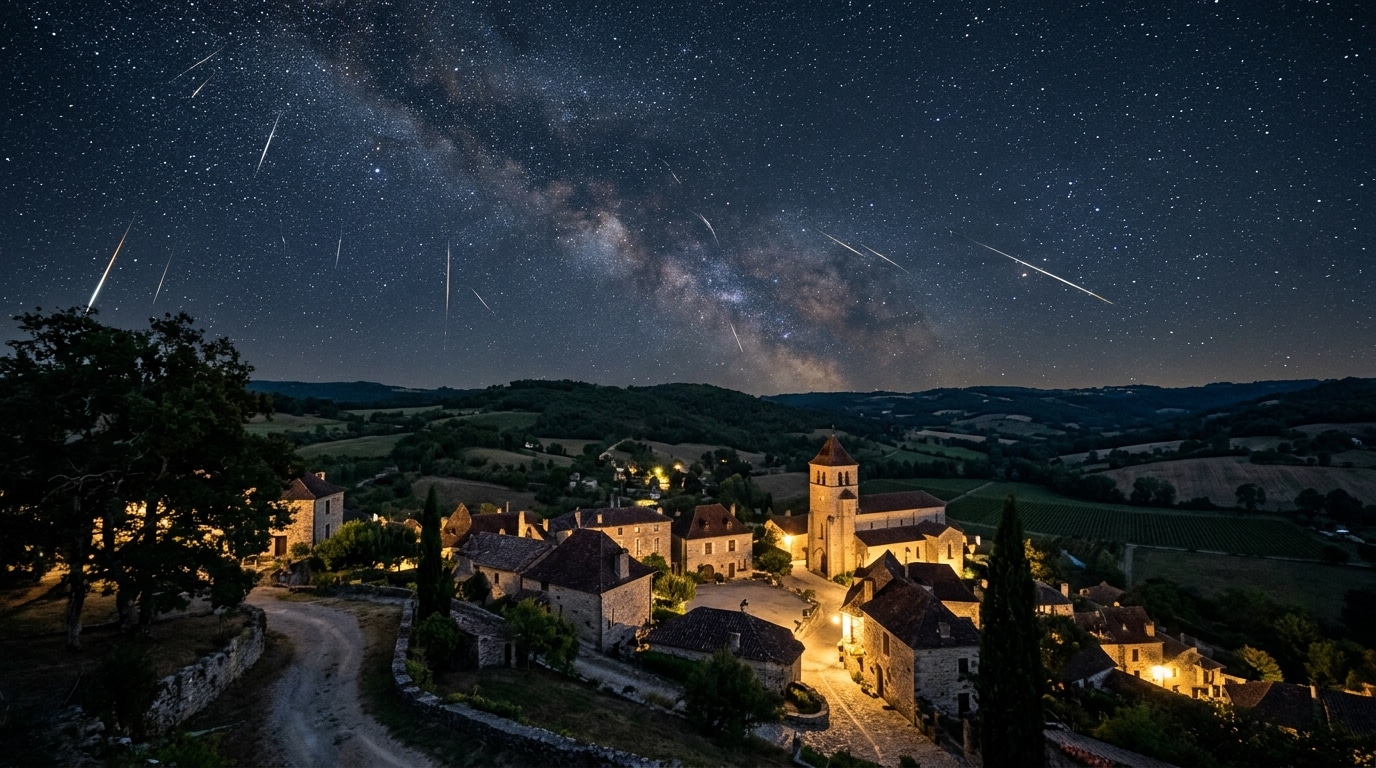
Too many nights of stargazing spoiled by a Moon that shines too brightly, drowning shooting stars in its glow. This year, the problem disappears: the New Moon coincides exactly with the peak of the Perseids. The result, a perfectly dark sky and up to a hundred meteors per hour. Here’s how not to miss this rare spectacle.
The New Moon, the Unexpected Ally That Will Elevate the Perseids
Every summer, the Perseids return faithfully. But their quality often depends on one detail we forget: the Moon. When it shines full and high, it lights up the sky and washes out the faintest shooting stars. You lose half the show.
This time, luck is on our side. The New Moon falls precisely on the night of the peak. In other words, our satellite sits between the Earth and the Sun and becomes invisible. The sky stays plunged into total darkness, ideal for catching every light trail.
This coincidence is no accident. It occurs only about once every fifteen years. Seeing the maximum of the Perseids fall on a Moonless night is thus a small astronomical event. An opportunity not to be missed.
100 Meteors per Hour: Where Do These Shooting Stars Really Come From
Contrary to popular belief, a shooting star is nothing like a real star. It’s a tiny dust particle, often no bigger than a grain of sand, that collides with Earth’s atmosphere at very high speed. As it burns, it leaves behind that bright trail that crosses the sky in a fraction of a second.
This dust comes from a comet. Each summer, Earth traverses the cloud of debris it has left in its wake. All these particles seem to originate from the same point in the sky, located in the constellation Perseus. Hence the name Perseids.
Under ideal conditions, the theoretical rate climbs up to 100 meteors per hour. Let’s be honest: under a truly dark rural sky, you’d count about 50 to 60 shooting stars per hour. That’s already enormous, and it’s enough to make the Perseids the most spectacular meteor shower of the year.
When to Look Up and Where to Stand to Not Miss a Thing
Timing matters as much as the location. For France, the best window is in the second half of the night, between 3:00 and 6:00 in the morning, Paris time. At that moment, the radiant climbs high in the sky and the number of meteors increases as the night goes on, up to dawn.
The reason is simple: as the night wears on, our hemisphere turns toward the stream of particles. Like a windshield in the rain, it then receives the maximum debris. The closer dawn approaches, the more intense the show becomes.
On the location side, avoid cities. The light pollution remains the worst enemy of observation. Seek the countryside, an open field, a mountain pass, or the seafront, far from streetlights. The darker the horizon, the more trails you’ll see streaking across the sky.
Mistakes to Avoid and the Gestures That Will Make All the Difference
First classic mistake: bringing out binoculars or a telescope. Useless here. Shooting stars cross the sky too quickly and over too wide an area. Observation is done with the naked eye, sweeping the sky with your gaze. Your natural field of view is your best tool.
Second trap: checking your phone every five minutes. The eye takes about twenty minutes to adapt to the darkness. Each glance at a bright screen erases the adaptation. Leave the phone aside, or switch it to red night mode.
- Settle in comfortably, lying on a sunlounger or a blanket.
- Bundle up: even in August, the nights become chilly in the second half of the night.
- Bring a hot drink and a dash of patience; meteors arrive in waves.
- Face a broad swath of sky, not fixating on a single point.
One last fun point: this same New Moon makes possible, during the day, a total solar eclipse. Its path of totality sweeps across the Arctic, Greenland, Iceland, and the north of Spain. The two phenomena share only this New Moon, but what a beautiful day for sky enthusiasts.
What to Take Away to Fully Experience the Night of August 12
Keep three simple points in mind. First, the sky will be perfectly dark thanks to the New Moon, a boon that comes only about once every fifteen years. Next, the best moment runs between 3:00 and 6:00 in the morning. Finally, move away from city lights.
No gear needed, no need to be an expert. A blanket, a clear sky, and a little patience are enough. Also remember that Perseid activity extends well beyond a single night: it peaks around the maximum, which leaves several chances to try your luck.
So, this Moonless night when up to a hundred meteors per hour streak across the sky, will you let it pass by, or will you finally lie down under the stars to make a few wishes?
