
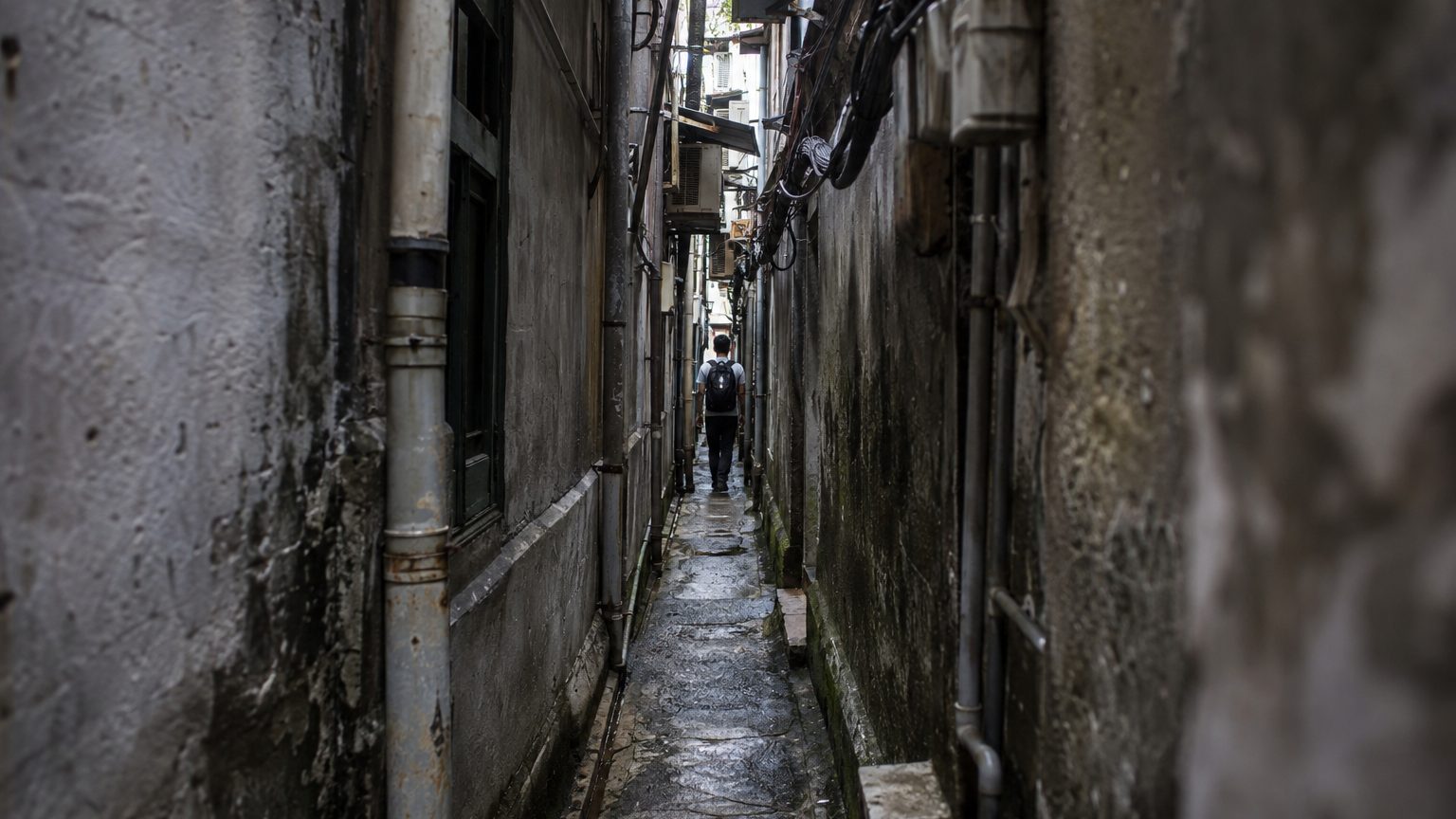
Alleys so narrow that two people cannot pass each other without brushing past one another. Pipes running overhead, dripping water that never quite reaches the sky. A single concrete block, bristling with electrical wires, where daylight never touches the ground. It was in Hong Kong, in a pocket of the city under British administration, that this compact mass existed until 1993, the year of its demolition.
The site covered barely a hectare. Yet 33,000 people lived there, crammed into a stack of buildings welded to one another, with no state—British or Chinese—really taking charge of its administration.
- An enclave of 33,000 inhabitants occupied one hectare in Hong Kong, crowded into welded-together buildings with daylight never touching the ground.
- No state administered this territory: a legal vacuum stemming from old diplomatic treaties made it an urban no-man’s-land for a century.
- Lacking official regulation, the enclave developed its own unlicensed shops, schools and medical services, with a spirit of solidarity despite precarious living conditions.
- Demolition began in 1993 after an agreement between British and Chinese authorities, involving censuses, negotiations and forced expulsions.
An enclave born from a legal vacuum, not by chance
There was nothing fanciful about this absence of authority: it stemmed from an old diplomatic text. The convention that ceded surrounding territory to Britain explicitly excluded this enclave, and after the fall of the ruling dynasty, the Chinese authority that followed inherited this claim on paper, never exercising it on the ground.
Result: an administrative no‑man’s‑land in the very heart of a British colony. No police were ever sent there, no taxes collected, no building permits issued. This ambiguity allowed the place to grow unchecked as waves of refugees from mainland China crowded in.
Without urban planning regulations, residents did what any space-starved community would do: build upward, leaning against neighboring walls, sharing beams and foundations. The enclave thus became a near-continual block, where floors stacked so tightly that they formed a single organic structure. Between the buildings wound a maze of alleys, just one to two meters wide, where daylight almost never touched the ground, and residents moved about with umbrellas to shield themselves from water dripping from the pipes above.
A city within the city, with its own rules
With no state to regulate anything, the enclave developed its own ecosystem. Residents opened numerous small shops, workshops, and unregulated services such as schools, medical clinics and dental offices, often run by practitioners without credentials recognized by any administration.
There were dentists practicing without official licenses. Noodle factories operated at full tilt in windowless backyards. Garment workshops sewed day and night, feeding the stalls in the neighboring district without ever appearing on any commercial register.
The place’s reputation long carried a seedy aura, linked to organized crime and various trafficking. Yet that obscured a more nuanced reality: despite harsh living conditions, marked by poor hygiene and an almost total lack of sunlight on the lower floors, the majority of residents lived peacefully. A spirit of solidarity had taken root, woven by proximity and the absence of external recourse in times of trouble.
The demolition, a project as political as it is urban
Over the decades, the enclave had become a burdensome symbol. Neither the British power nor the Chinese authority wished to claim this hub of urban anarchic life, let alone publicly assume its management.
An agreement was eventually reached between the two sides to raze the whole area. The process stretched over years: a census of residents, case-by-case negotiations, compensation paid to families who had settled there for generations. A compensation scheme was put in place for the residents, and for those who continued to resist, forcible evictions were eventually carried out. Some occupants held out to the end, convinced that no external authority had legitimacy to eject them from a place it had never administered. Demolition finally began in 1993, ending a century of anomalous existence.
A garden in place of chaos
From the rubble, the city did not choose to rebuild towers or offices. It opted for a public park, designed in the style of classic Chinese gardens. Some buildings and historic elements were preserved to be integrated into the new space, with a layout inspired by the refined gardens of the early Qing era.
The park’s paths trace, in places, the outline of the former enclave. Remnants of walls and some original gates were kept, as if leaving an imprint of the vanished buildings beneath a pristine lawn.
Today, families picnic where tens of thousands once crowded without a unified civil status. The contrast alone encapsulates the place’s history: from a space where no one governed to a garden maintained to the centimeter by a municipal authority.
Sources: linfo.re | chineescapade.com
