
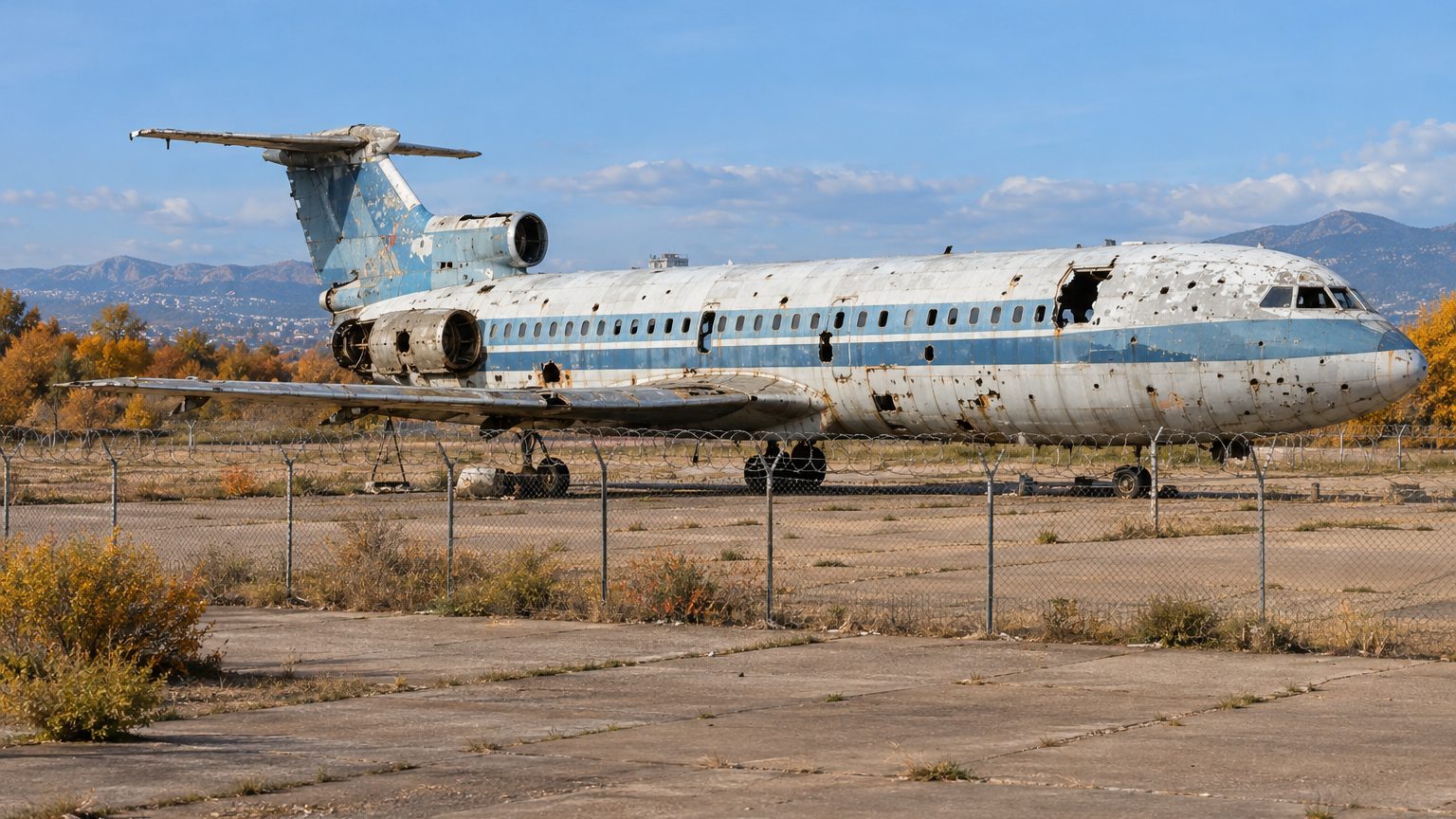
The Hawker Siddeley Trident 2E of Cyprus Airways, registered 5B-DAB, was damaged on the tarmac at Nicosia Airport during the Turkish airstrikes of July 22, 1974, the day of the ceasefire. It has never taken off again.
It has been fifty-two years waiting, riddled with impacts, on the same concrete.
The aircraft, about 35 meters long, roughly the length of two articulated buses end to end, was delivered to the Cypriot airline in May 1970. It thus bore barely four years of commercial service. The Trident did not enjoy the same success as its American rival, the Boeing 727, and only 117 were built, making this wreck one of the few witnesses to a British airliner that has become rare.
- A Hawker Siddeley Trident aircraft was damaged during the July 22, 1974 airstrikes in Nicosia and has never taken off since.
- Nicosia Airport became a United Nations buffer zone after the ceasefire, blocking any reopening without agreement from both parties.
- The wreck remains Cyprus Airways’ property and is guarded by UNFICYP, accessible only by special authorization for 52 years.
A July morning when the runway becomes a battlefield
The Greece-backed coup erupts in Cyprus, and Turkey launches its intervention on July 20, 1974. Nicosia Airport, then the island’s international gateway, becomes the stage for some of the fiercest fighting between Cypriot and Turkish forces. That morning, Trident 1E 5B-DAE arrives from London with only six passengers, its captain having vainly requested the flight’s cancellation. Less than an hour later, the bombing destroys it completely. Sources differ on the exact date of damage to 5B-DAB: some cite July 20, others July 22, the day of the ceasefire, which Aviation Safety Network also notes.
The airline then fielded four Tridents. Two of them, 5B-DAC and 5B-DAD, sustained only minor damage but remained stranded on site. The 5B-DAB, however, was too badly damaged to repair and was abandoned near the company’s maintenance hangar. In 1977, engineers from British Airways came to recover the salvageable aircraft and ferry them to London.
The engines of the 5B-DAB were used to restart its two sisters.
A platform frozen by the Green Line
On July 23, 1974, the UN force commander in Cyprus orders his troops to take control of the airport and declares it a United Nations-protected area. The two sides must withdraw to at least 500 meters from the perimeter. When the ceasefire lines are drawn in August, the area is incorporated into the buffer zone that separates the island’s north and south.
Since then, the airfield has fallen under UNFICYP. It hosts its headquarters, active UN helicopters, and recreational facilities for personnel. Neither party can reopen the platform without the other’s consent, and civil traffic shifted to Larnaca, which opened in 1975. Negotiated attempts to reopen over the decades have never materialized.
In February 2026, a citizen-driven project for a bicommunal museum on the site made the headlines, before UNFICYP spokesman Aleem Siddique labeled it speculation. No formal proposal had been submitted to the UN, and the airport’s status remained unchanged.
What time has done to the aircraft
The Trident lies behind barbed wire, engines missing, tires deflated, interior stripped of its seats. The famous bullet marks still mark the fuselage, and the mouflon, the airline’s emblem, fades under the Mediterranean sun. A detail reported by former UN Blue Helmets in 2015: the flight-control sticks had not been removed by collectors.
It still belongs to the former Cyprus Airways, but it is the UN that protects it.
Visiting is a real obstacle course. Public access is forbidden, and only case-by-case UNFICYP authorizations, granted to researchers or photographers, open the gate to the buffer zone. For the military stationed on the island, the wreck serves as a backdrop for souvenir photos.
One of its twins fared better: one of the Tridents 2E repatriated to London is today on display at the Imperial War Museum at Duxford, in England. In 2015, the son of Cyprus Airways’ first pilot also launched an effort to have 5B-DAB declared a national monument, with UN support, but no ownership transfer has been announced to date.
Sources: cyprusscene.com | airportspotting.com
