
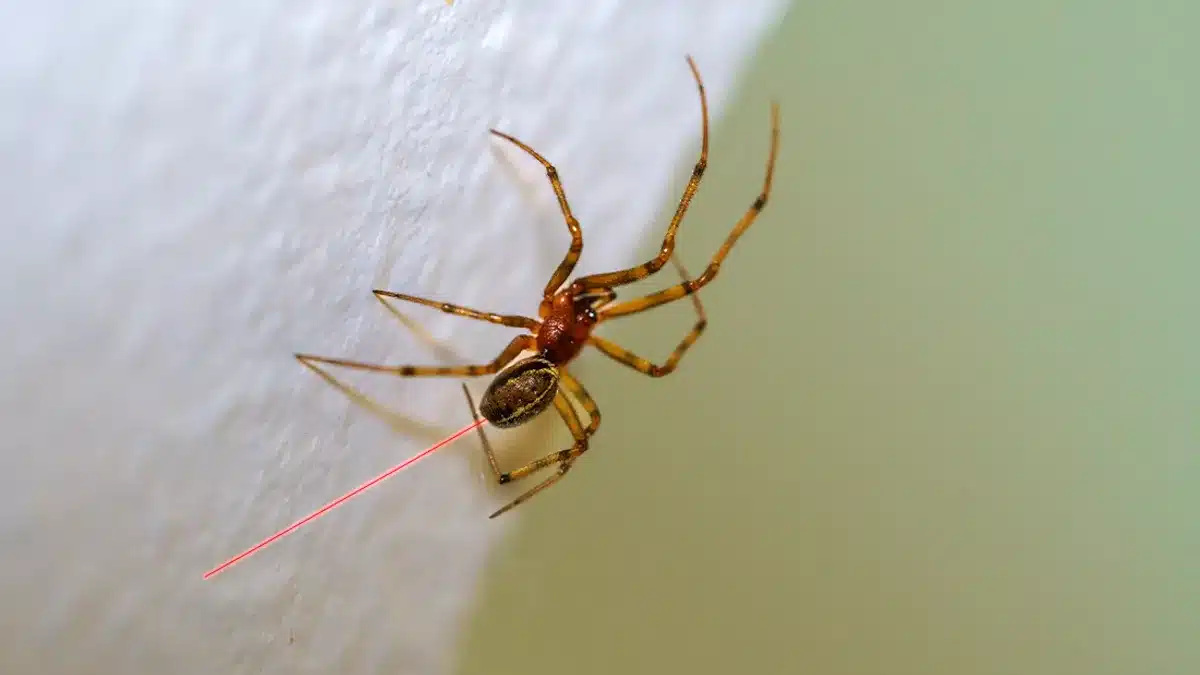
If you have ever shivered at the thought of crossing paths with a spider, here is news that could inject a touch of science fiction into your phobia. Researchers have recently created the very first genetically modified spider using the renowned CRISPR-Cas9 technology. But that’s not all: this spider now produces silk that glows under certain lights, an innovation with potentially revolutionary applications for materials science.
A Revolutionary Genetic Breakthrough
CRISPR-Cas9, the gene-editing tool that has transformed biology, allows precise modification of an organism’s DNA by targeting specific sequences and inserting new genes. This technology, which earned its inventors a Nobel Prize, is already used in a range of fields, from medical treatments to combating certain genetic diseases. But its reach does not end there. Researchers have now turned their attention to the animal kingdom, and more specifically to the domestic spider, to harness its remarkable capabilities.
The spider chosen for this experiment is Parasteatoda tepidariorum, also known as the common house spider. While these creatures are often feared and avoided, they possess a fascinating trait: their silk. This material is not only extraordinarily strong but also surprisingly light, elastic, and biodegradable. These properties make it a material of choice for researchers, but also a budding biotechnology model in the making.
Manipulating Spider Silk
The goal of this study was to modify spider silk so that it could be enriched with new properties, notably visible fluorescence. To achieve this, researchers used CRISPR-Cas9 to insert a gene encoding a red fluorescent protein into the spider’s genome. This modification not only facilitates easy tracking of the gene-editing success but also opens the door to future applications in areas such as biomaterials and medicine.
The experiment was conducted by a team led by Professor Dr. Thomas Scheibel from the University of Bayreuth in Germany. Their method involved injecting a solution containing the modified genetic material into unfertilized female spider oocytes. Once fertilized, these spiders produced offspring that were genetically modified, yielding fluorescent silk. This achievement is not merely a genetic feat; it could also revolutionize the use of spider silk in technological applications.
Why is this silk so special?
Spider silk already boasts remarkable properties: it is five times stronger than steel of the same weight and possesses incredible elasticity. Yet the possibility of modifying this silk through genetic editing could allow it to become even tougher or endowed with other useful traits. For instance, one could imagine spider silk that is even more resistant to tensile stress, or capable of absorbing energy more efficiently.
In addition to its applications in materials science, this research could have implications for biomedicine. The idea of producing natural, lightweight, biodegradable, and strong fibers could spur innovations in the manufacture of sutures, dressings, or even prosthetics. The modified spider silk could thus become a preferred material for high-performance medical solutions.
The details of the study were published in Angewandte Chemie.
