
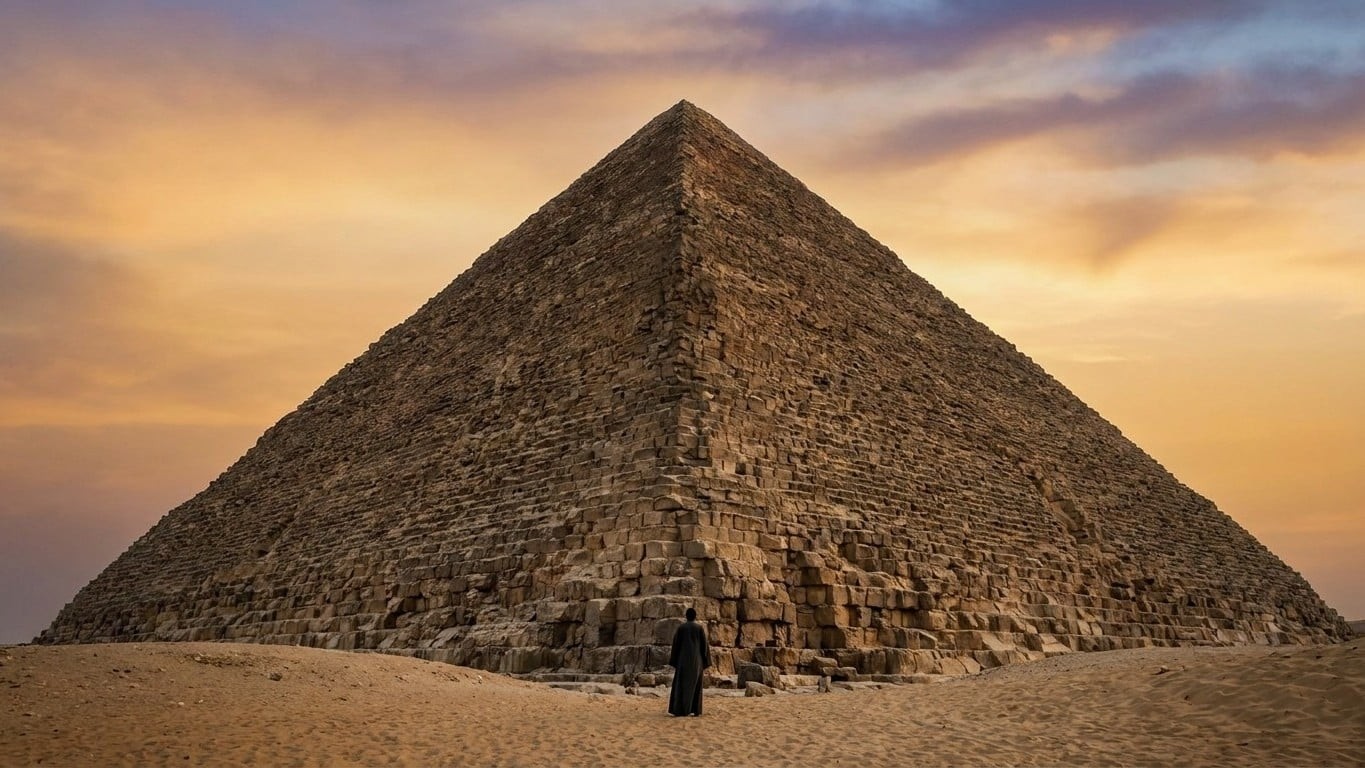
Nine meters. Barely the length of a corridor in a Haussmannian apartment. And yet, this stone space has not seen the light for 4,500 years. Behind the monumental beams of the north face of the Great Pyramid of Khufu (Cheops), researchers confirmed in 2023 the existence of a hidden 9-meter corridor behind the pyramid’s north entrance, thanks to a technology that comes from the stars. Literally.
Key takeaways
- A 9-meter corridor detected without damaging the pyramid thanks to cosmic particles
- No signs of human activity for 4,500 years: the chamber remains intact and pristine
- A sealed door at the end of the passage could reveal secrets in 2026
Cosmic particles as a radiographic scan of Antiquity
The tool that enabled this discovery does not belong to classical archaeology. It belongs to particle physics. Muons are elementary particles created in the upper atmosphere by cosmic rays. When they encounter matter, they slow down and eventually stop. Researchers measure the number of these particles that are recovered behind an object to be scanned: if they observe an excess at a location, it means the muons passed through less material, hence there is void. In plain terms, particles that continuously bombard Earth from space serve as a giant scanner to read the interior of ancient monuments without touching a single stone.
The ScanPyramids mission is an international project designed and led by Cairo University and the French HIP Institute, launched in October 2015, which combines several non-invasive and non-destructive techniques to better understand the pyramids’ structure and construction methods. It was this consortium that, as early as 2016, placed detector plates inside Khufu/Khéops’ known corridors to measure muon flux from the outside.
A new measurement campaign conducted in 2019 clarified the existence of this corridor after only three weeks of data acquisition and the collection of more than 100 million muons. Several hypotheses were then tested about the corridor’s dimensions and position, and it was established that it began only a few tens of centimeters from the chevrons of the north face and extended about 9.5 meters. The CEA-Irfu and Nagoya University, working independently, arrived at the same conclusions, within a few centimeters. This kind of cross-validation in science leaves little room for doubt.
A corridor with a triangular vaulted ceiling, empty and intact
The new measurements, obtained with nuclear emulsion films from Nagoya University and gas detectors from the CEA, revealed a structure about 9 meters in length with a cross-section of roughly 2.0 by 2.0 meters. The integrated radar and ultrasound approach allowed precisely defining the cavity as a corridor with a chevron-shaped ceiling, measuring approximately 2.30 meters in height and 2.15 meters in width. A gabled corridor, in short, whose architecture follows a logic that Egyptian builders mastered perfectly: distributing the colossal weight of the limestone blocks above the entrance to prevent collapse.
The most puzzling aspect is what the scientists did not find there. In 2023, by combining muography results, ground-penetrating radar, and ultrasound tests, the ScanPyramids team found an opening capable of introducing an endoscope with a diameter of only 5 mm. The scientists found no trace of footprints or other signs of human activity in the chamber, and they estimate that the room has not been visited for about 4,500 years. It was then possible to slide this ultrafine endoscope between the stones’ joints, accessing a room that had remained hidden for 4,500 years, “the first to be muographed before being photographed,” according to the lead physicist overseeing the measurements.
Analyses also showed that the NFC (North Face Corridor) lay in the same plane as other known structures with a precision of a few centimeters, suggesting that it was an original cavity rather than something dug later. This corridor is not the product of a poorly documented construction site or a late modification. It was put in place from the outset by the architects of Pharaoh Khufu. Why? That is where certainties stop.
What the door at the end of the passage might be hiding
The 9-meter corridor is only the first level of the mystery. Because robots sent inside have traced the trail further. Remote-controlled robots advanced deeper into the monument and reached a sealed stone door at the end of a passage. Zahi Hawass indicated that what lies behind it should be revealed publicly in 2026.
This unknown corridor sits in the Great Pyramid of Giza, built about 4,500 years ago to house the mummy of Pharaoh Khufu, whose mummy has never been found to date. For Hawass, this absence is not an insoluble mystery: it suggests that the true burial chamber is simply somewhere else than where archaeologists have looked so far. Not in the “King’s Chamber,” nor in the “Queen’s Chamber” (two names arbitrarily assigned by Arab explorers in the Middle Ages), but behind this door that no one has touched since ancient Egypt existed.
Caution, however. Other specialists remain more reserved. Some Egyptologists quickly rejected the idea of hidden burial chambers, and this potential 2026 reveal sits in the context of the inauguration of the Grand Egyptian Museum, located immediately near the pyramids of Giza, considered the largest museum devoted to a single civilization. Unlike the “Big Void” discovered in 2017, this passage seems more deliberate in its architectural placement, and experts believe it was designed to redistribute the immense weight of the blocks or to conceal something of extreme value.
A pyramid that continues to rewrite its own plans
As early as 2017, the ScanPyramids project had highlighted, thanks to muography, a vast cavity nicknamed the “Big Void,” about 30 meters long, located above the Grand Gallery. This discovery constituted the first major internal structure identified since the XIXth century. The 9-meter corridor is therefore the second brick in a series of revelations that, decade after decade, redraws our understanding of the best-studied monument in human history.
What strikes is the method. Not a pickaxe, not a jackhammer. It is thanks to thermal imaging, 3D mapping, and muon radiography that researchers identified these spaces. The Great Pyramid of Khufu is not destroyed to be understood. It is traversed, silently, by particles from space, the same ones that bombard your skull at this very moment. The difference is that detectors await them on the other side, inside a monument built two millennia before the invention of zero. And the Giza plateau doesn’t stop there: the extended muography campaign of 2024-2026 by the ScanPyramids program yielded an unexpected result beneath the neighboring pyramid of Mykerinos, with muon detectors pointing to a much larger anomaly, estimated at 9 meters by 5 by 3, tucked 18 meters below the known burial chamber. The Giza plateau has not finished speaking.
Sources: letribunaldunet.fr | demotivateur.fr
