
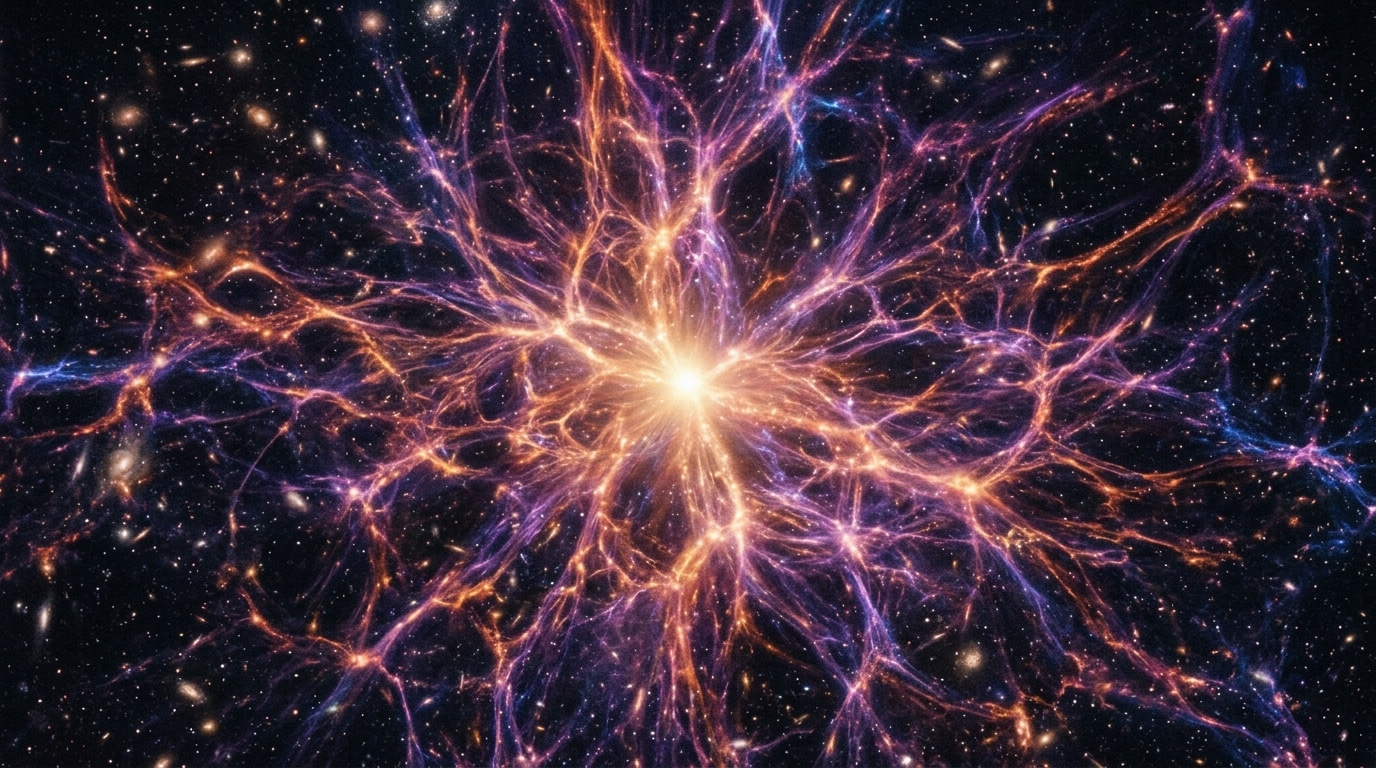
Imagine a tiny point that, in a moment far shorter than anything our brain can conceive, suddenly becomes a trillion times larger. This isn’t science fiction; it is what the inflationary model describes. Even before the explosion associated with the Big Bang, the Universe would have undergone an expansion so violent that it defies human intuition.
- Cosmic inflation, a phase during which space itself expands rather than matter exploding, would have multiplied the size of the Universe by at least a factor of 10^26 between 10^-36 and 10^-32 seconds after the Big Bang.
- Funding for the American project CMB-S4, aimed at tracking primordial gravitational waves, was recently halted after logistical constraints at the South Pole.
- The Simons Observatory in Chile and the Japanese mission LiteBIRD have taken the baton to attempt to detect inflation’s traces in the cosmic microwave background.
- An explosion that isn’t one: the revisited Big Bang myth
- Twenty-six powers: the expansion factor beyond imagination
- Thirty-six billionths of a second: the time window when it all tipped
An explosion that isn’t one: the revisited Big Bang myth
In popular imagination, the Big Bang looks like a giant bomb. A pinpoint of concentrated matter exploding in a pre-existing space, flinging galaxies and stars to the four corners of the cosmos. This is the image you find in documentaries, films, and even many school textbooks.
The problem is that this depiction is false. There wasn’t any preexisting space in which matter could spread. It is space itself that began to grow, much like the surface of a balloon being inflated, with no single point truly at the center of the explosion.
Cosmologists instead speak of a phase of extremely rapid expansion, named cosmic inflation. It would have occurred just after the initial instant, long before the more gradual phase usually associated with the Big Bang in popular portrayals.
To picture it, imagine points drawn on a rubber band that you stretch violently. They move away from each other even though none of them actually moves through space. That is precisely the mechanism, on a scale that mathematics itself struggles to render tangible.
Twenty-six powers: the expansion factor beyond imagination
To convey the scale of this phenomenon, physicists propose a growth factor of at least 10^26. In practical terms, that would transform an object the size of an atom into something larger than our solar system, in a time frame far shorter than a blink of an eye.
Tracking direct proof of this episode remains one of the greatest challenges of modern cosmology. Researchers search for traces of primordial gravitational waves, footprints left by inflation in the cosmic microwave background, the fossil radiation that still bathes the Universe today. The American project CMB-S4, active since 2013 and valued at about $900 million, aimed precisely at this objective with nearly 400 researchers involved. Yet the Department of Energy and the National Science Foundation recently cut its funding after years of logistical constraints at the South Pole, where buildings sink into the snow and power supply remained insufficient.
Fortunately, other projects have stepped in. In the Atacama Desert in Chile, the Simons Observatory began collecting its first data in 2024, with the aim of measuring the cosmic microwave background with unprecedented precision over a full decade. Its large telescope achieved first light in early 2025. The instrument should also enable the detection of tens of thousands of galaxy clusters, providing a valuable map of how matter is distributed in the Universe.
On the Japanese side, the LiteBIRD mission, led by JAXA, is advancing as well. It cleared an important validation milestone in 2026 and targets a launch toward the L2 Lagrange point aboard an H3 rocket, in the coming decade. While these projects are distinct, they all pursue the same prize: capturing the subtle signature inflation would have left behind.
Thirty-six billionths of a second: the time window when it all tipped
If we were to place this episode on a timeline, we would need to zoom in on a vertigo-inducing sliver of time. According to the inflationary model, the Universe would have grown by at least 10^26 in size between 10^-36 and 10^-32 seconds after the Big Bang. An interval so brief that it escapes any human experience of time.
In that fraction of a second, tiny quantum fluctuations would have been stretched to cosmic scales. These minuscule irregularities, invisible at our scale, would become the seeds of the Universe’s future structures: galaxy clusters, cosmic filaments, and the very fabric we observe today with telescopes.
Only after this inflation phase would the accumulated energy be released, producing intense heat and a more conventional expansion. It is this moment, not the very first instant, that is usually associated with the popular image of the explosive Big Bang.
Detecting signatures from this period remains an extraordinarily challenging task. Current and future instruments, from the Simons Observatory to LiteBIRD, are specifically looking for distinctive polarization patterns in the cosmic microwave background, known as B-modes, which could reveal the passage of gravitational waves generated during this extremely brief window.
Between the announced end of CMB-S4 and the rising prominence of its successors, the quest to uncover the Universe’s origins continues, carried by a handful of instruments capable of probing the infinitely ancient. Patience will likely be required before obtaining definitive proof of this incredible stretch, but every datum gathered brings physicists a little closer to that missing page of our cosmic history.
