
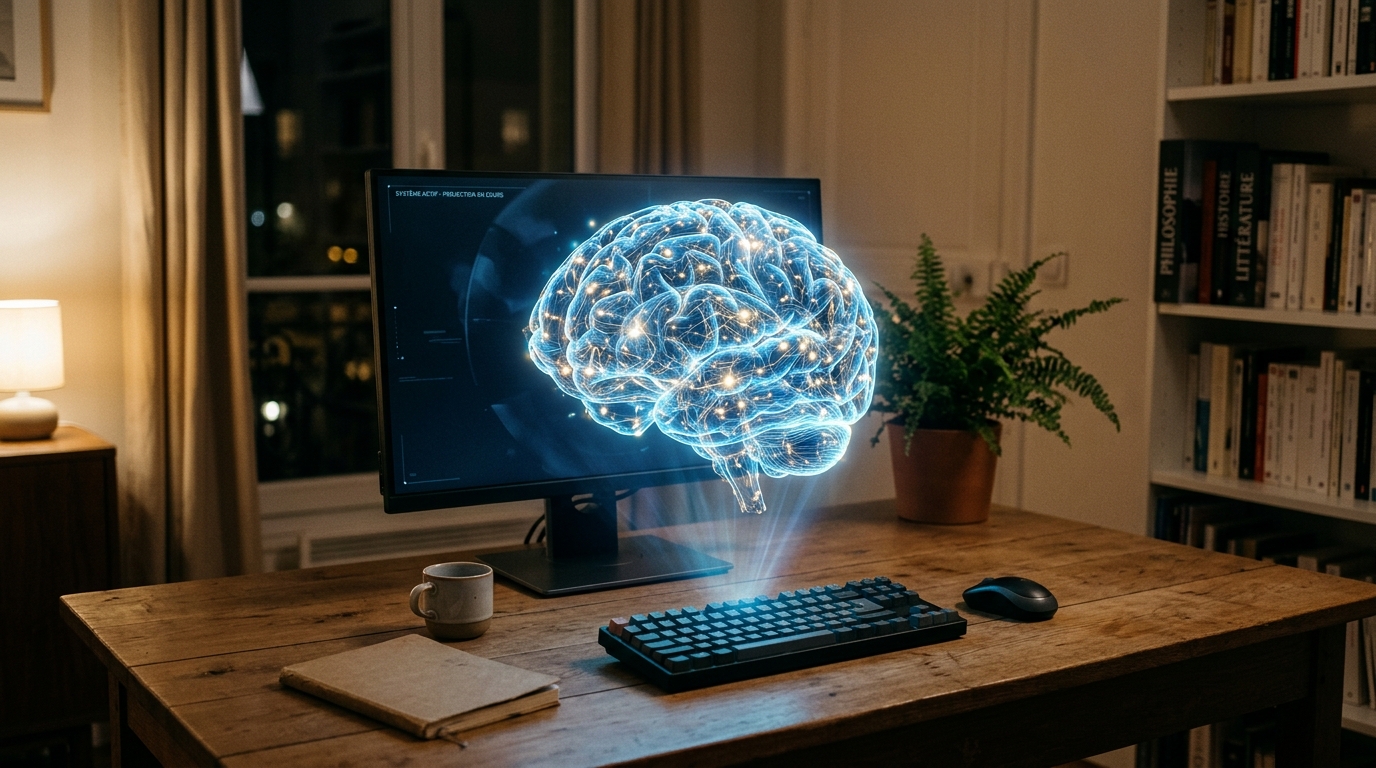
A Chinese laboratory claims to have simulated dynamics in a machine that resemble those of a human brain. This is the kind of prospect that could spark the imagination of any science-fiction aficionado. Yet the digital copy remains partial: it captures a fixed structure, not a living individual who evolves over time, through experiences and moods. What the researchers have uncovered while testing these digital twins changes how we think about brain imitation, and perhaps this is where the true surprise of the story lies.
- A Chinese laboratory has simulated dynamics similar to the human brain, but this copy remains a fixed structure, unable to track the evolution of a real individual over time.
- Unlike the nematode worm, whose connectome is faithfully reconstructed, the human brain can only be modeled in rough sketches due to a lack of sufficiently precise and plentiful data.
- To overcome this limit, researchers combine electron microscopy, mesoscopic statistics, and MRI to create multi-scale hybrid scaffolds, without yet achieving continuous updating, closed-loop interaction, or physical embodiment.
- A Copied Brain, But Not the Right Brain
- Why Counting Neurons Isn’t Enough to Copy a Mind
- The Researchers’ Trick to Bridge Three Scales
- What the Machine Still Can’t Do
A Copied Brain, But Not the Right Brain
The idea behind a digital twin of the brain, or DTB for the insiders, starts from a seductive premise: rebuild in a computer the architecture and functioning of a precise human brain. Not a generic brain from a neurology textbook, but your brain, with its peculiarities. The problem, highlighted by the researchers, is that current models fail precisely on this point. They capture well an abstract brain function, a generic model of what a human brain does, but they do not follow a real individual in their uniqueness.
Even more, these models remain frozen once calibrated. They receive no ongoing updates, whereas a living brain never stops remodeling itself. It’s a bit like taking a photograph of someone at a single moment and claiming that image represents all of their life, their future choices, and their evolutions. The snapshot is faithful at that instant, but it tells nothing about movement.
Why Counting Neurons Isn’t Enough to Copy a Mind
One might think that the more neurons there are to model, the harder the task becomes. In fact, it isn’t the number of neurons that is the problem, but the resolution and the availability of measured data. A striking example: the same method used to map the nervous system of a nematode worm, with its few hundred neurons, yields a remarkably faithful result. When applied to a human brain, it only produces a rough sketch.
The reason is simple once stated: reconstructing the human connectome in full, that is, all the connections between neurons, is simply not feasible at scale with current tools. We are not lacking ambition; we lack data that are precise and plentiful enough to cover an organ as dense and complex as the human brain.
The Researchers’ Trick for Bridging Three Scales
Facing this impasse, the team offers an ingenious solution rather than giving up: multi-scale hybrid scaffolds. Specifically, this means combining three very different data sources to build a coherent model. First, electron microscopy, which provides extremely precise ground truth but only on small portions of the brain. Next, mesoscopic-scale statistics, which allow generalization of certain repetitive structures. Finally, magnetic resonance imaging, which provides an overall view of the brain, less detailed but global.
This approach comes with two important re framings for human-scale work. The first is to favor structure-function generative mappings where exhaustive mechanistic reconstruction fails. The second invites viewing the well-known “coevolution” between the brain and its digital copy not as the emergence of an autonomous digital partner, but as a simple closed-loop study conducted in a perfectly controlled context. In other words, one observes controlled interactions, not the birth of an independent thinking entity.
What the Machine Still Can’t Do
Despite these advances, the brain’s digital twins are still described by researchers as partial, simulation-based counterparts. They manage to reconstruct a structure and reproduce a dynamic, which is already substantial. But three goals remain out of reach in the near term: the persistent updating of a brain that continues to evolve, closed-loop interaction with its environment, and embodiment—the ability to act truly within a body or physical context.
The limits are not only technical; they are also deeply scientific: precisely identifying what makes a brain unique, validating the models obtained, and governing neural data as personal as these remain open projects. The intended applications are broad: healthcare, fundamental neuroscience, and brain-inspired artificial intelligence.
Despite the excitement around these advances, the research also offers a reassuring takeaway: the human brain still guards a large portion of its secrets. Machines are learning to sketch its outlines with increasing precision, but they have not yet learned to grasp its perpetual movement, that living part that currently escapes any copy. It remains to be seen how long this edge of nature over technology will endure.
