
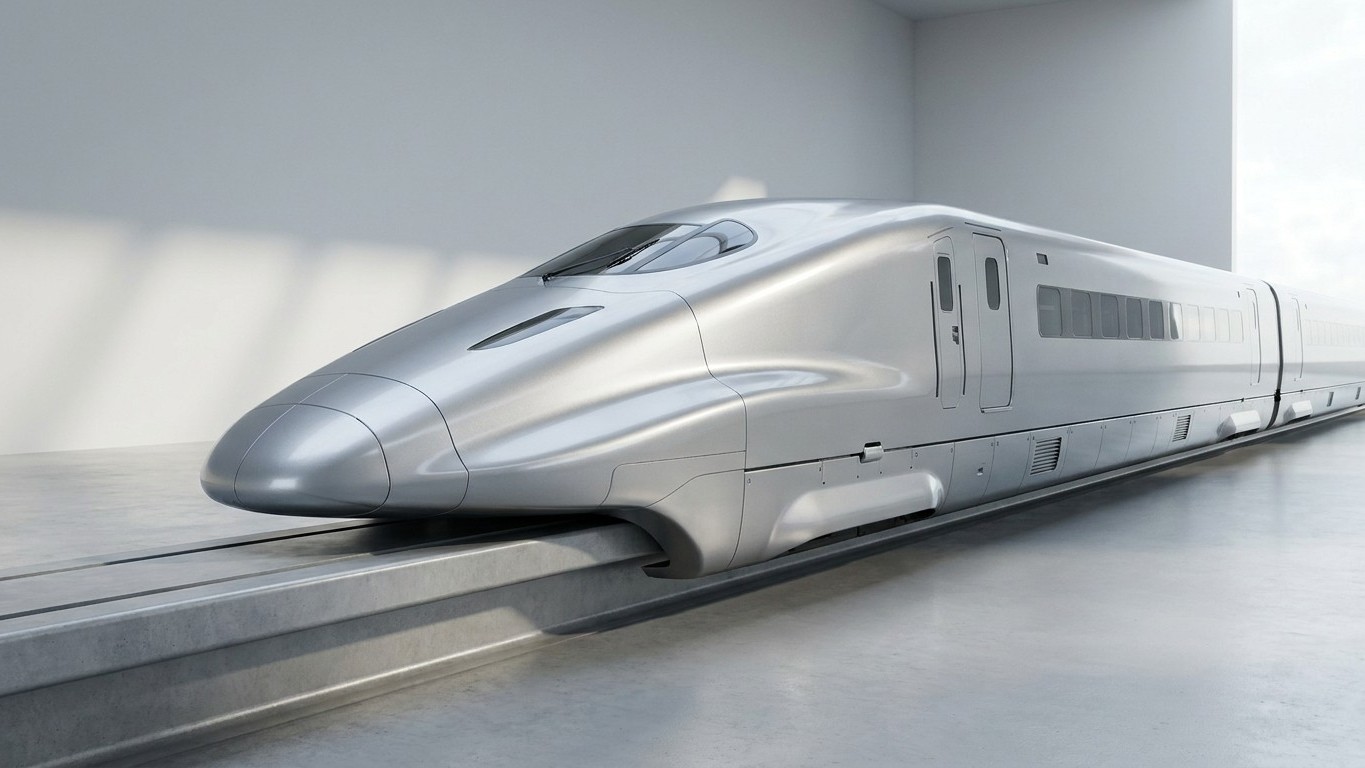
Five years after unveiling its technological jewel with great fanfare, China still awaits the moment to put the first passenger on board. The maglev train designed by the state-owned CRRC, theoretically capable of reaching 600 km/h, remains a showcase without a commercial line. No infrastructure in the world today is able to host it for commercial operation.
Back in Qingdao, July 20, 2021. The maglev train is presented as the fastest ground vehicle in the world, and the fastest surface transport method for distances up to 1,500 kilometers, according to a report provided by CRRC. The demonstration is spectacular: a journey currently taking 10 hours by high-speed train between Shenzhen and Shanghai would be reduced to only 2.5 hours once the line is built. Enough to make any traveler accustomed to endless connections dream.
Key takeaways
- A revolutionary train touted as the world’s fastest remains idle for four years without a commercial line
- Experts question the very nature of the prototype: is it truly a functional train or merely an exhibition model?
- Meanwhile, Japan is already preparing its own maglev line for 2027, while China keeps pushing back its commissioning deadlines
A project born in 2016, technology licensed from Germany
The development of this railcar did not begin yesterday. The project was launched in October 2016 under the auspices of China’s Ministry of Science and Technology, with a prototype developed in 2019 and successfully tested on Tongji University’s test track in Shanghai in June 2020. After optimizing the system, the final technical plan was settled and a complete system was developed in January 2021. A detail that few Western articles mention: this Chinese feat is historically based on German technology. The train uses German Transrapid technology, licensed from ThyssenKrupp. Beijing thus blended imported know-how with domestic engineering to arrive at what it presents as a fully mastered system.
On paper, the technical performance is impressive. The new train highlights several technological advances, including a self-developed braking system 30% more efficient than Shanghai’s maglev, which reduces braking distance from roughly 16 kilometers to 10 kilometers. In terms of capacity, the train can be configured from 2 to 10 cars, each capable of carrying more than 100 passengers, to meet various needs. A device designed to absorb large traffic volumes along China’s major urban corridors.
The problem isn’t technical; it’s physical and budgetary
The snag? This train does not run on any conventional rail. Testing the train at its maximum speed would require extending the test track, because maglev trains cannot use standard high-speed rail lines. In other words: even to verify that the vehicle lives up to its promises, a dedicated infrastructure would first need to be built, and there is none anywhere in the world on the required scale. The only available test section, at Tongji University, measures just 1.5 kilometers. It is impossible to reach 600 km/h there; there isn’t even room to accelerate meaningfully.
Some railway specialists go further and question the very nature of the object unveiled in 2021. According to a detailed analysis published by High Speed Rail Canada, the CRRC 600, unveiled in July 2021 at the CRRC Qingdao Sifang plant, is better described as a full-scale mock-up or a static exhibition prototype rather than a functional high-speed maglev train. A strong claim, but backed by: while the physical car exists and has been shown at various exhibitions, there is no verified evidence that this vehicle has ever operated at or near its claimed design speed of 600 km/h.
The chronology tracked by these same analysts reveals the gap between communication and reality. 2016: CRRC announces the development of the 600 km/h maglev system. 2019: a prototype mock-up is unveiled with announcements of imminent testing. 2020: low-speed debugging tests limited to a 1.5 km track. 2021: the full-scale car is unveiled and displayed, presented as ready for commercial production (which never materialized). 2023: the same car is shown at trade shows, now with announcements of deployment by 2025. 2025: still no operational line, no high-speed test results, and the commercial service schedule pushed to “in 5 to 10 years.” Five years after launch, the original promise thus mechanically slides toward an ever-distant horizon.
The confusion surrounding other Chinese records
This ambiguity fuels a certain media confusion. Regularly, headlines announce that China “breaks a speed record” with a maglev, without clarifying that it refers to a completely different machine. In June 2025, researchers at the Donghu Laboratory, in Hubei province, managed to accelerate a 1.1-ton test vehicle to 650 km/h on a 1-kilometer test track. But this prototype has nothing to do with the train shown in Qingdao: it was a test sled or a small test vehicle, not a passenger-carrying train prototype, reaching that speed in about 7 seconds over 600 meters before braking. A laboratory test, spectacular but with no direct link to passenger operation.
Meanwhile, the only maglev actually in service in China remains the one opened nearly a quarter of a century ago. Opened in 2002, the Shanghai maglev line remains the sole commercially operating maglev line carrying passengers in China, built with the German Transrapid technology and linking Pudong International Airport to downtown over 30 kilometers. A section capped at 430 km/h, far from the 600 km/h speed announced for its successor.
The CRRC 600 has not vanished from the radar either: it continues to be exhibited at major rail fairs, including the UIC World Congress held in Beijing in July 2025, where CRRC presented the maglev alongside 21 other railway vehicles, including the CR450 prototype, the Fuxing smart train, and the Lancang train on the Kunming–Laos line. A car that has toured exhibitions for four years without ever having a paying passenger sit in its seats, while Japan, with its own levitation train project, aims for commercial service as early as 2027 on its dedicated Tokyo–Nagoya line.
Sources: travelandtourworld.com | china-high-speed-rail.fandom.com
