
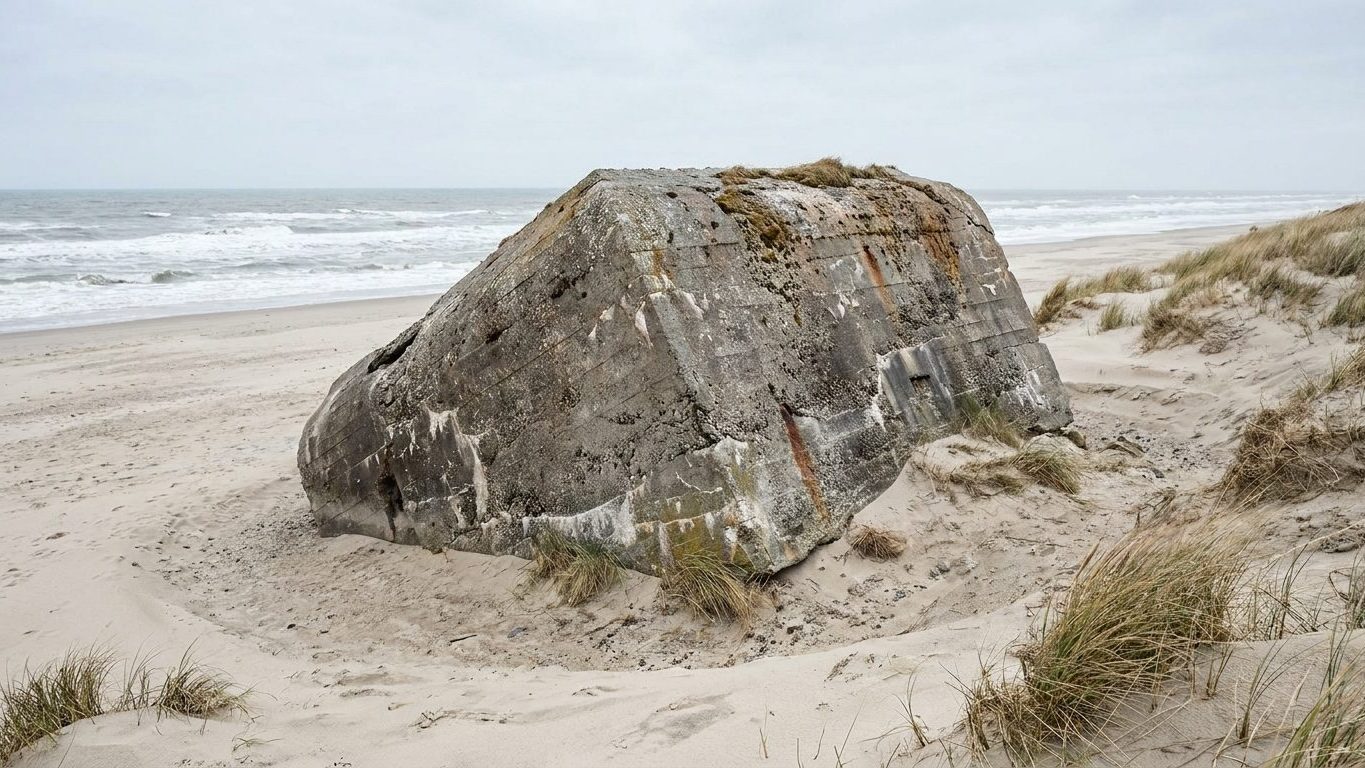
On the Horizon Beach, in Lège-Cap-Ferret, a gray concrete block lies on its side, half-swallowed by the sand. Not long ago, it stood proudly at the top of the dune. Despite the gusts that rattle the coastline, some curious onlookers have insisted on witnessing this sight, as magnificent as it is unsettling, circling the carcass as one would skirt a rock fallen from the sky.
This block has never fired a shot.
- The Atlantic Wall covered a vast front, and most of its bunkers were never used in combat
- Coastal erosion removes sand from beneath foundations, causing blocks to slide down the dune
- Communities choose to accompany this natural phenomenon rather than demolish or reinforce these structures
Structures Built for Eternity
The bunker belongs to the Atlantic Wall, that line of fortifications erected along the French coast during the Second World War. It was not conceived as a makeshift shelter. Its reinforced concrete walls, several meters thick, were designed to endure the most intense bombardments. You don’t build this kind of structure for ten years: you pour it to withstand the centuries, impervious to time as to storms.
At Grandcamp-Maisy, on the beaches of the D-Day landings, another one of these structures eventually gave way. The historian Marc Laurenceau sums it up soberly: “It remains a testament to the Atlantic Wall,” regardless of whether the block played any role in the fighting.
Many of these bunkers never served a purpose.
A Line of Defense That Never Fired
The logic of the Atlantic Wall was not to wait for the enemy at a single point, but to cover a vast front from north to south along the coast. The result: a large portion of the ouvrages were built as a preventive measure, never actually facing the assault they were meant to repulse. The war played out elsewhere, on other beaches, at other dates. The block remains there, intact in its unfulfilled function, like a soldier who never received the order to fire.
The small structure at Grandcamp-Maisy, a Tobrouk designed to shelter one man and a machine gun, illustrates this silence well. It was not visited by tourists and it did not directly participate in D-Day. It simply waited, on its dune, for decades.
Silence has been their sole mission.
The Sand Slips Under the Concrete
What threatens these blocks today has nothing to do with a weapon. It is the ground itself that disappears beneath them. A geographer studying the phenomenon along the Atlantic façade sums up the mechanism in a simple formula: “the foundation of the blockhouse rested on sand, and the sand is eroding, so the sea removes the sand and it tips over.” The bunker itself does not move much: it is the ground beneath it that has vanished, so the bunkers have not advanced; at most they have slid to the foot of the dune.
In Lège-Cap-Ferret, a local elected official describes the same mechanism in plain terms: the more the ocean attacks the base of the dune, the more sand collapses, and when a blockhouse sits on the crest of the dune, it slowly slides, tilts, and descends. The scene has repeated itself on the Pen Bron peninsula in Loire-Atlantique, where another bunker detached in the same way.
Neither Demolished nor Maintained
No one comes to reinforce these blocks, but no one comes to raze them either. Their legal status fuels this blur: originally placed on private or municipal land, they tip into the public maritime domain as the tide advances, and the State then becomes theoretically responsible for managing these ruins that have become dangerous. In practice, maintenance remains rare and demolition is exceptional.
In Cap Ferret, the municipality did react after the latest topple: an emergency contractor was called to secure the site and prevent any risk to walkers. But the general spirit remains one of accompaniment rather than combat, as the commune itself sums up by claiming to “accompany this natural phenomenon to face climate change.” We no longer fight the sea; we watch it advance.
Along the coast, these toppled blocks have ended up taking on new functions without any real decision. Once threatening, they have lost their aura, but gained another with children, becoming spots for seaside adventures while remaining witnesses to coastal erosion. The bunker that never served in war now serves, albeit unwittingly, as a visible coastline feature.
Sources: futura-sciences.com | bougerabordeaux.com
