
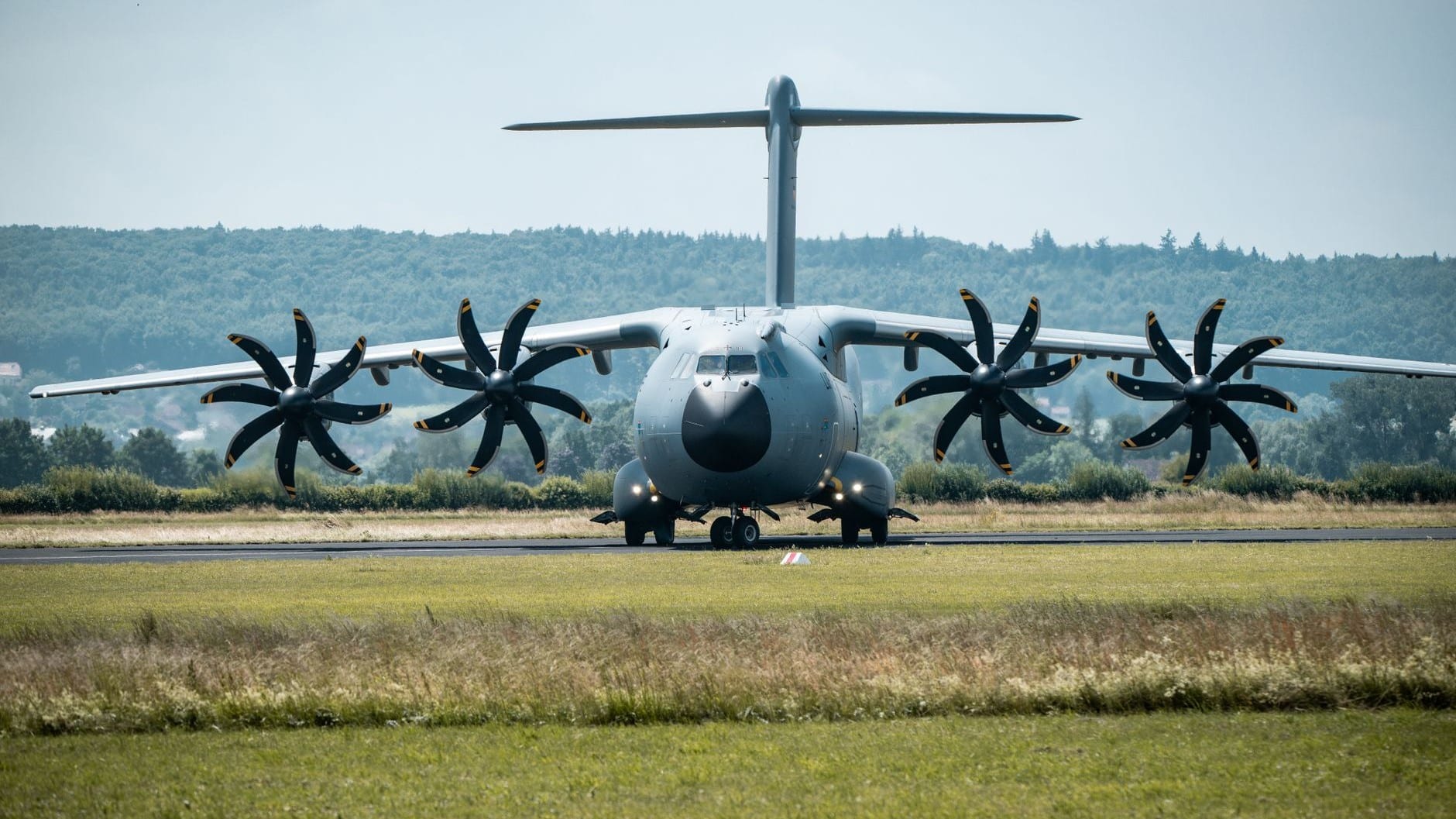
An Airbus A400M dropping water on a forest fire in France: a scene that, just a few months ago, seemed unimaginable, became a reality this Saturday, July 26, 2026, in Gironde. Prime Minister Sébastien Lecornu asked the armed forces to deploy this military transport aircraft without delay in the face of a blaze that had already burned 30,000 hectares and now threatens the outskirts of Bordeaux. A first operational mission in France, which upends a long-standing certainty: that only Canadairs and Dash-8s could fight the fire from the sky.
The choice is surprising. The A400M is not originally a water bomber. This four-turboprop aircraft with a wingspan of 42 meters, capable of taking off at 141 tonnes, was designed to land troops and cargo on rough airstrips, not to drown a fire. The A400M is normally used to transport soldiers, vehicles, equipment and cargo over long distances, and possesses numerous tactical and logistical capabilities. What changes everything is a removable accessory slid into its cargo hold from the aft ramp.
Key takeaways
- A military transport aircraft becomes a water bomber: how the impossible becomes reality
- Twenty thousand litres dropped in 10 seconds: what is the limit of this new tool?
- The A400M can fly at night unlike the Canadair: a hidden asset that changes everything
A cargo transformed into a flying water tanker
The principle is called roll-on/roll-off, or RORO. The core of the system rests on a removable module installed in the A400M’s cargo hold, which requires no permanent structural modification: you simply load the reservoir into the hold and connect the discharge lines that exit via the aft ramp. It is the European cousin of the American MAFFS system, which has equipped the U.S. National Guard’s C-130 Hercules for decades. The same logic: a module that temporarily turns a military transport aircraft into a firefighting tool, without touching its structure.
The capacity is impressive on paper. The solution developed by Airbus equips the A400M with a removable kit, allowing it to drop up to 20,000 litres of water in 10 seconds, versus 6,000 litres for a Canadair. A Dash-8, for its part, carries about 10 tonnes of retardant per rotation. An A400M equipped with the kit thus amounts to mobilizing the equivalent of three Canadairs or two Dash-8s in a single pass, an argument the government highlighted to justify this unprecedented deployment in response to the scale of the Gironde blaze.
The kit had been tested for several years prior to this first operational mission. The Testing and Research Center of the Entente-Valabre conducted in April a series of retardant drop tests at Nîmes-Garons airport, and the evaluation report confirmed the A400M’s suitability to support firefighting operations. Similar trials were conducted in Spain, where the country, from the summer of 2026, deployed part of its A400M military transport aircraft in fighting forest fires, providing for the first time a capacity for a large water bomber in addition to its fleet of amphibious aircraft.
What we gain, what we lose
That covers the volume. But turning a military cargo into a water bomber comes with a trade-off that must be faced: the A400M cannot scoop water. A Canadair, by contrast, skims the surface of a lake or other water body for about ten seconds to refill, then heads back to the fire. The A400M, once its tank is emptied, must land at a base equipped to be refilled. The removable tank loaded into the hold in a RORO configuration allows it to drop up to 20 tonnes of water or retardant via the aft ramp, and filling can be completed in under 10 minutes. Ten minutes is fast for a ground fill, but it has nothing to do with the cadence of a Canadair, which makes rotations in just a few minutes from a lake near the blaze.
Another technical nuance: dropping from an A400M does not behave the same as a drop from a specialized aircraft. The effectiveness of water dropping partly relies on the blast effect created by an almost instantaneous drop, less than two seconds on a water bomber, while the A400M exhibits a more dispersive effect. It is precisely this dispersion along a long line, rather than a single impact, that makes the aircraft particularly suitable for retardant rather than for water alone: the A400M can create lines with high concentrations of more than 400 meters in length in a single pass. This allows it to lay down a true chemical firewall in front of an advancing front, rather than merely dousing a single point. The aircraft also has a优势 that Canadairs do not: it can conduct night missions, unlike the Canadair, whose surface scooping requires daytime flight.
How we arrived here
This use of the military is not insignificant. On the ground, around 1,000 military personnel were expected to reinforce the firefighters, alongside roughly 900 firefighters already mobilized, to prevent the flames from reaching the Bordeaux metropolitan area. Facing a front of this scale, the Civil Security’s standard fleet of Canadairs and Dash-8s could no longer cover all hot spots simultaneously. The initial schedule had anticipated a later deployment: the A400M was due to come into service at the very end of the month, following the technical preparations and tests required beforehand. The urgency of the situation in Gironde accelerated the timetable by several days.
The dossier even turned into political controversy this week, some officials accusing the government of delaying activation of a system known for months. The government spokesperson had to clarify that the A400M’s firefighting kit was not in operational service in Spain before this summer, countering the idea of a French delay. One key fact remains: France currently has only one aircraft equipped with the kit, out of a fleet of 25. A supplementary tool, valuable in large fires, but it will not replace the rapid scooping of Canadairs for medium-sized fires any time soon.
Sources: cnews.fr | journal-aviation.com
