
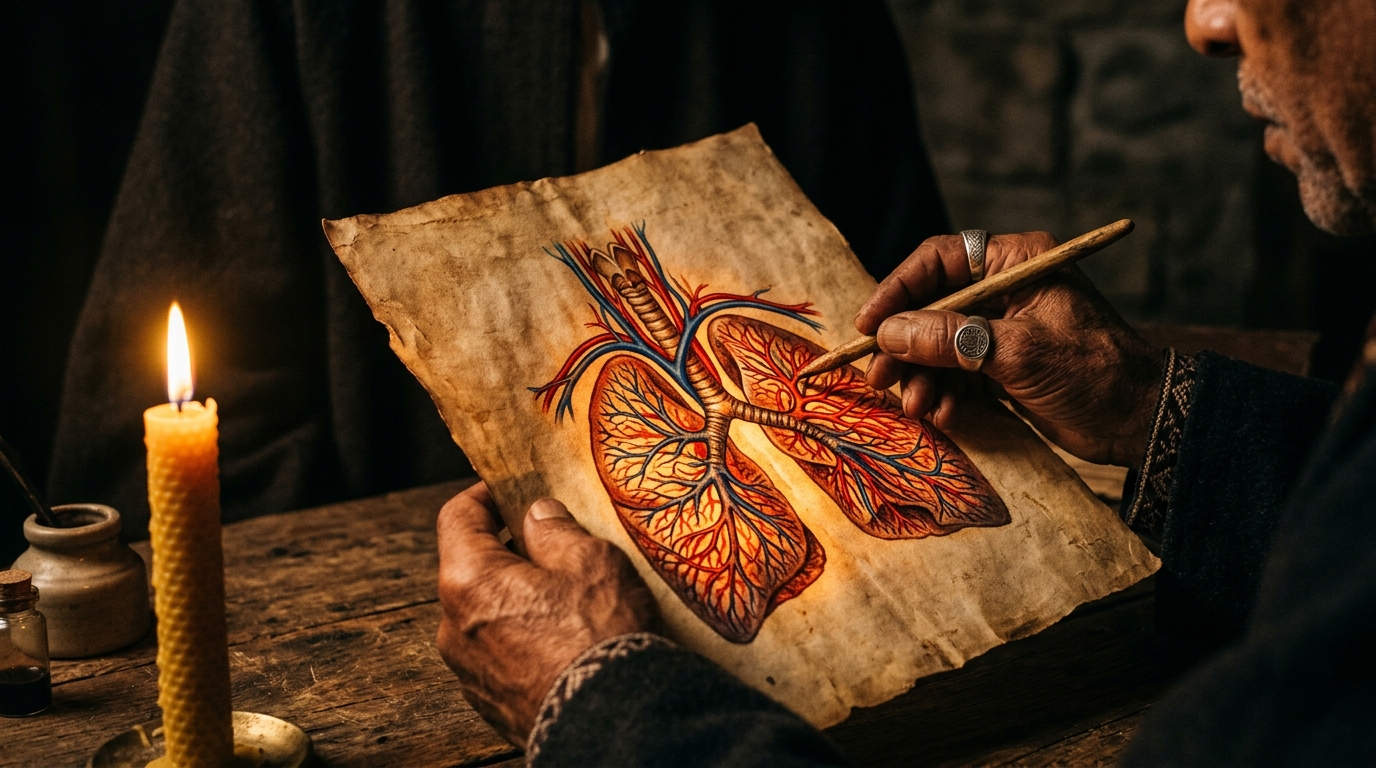
A manuscript lay dormant for seven hundred years in a library before anyone bothered to decipher it seriously: that is how the Official History of Medicine ended up with a major problem. For generations, Western schoolbooks attributed to a sixteenth‑century Spanish physician the discovery of the path of blood through the lungs. A beautiful, tightly woven tale, but incomplete. For three centuries earlier, in the bustling streets of medieval Cairo, a scholar had already put on paper an astonishingly precise description of this phenomenon, without a microscope, without a stethoscope, armed only with his powers of observation and a bold willingness to challenge the dogmas of his time. This story deserves attention, because it reveals how science progresses, sometimes by winding, forgotten routes.
- Ibn al-Nafis, a Cairo physician, described around 1242 pulmonary circulation by demonstrating that blood passes from the right heart to the left via the lungs, contradicting Galen’s theory of a permeable cardiac septum
- His manuscript, left unknown in Europe, was rediscovered only in 1924 in a Berlin library by the Egyptian physician Muhyo Al-Deen Al-Tatawi
- A partial Latin translation of his work may have circulated in Venice in the 16th century before Servetus and Colombo, suggesting a possible influence on European scholars who preceded Harvey
- When Cairo was three centuries ahead of Europe on the mysteries of the human body
- An overlooked physician who uncovered the secret of pulmonary circulation
- The impossible septum: why Galen was wrong for thirteen centuries
- From Cairo to Padua: how a medical truth crossed borders and time
- Ibn al-Nafis, the visionary whom official history took centuries to recognize
When Cairo was three centuries ahead of Europe on the mysteries of the human body
In the thirteenth century, while Europe struggled to break free from certain conceptions inherited from Antiquity, the city of Cairo buzzed with intellectual activity. It is in this knowledge hub that Ibn al‑Nafis worked, a physician who would, perhaps unknowingly, upend our understanding of human anatomy. His most famous work, the Commentary on the Anatomy of Avicenna’s Canon, tackles a reference text of medieval medicine to question some of its foundations.
What stands out in Ibn al‑Nafis’s approach is his refusal to accept established truths without debate. In an era when challenging ancient medical authorities bordered on scientific heresy, he dared to question a theory that had endured for more than a thousand years. This intellectual audacity, guided by a rigorous observational method, would lead him to a discovery that would only be fully recognized centuries later.
An overlooked physician who uncovered the secret of pulmonary circulation
Here is the core of the matter, so to speak: Ibn al-Nafis asserted that blood passes from the right heart to the left through the lungs, rather than crossing directly the septum that separates the chambers as was then believed. In his description, blood exits the right ventricle, travels into the lungs where it becomes infused with its life‑giving task, and then returns to the left chamber before being redistributed throughout the body.
This description aligns, with a few nuances, with what modern medicine today teaches as pulmonary circulation. To reach this conclusion, Ibn al‑Nafis relied on dissection, a practice that also enabled him to describe another fundamental phenomenon: the coronary circulation, the network of vessels that nourishes the heart itself. Two major discoveries, then, realized by a single man, in a context where investigative tools were rudimentary compared to what we have today.
The impossible septum: why Galen was wrong for thirteen centuries
To understand why this discovery was so revolutionary, one must return to the thesis that had dominated medicine since the second century—the Greek physician Galen. According to him, the heart functioned as a kind of double system, and a portion of the blood contained in the right cavity traversed directly the wall separating the two ventricles to feed the left cavity. A simple theory, almost intuitive, but fundamentally erroneous.
Ibn al-Nafis, by contrast, argued that this interventricular septum is entirely impermeable. It is therefore impossible for blood to cross it as Galen had claimed. That is the strength of his demonstration: rather than making a marginal adjustment to the prevailing theory, he dismantled it entirely to propose a mechanism more coherent with what he observed during dissections. One can imagine the difficulty of contradicting an authority as established as Galen, whose writings had shaped medical thinking for more than a thousand years. It required a steadfast confidence in his method to venture into such territory.
From Cairo to Padua: how a medical truth crossed borders and time
The story could have ended there, in utter oblivion. Ibn al‑Nafis’s manuscript remained completely unknown in Europe for centuries, until its accidental rediscovery in 1924 in a Berlin library by the Egyptian doctor Muhyo Al‑Deen Al‑Tatawi. This moment, almost anecdotal, made it possible to establish with certainty that Ibn al‑Nafis had described pulmonary circulation nearly three centuries before William Harvey, who is often credited in the West with this discovery.
Yet history still holds a fascinating gray area. Some historians suggest that a partial Latin translation of Ibn al‑Nafis’s work, produced by Andrea Alpago in the sixteenth century, may have circulated in Venice before the works of Servetus and Colombo, two major figures of European anatomy. If this hypothesis proves correct, it would mean that European scholars did not rediscover pulmonary circulation entirely independently, but perhaps consciously or unconsciously drew on works from the Arab‑Muslim world. A lead that invites us to rethink how knowledge circulated between medieval and Renaissance civilizations.
Ibn al-Nafis, the visionary whom official history took centuries to recognize
Beyond his discovery about blood circulation, Ibn al‑Nafis harbored an even grander ambition: to compose a true medical encyclopedia of three hundred volumes, the Kitâb al-shâmil fî l-sinâ’a al-tibbiya. He died before he could complete this titanic project, leaving behind roughly eighty volumes, along with works of theology and philosophy that attest to the breadth of his intellectual curiosity.
Today, historians of science agree that Ibn al‑Nafis was a genuine precursor of the great names of European anatomy, from Servetus to Vesalius, through Colombo and Harvey. A late, almost symbolic recognition, but one that corrects the record on the true genealogy of this foundational discovery.
This 1924 rediscovery reminds us of a truth often neglected: the history of science is never as linear as we would like to believe. How many other manuscripts lie dormant somewhere, waiting for the attention they deserve? By delving into forgotten archives, we might uncover other entire segments of our current knowledge that actually originated much earlier than imagined, in different skies and languages.
