
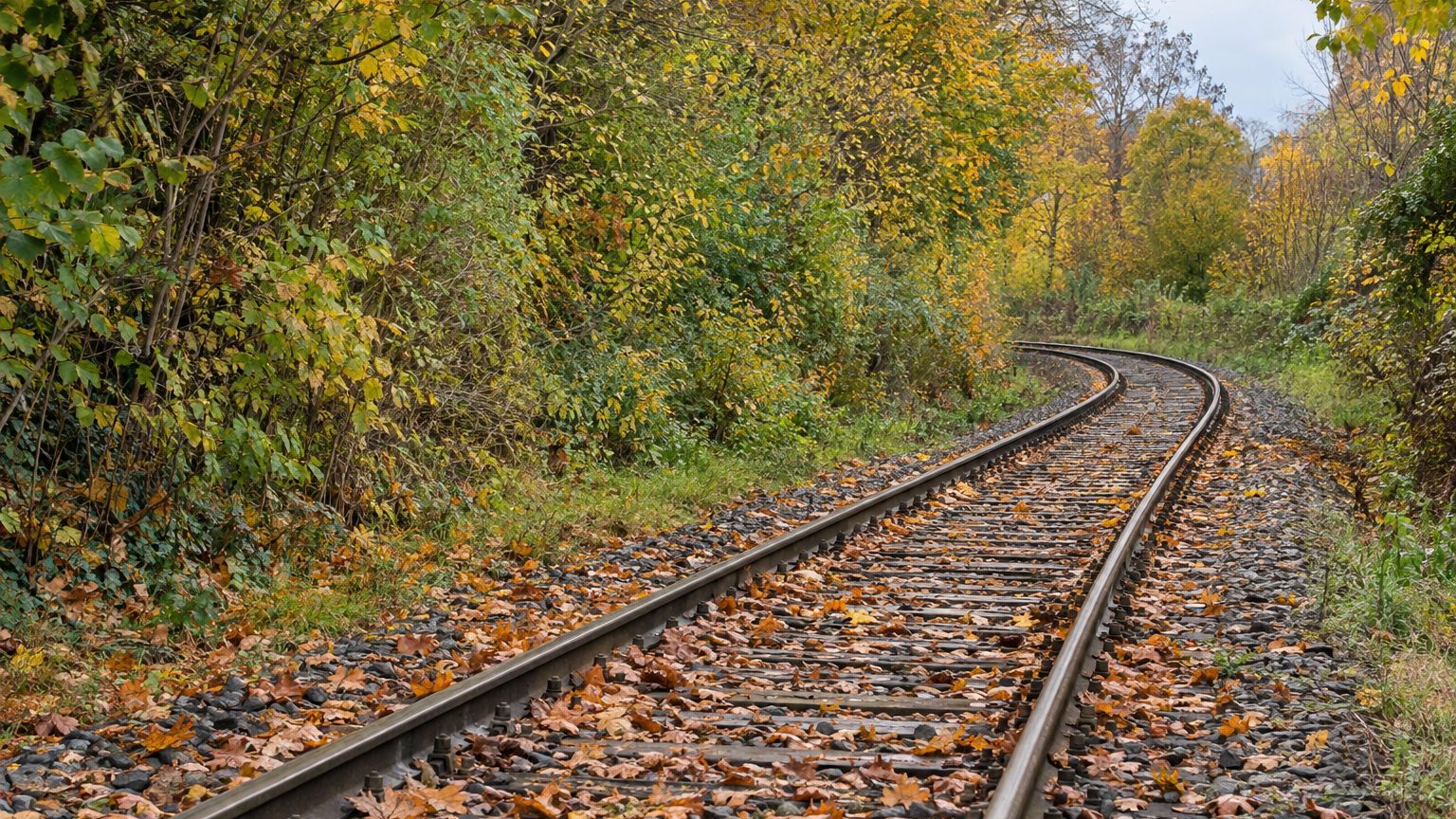
On 31 October 2021, at 18:42:02, the driver of the South Western Railway train from London Waterloo to Honiton applies the brakes as its formation hurtles toward Salisbury at 86 mph, i.e., 138 km/h. The wheels begin to slip. The UK rail accident investigation body (RAIB) identified the cause in its report 12/2023: contamination of the rail by leaves.
A film of crushed leaves pressed against the steel.
The driver senses the slip and applies emergency braking 12 seconds later. His three-car train passes a red signal about 200 m ahead, almost two football fields. It then collides at 52 mph (84 km/h) with the side of a Great Western Railway Portsmouth Harbour-Bristol train, which was travelling at 20 mph (32 km/h). The two trains derail partially and come to rest in Fisherton Tunnel, just after the Salisbury Tunnel Junction, in Wiltshire.
Fourteen people were hospitalized, including 13 passengers and 1 crew member. The RAIB’s chief inspector noted that two of them were seriously injured, and that this was the first time since the agency’s creation in 2005 that it had investigated a collision between two passenger trains travelling at significant speeds.
- A film of crushed leaves pressed onto the rail reduced wheel adhesion during the accident.
- The rail had not been treated for 32 hours, instead of the planned 24-hour cleaning interval.
- Vegetation near the junction had seen no intervention between 2018 and 2021.
The Slippery Rail, Without Heavy Rain or Ice
The report, published at the end of October 2023, identifies a very low wheel/rail adhesion caused by leaves compressed on the running surface. A drizzle that fell just before the train’s passage worsened the situation. This mechanism is known to operators: leaves stick to damp rails, then passing trains crush them into a thin black layer that disrupts braking and acceleration.
The day’s weather was by no means insignificant. The February 2022 interim report recorded strong winds and rain at Salisbury—about 21 mm between 6 a.m. and 6 p.m.—with gusts up to 63 km/h, and judged these conditions likely involved. Water therefore acted as a revealer, not the primary cause. As for the “ice” in the title, that is the analogy Network Rail uses: a layer of crushed leaves behaves like black ice on a road. The Salisbury driver did not encounter ice, but the result under the wheels resembled it.
The rail had not been treated for 32 hours.
The plan called for cleaning every 24 hours. On that Sunday, the cleaning train expected at 17:03 on the affected line had been rescheduled due to works between Southampton and Brockenhurst.
The Vegetation, The Great Oversight of the Works
Leaves do not fall from nowhere. The report notes an increased density of vegetation near the junction, and finds that no intervention had been carried out on this vegetation between 2018 and 2021. A nearby video shows trees and shrubs continuing to grow from 2019 to 2021. To illustrate the evolution, investigators compared site photographs dating from 1963, the 1970s, and 1 November 2021, the day after the accident.
A historical explanation circulates: in the steam era, the vicinity of the tracks was regularly cut back to prevent fires caused by embers, and that maintenance is said to have slackened afterwards. It comes from secondary sources, and the RAIB report does not state it as a fact; it simply presents the images.
In total, the RAIB issues 10 recommendations. One asks Network Rail to revisit its management of leaf-related adhesion risk. Another, addressed to Porterbrook, Eversholt and Angel Trains, concerns the design of the interior sliding doors of the Class 158 and 159 vehicles.
Each Autumn, an Entire Fleet Against the Leaves
The operator of the British rail network runs 67 dedicated treatment trains, the so-called “leaf busters.” They clean the rail with high-pressure water jets, then lay down a gel infused with sand and steel grains that restore wheel adhesion. Nationally, these jets discharge 200 million litres of water each autumn, according to a Network Rail press release from November 2025.
That is roughly the equivalent of 80 Olympic-sized swimming pools.
The operation is massive: thousands of tonnes of leaves fall onto the tracks each autumn, and millions of trees line the network. These trains do not cover every section, hence supplementary solutions, such as a road-rail vehicle converted to spray a leaf-degrading product on sections inaccessible to the large trains. As for the slowdowns that British travelers experience in October and November, they reflect the instruction given to drivers: on a slippery rail, brake earlier and brake longer.
Since 2022, Network Rail has been collaborating with Route Reports on a platform that receives train data via GPS and 4G, so as to know which stretch of track has been cleaned and when. On paper, this tool addresses the Salisbury case, where the rail had waited for treatment for 32 hours.
Sources: railway-news.com | x.com | dft-newsroom.prgloo.com
