
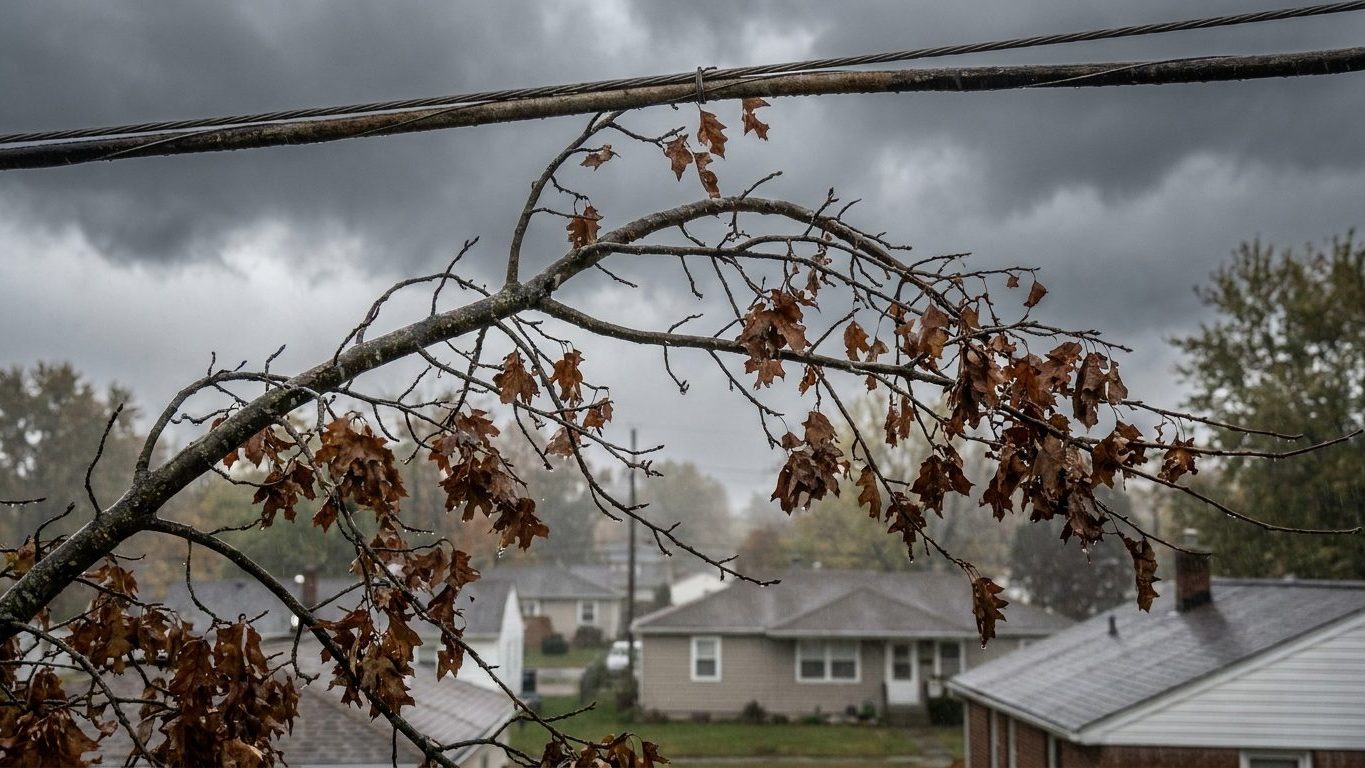
The scene repeats itself every autumn in the same way. A gust of wind, a branch bending toward a power line, and an entire block plunges into darkness. What residents often don’t realize is that the bill for the outage can come back to them, even if they touched nothing.
- Wet wood behaves like an electrical conductor and can cause a short circuit without direct physical contact
- The owner or tenant is responsible for pruning trees overhanging power lines on their property
- If a tree falls onto the line, Enedis may bill the owner for repair and intervention costs
Why a single branch is enough to cut it all
Wood doesn’t need to be dry and brittle to cause trouble. On the contrary: wood conducts because it contains sap and thus water, and its conductivity depends on time—the more humid it is, the more current the wood can carry. A green branch, saturated with water and minerals, then behaves almost like an exposed wire.
Physical contact is not even necessary. In damp conditions, arcing can occur at a distance, electricity literally “jumping” from the branch to the conductor without a clear contact. The climbing arborists’ forum confirms this without hesitation: truly dangerous branches are those that overhang the wires and tilt toward them, risking a short circuit that increases the current flow.
The fault thus created triggers the protection at the electrical start. It’s a normal safety reflex. But the automatic switchgear that manages the line will attempt several automatic re-closures before giving up, which explains outages that flicker and return, sometimes three or four times in quick succession.
A figure from across the Atlantic, where statistics are better documented, gives a sense of the phenomenon: nearly 40% of power outages would be caused by fallen branches or trees on power lines. A magnitude that is dizzying when you realize that a single poorly maintained tree can deprive an entire neighborhood of electricity.
Who pays when the tree touches the line
The principle is simple to state, but more difficult to apply depending on configurations. On private property, pruning trees that overhang power lines is the responsibility of the occupant of the land, owner or tenant. A rule that surprises many, convinced that network maintenance falls entirely to the operator.
Enedis, the distribution network operator, specifies the situations where this responsibility applies. The owner must undertake pruning if the tree is planted on private property and encroaches onto the public domain where the line runs, if the tree was planted after the construction of the line that towers over private land, or if it sits close to the cable that feeds the property. The timing of planting thus changes everything: a tree planted before the line falls under different rules than a tree sown decades later under an already existing cable.
In other cases, when the line crosses a property and the tree was there first, it is the network operator’s job to intervene. When the electrical network crosses a property, it is up to RTE or Enedis to ensure vegetation clearance near the line to guarantee safe distances. If there is any doubt about which came first—the tree or the line—the only solution is to consult the operator directly before taking any action.
The remaining, thorny case is the fall. Here, the rule leaves little room for exception. If a tree or branch falls onto the power line, the owner or tenant, as the guardian of the tree, is presumed responsible for the damages, and Enedis may seek compensation for the losses. Even if the tree was planted before the line, its fall remains attributable to the person who was responsible for it.
A concrete example regularly appears in residents’ anecdotes. A homeowner hadn’t pruned trees under a low-voltage line in their yard; after a storm, a branch fell onto the cable and caused an outage, and the operator intervened urgently by severely cutting back the trees, then billed the homeowner for the intervention. The sanction is therefore not theoretical: it comes after the event, when the harm has already been done.
What you should never do yourself
The temptation exists, especially when a branch clearly threatens to touch a cable before autumn. But approaching a line yourself to cut a branch remains a very bad idea.
Safety distances vary by line type. Never touch a line, even a insulated cable, nor approach within 5 meters of lines, nor touch a tree whose branches are within 2 meters of an uncovered conductor or in direct contact with an insulated cable. These margins exist because current can traverse humid air without visible contact, exactly as the arcing mechanism described above.
The intervention must be entrusted to a qualified company, never improvised by the owner with a chainsaw. The arborist who works near lines must hold a specific authorization, training that teaches precisely how to assess distances, cut without tipping the branch toward the conductor, and react if arcing occurs despite everything.
A branch already fallen onto a line must not be touched under any circumstances, even if it seems harmless. The network managers’ instruction is categorical on this point: if a tree threatens a line or if a branch has fallen onto it, one must call the emergency repair number and never touch the pylons or the cables, even if they are on the ground, while keeping a distance. Wet wood resting on a wire can stay electrically charged without any external sign betraying it.
The window to act closes quickly. Before the first autumn storms, a simple look skyward, under the canopies lining a street or garden, often allows you to spot the threatening branch. The reflex to have is not the chainsaw but the phone: contacting the network manager to report the situation remains, in all scenarios, the first step before any intervention.
Sources: fournisseurs-electricite.com | agriculture.gouv.fr | enedis.fr
