
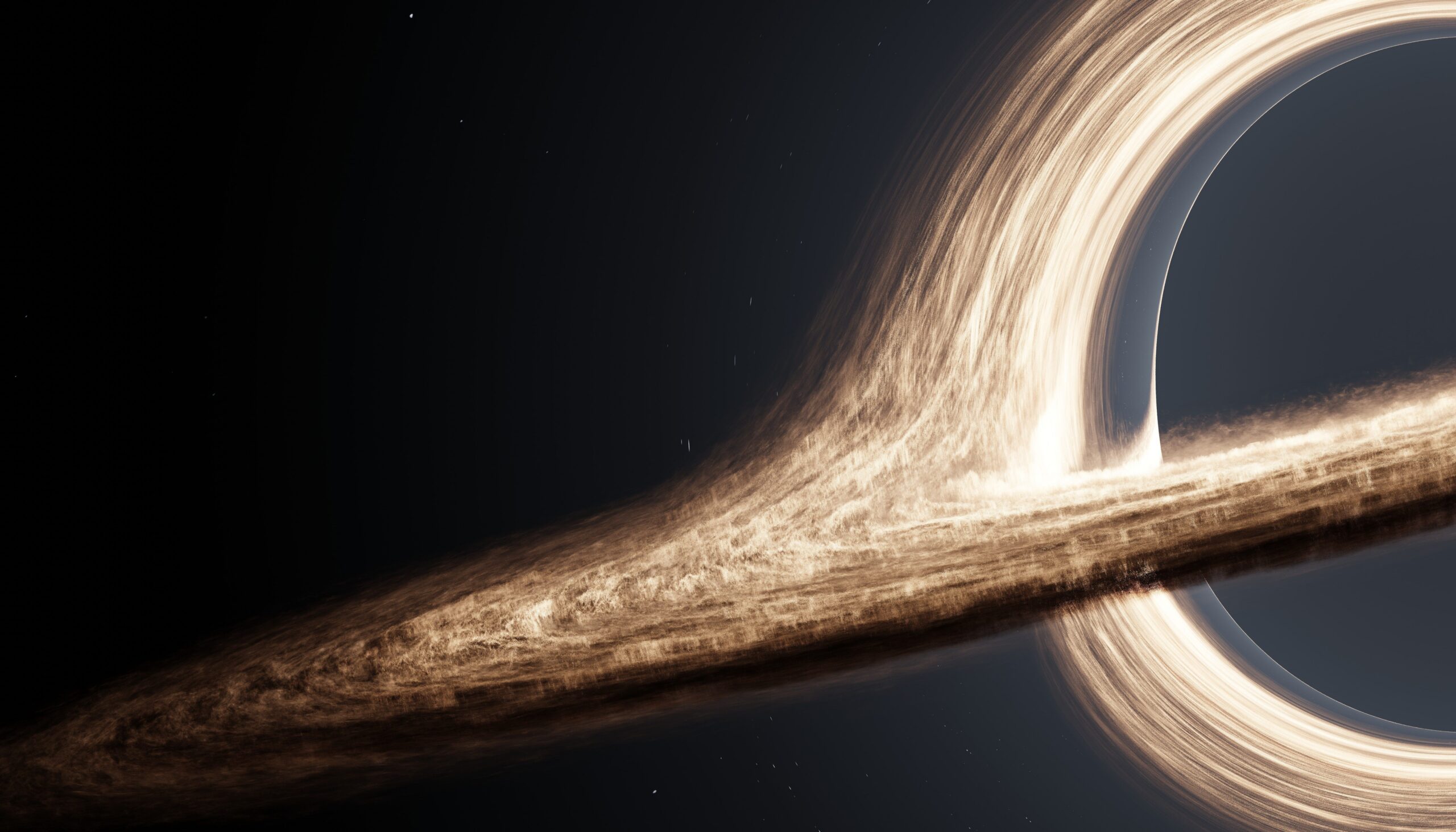
Using the Very Large Telescope (VLT) of the European Southern Observatory (ESO), astronomers studied a remarkable quasar now regarded as the brightest object ever observed. This black hole, about 500,000 billion times brighter than our Sun, grows in mass by roughly one solar mass per day, making it also the fastest-growing black hole ever observed.
The brightest objects in the Universe
A quasar, short for “quasi-stellar radio source” (source radiative quasi-stellar), is a tremendously luminous and distant astronomical entity. These objects are associated with active galactic nuclei (AGN), the central regions of certain galaxies that harbor supermassive black holes. Quasars emit an extraordinary amount of energy, thus standing out as the most luminous objects in the observable Universe.
Astronomers originally believed these objects (discovered in the 1960s and appearing as highly bright point-like sources when observed in the radio domain) were stars located within our own galaxy, hence their name. Yet, deeper observations revealed that they lay at cosmically enormous distances, far beyond the stars of our Milky Way.
The intense emission of quasars arises from the process of matter accretion by a supermassive black hole. Indeed, these black holes attract surrounding matter (gas, dust, and stars) into an accretion disk before it is swallowed. During this process, enormous amounts of energy are released in the form of electromagnetic radiation, spanning from radio waves to X-rays.
Quasars play a crucial role in understanding the evolution of galaxies and the Universe itself. Their study allows astronomers to look back in cosmic time and better grasp the conditions that prevailed in the early Universe.
An incredibly voracious black hole
A team recently came across the nearly record-breaking quasar, or nearly so. Named J0529-4351, this object is so distant from Earth that its light has traveled for more than twelve billion years to reach us.
The black hole at the heart of this quasar is exceedingly ravenous. According to researchers, the object would be consuming a little more than one solar mass per day in material, reaching an impressive mass of 17 billion Suns. The infalling matter forms an accretion disk whose energy output is so intense that the quasar outshines our Sun by more than 500,000 billion times.
This disk, measuring seven light-years in diameter, is also considered the largest accretion disk in the Universe.
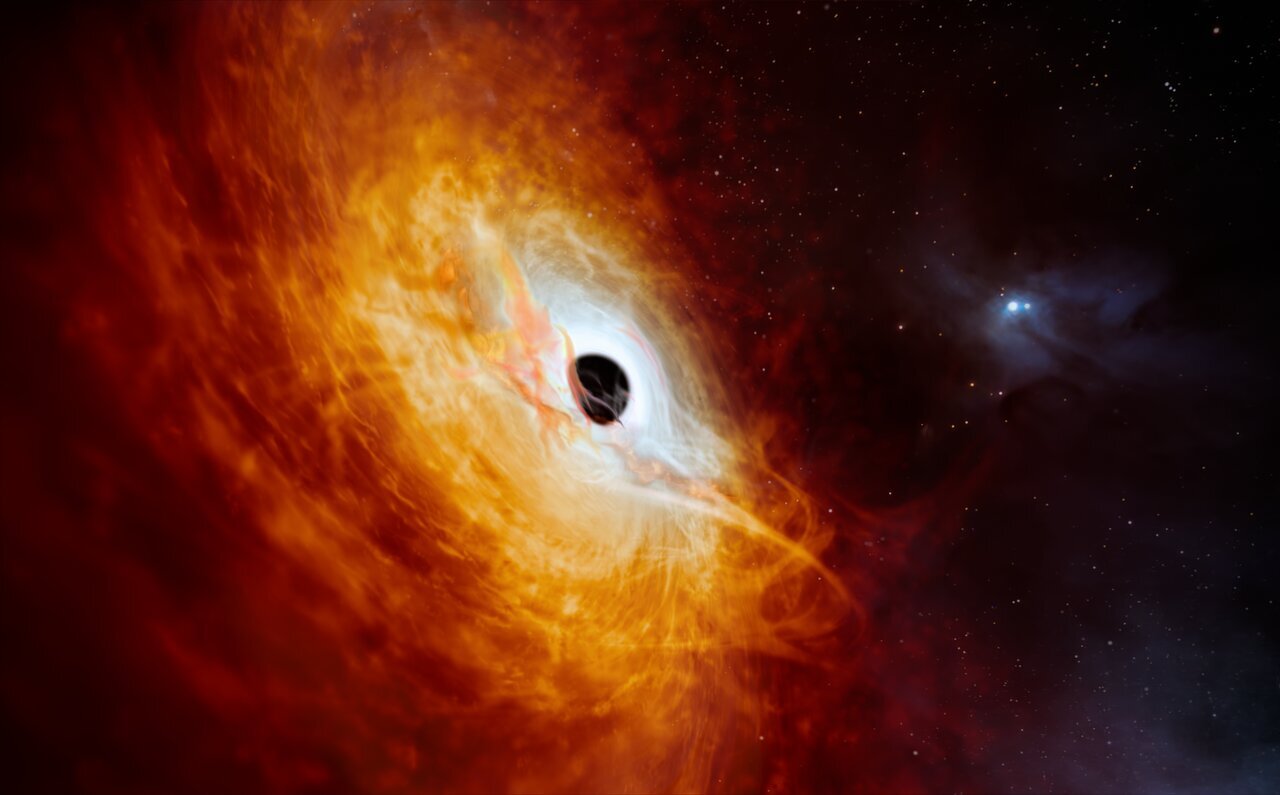
If this record-breaking object had remained hidden for so long, it is largely because the search for quasars often relies on machine-learning models trained on enormous sets of celestial data. However, these models are trained on existing data, which can lead to the rejection of atypical candidates.
In the case of J0529-4351, an automated analysis of data from the European Space Agency’s Gaia satellite initially treated the object as a star due to its exceptional brightness. Confirming its true nature required the use of the X-shooter spectrograph on the Very Large Telescope (VLT), located in the Chilean Atacama Desert.
This exceptional discovery paves the way for future observations with the upgrade of the VLT’s interferometer, as well as with ESO’s upcoming Extremely Large Telescope (ELT), to enable a better understanding of these distant objects.
