
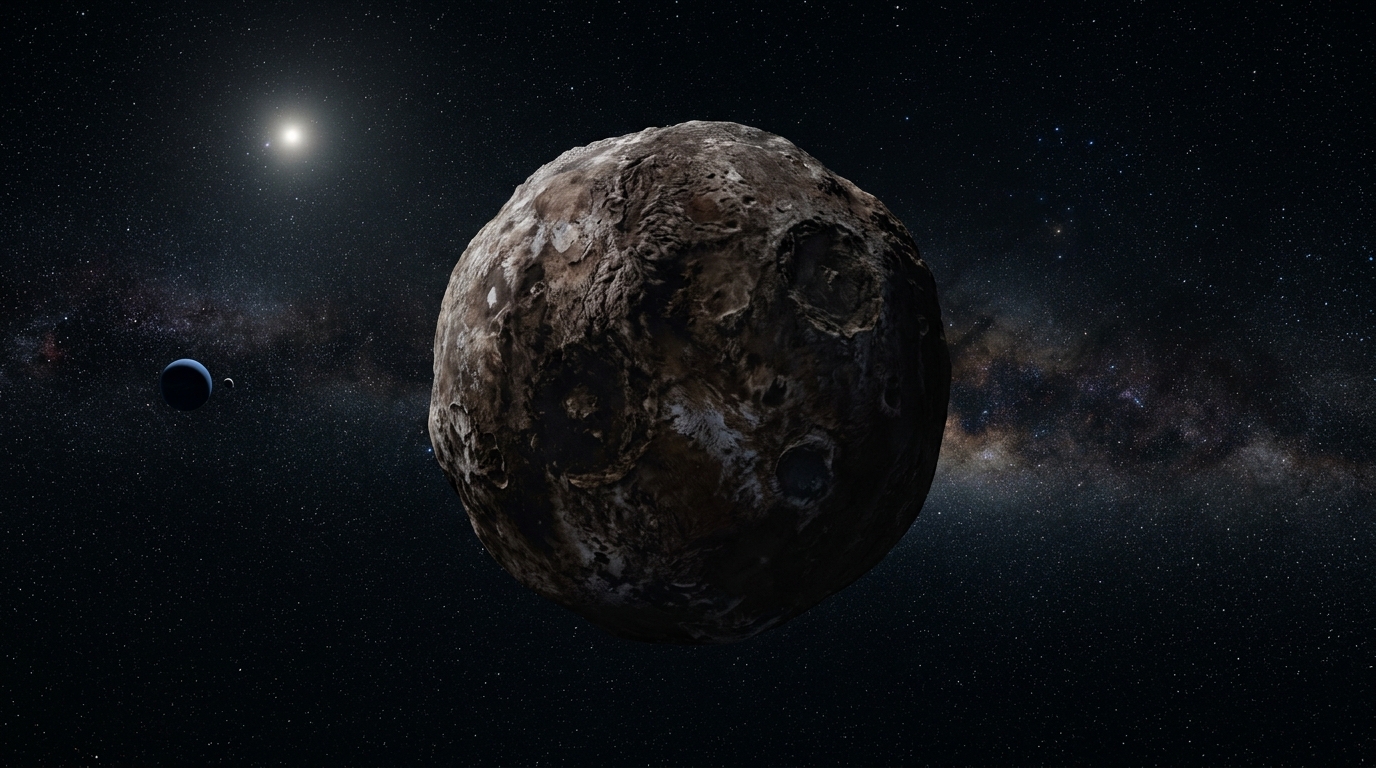
Twenty-seven. That is the number of tiny, previously invisible objects that have just been revealed at the far reaches of our solar system, nestled far beyond Neptune’s orbit. A technical feat that is far from trivial, since these icy bodies, about the size of a mid-sized town, had eluded observation until now. But what truly captivates researchers is not so much their discovery as what their surfaces disclose, strikingly at odds with the predictions of established theory.
- The James Webb Space Telescope, thanks to its NIRCam instrument paired with Hubble data (ACS and WFC3), enabled the detection of 27 trans-Neptunian objects the size of a city, previously undetectable.
- The analysis of these small bodies’ surface colors reveals a composition that does not fully align with the theoretical models built from larger, better-known trans-Neptunian objects.
- This discovery gives access to objects 40 kilometers in diameter or smaller, likely representative of the Kuiper Belt’s quiet majority, providing new clues about the primitive material that seeded the solar system.
- 27 tiny objects, a discovery that only JWST could make possible
- Surfaces that don’t fit the established theory
- Why the size of these objects changes the game for understanding the Kuiper Belt
- What these 27 objects tell us about the origins of the solar system
27 Tiny Objects, a Discovery That Only JWST Could Make Possible
Detecting a trans-Neptunian object has never been a simple undertaking. These bodies orbit at staggering distances from the Sun, wrapped in near-total darkness, and their faint glow makes them exceptionally hard to capture, even with the most advanced instruments. That is precisely where the James Webb Space Telescope comes into play. With its unprecedented sensitivity in the near infrared, the observatory has managed to detect 27 ultra-faint objects, whose size rivals that of a city, a class of celestial bodies that earlier technologies simply could not separate from the cosmic background noise.
This progress sits within a methodical scientific framework, in which JWST’s NIRCam instrument helped establish what astronomers call a luminosity function—a way of mapping how these objects are distributed according to their apparent brightness. To refine the analysis further, research teams merged these data with near-simultaneous observations from the Hubble Space Telescope, drawing on its ACS and WFC3 instruments. This complementarity between the two observatories enabled the retrieval of precious optical information, yielding a far more complete view of these previously phantom-like bodies.
Surfaces That Don’t Match the Established Theory
Once these 27 objects were identified, the most delicate question remained: what are they truly made of? To answer it, researchers focused on the colors of their surfaces, cross-referencing optical and near-infrared data. This seemingly straightforward technique actually allows them to infer clues about the chemical composition and the structure of these icy bodies, all without ever touching them with instruments.
Yet this is precisely where the current theoretical models encounter questions. The data gathered from these very small objects raise doubts about their alignment with what is typically observed in larger and better-known trans-Neptunian objects, a point that scientists continue to explore in order to refine the hypotheses about the evolution and composition of these distant populations.
Why the Size of These Objects Changes the Game for Understanding the Kuiper Belt
The Kuiper Belt, this vast region populated by icy debris beyond Neptune, remains largely a mysterious domain. Up to now, most observations concerned relatively large objects—easier to spot, but less representative of the belt’s overall diversity. By focusing on bodies of 40 kilometers or smaller, scientists are finally touching a category that likely represents the quiet majority of the Kuiper Belt.
This scale literally shifts the perspective. Studying these small bodies is a bit like examining the grains of sand on a beach rather than just the rocks: you obtain a much finer and more nuanced picture of the whole. Researchers now possess an unprecedented sample that helps them better understand how this belt formed and how it has evolved over billions of years, taking into account its most inconspicuous members.
What These 27 Objects Tell Us About the Origins of the Solar System
Beyond their mere existence, these 27 objects are true cosmic archives. Each trans-Neptunian object, however small, preserves traces of the primitive material from which our solar system coalesced. By studying their surfaces, astronomers aim to reconstruct the conditions that prevailed in the earliest moments of our celestial neighborhood, billions of years ago.
This joint effort between JWST and Hubble illustrates a complementary approach, where two instruments with different strengths collaborate to transcend the limits each would face in isolation. The findings regarding these miniature objects, still being interpreted by the scientific community, open a new window onto populations that had remained nearly invisible, and may well hold answers to long-standing questions about the formation of our solar system.
In this season of early stargazing, the sky’s quiet grandeur reminds us how space exploration relentlessly pushes the boundaries of knowledge, even across billions of kilometers. Twenty-seven small icy bodies, yet a vast potential to illuminate the shaded corners of our cosmic history. It remains to be seen what future observations will unveil, and whether other surprises await astronomers at the edge of the solar system.
