
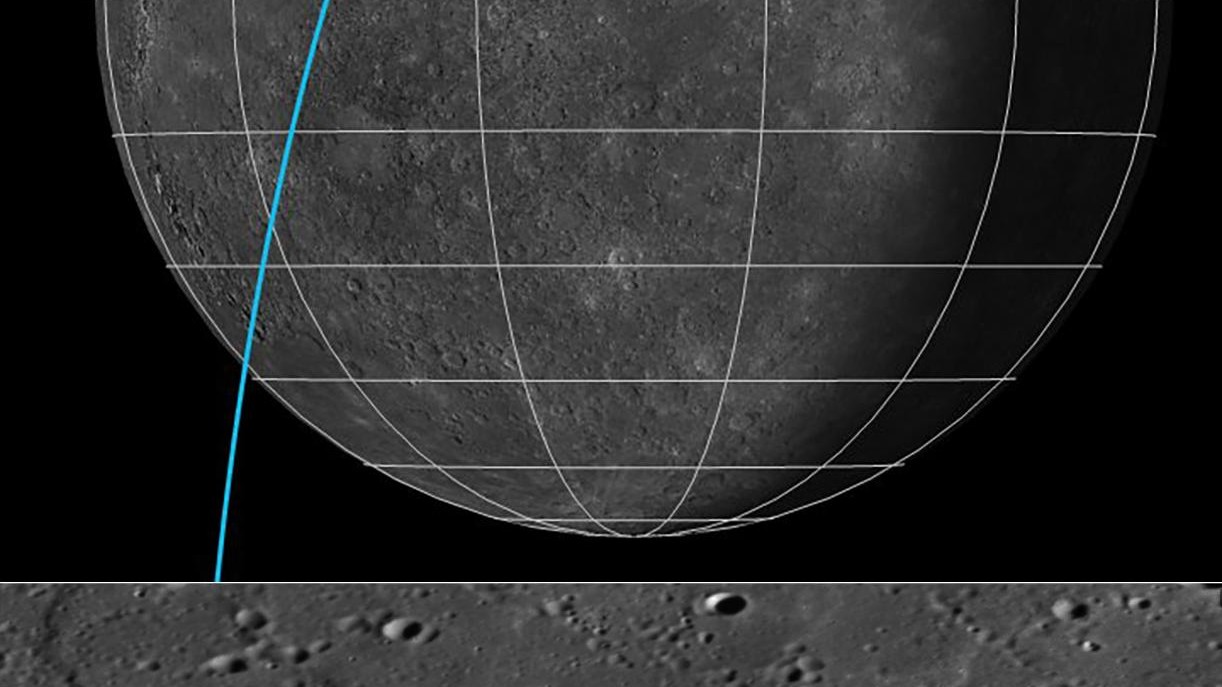
77 million kilometers. That is the average distance separating Earth from Mercury, the innermost planet of the solar system. A journey that an atlas would compress to a few millimeters on a page. Yet, after 9.3 billion kilometers of travel, BepiColombo is poised to orbit Mercury on 21 November 2026, a detour equivalent to about 120 times the direct Earth–Mercury distance. Welcome to the absurd, and perfectly rational, logic of orbital mechanics.
Key takeaways
- Mercury is closer to the Sun but vastly harder to reach than Saturn: why?
- A last-minute replacement trajectory saved BepiColombo from a doomed path after a short circuit
- Beneath Mercury’s surface may lie major clues about how rocky planets form
The paradox of the closest planet
Closer to the Sun and harder to reach for an orbiter than Saturn: this phrase from the ESA encapsulates Mercury’s paradox in a single line. It may be imagined as accessible, almost within reach. The physical reality is quite different. The planet sits in a solar gravity well of staggering depth. The closer a probe gets to the Sun, the more the star’s pull accelerates it. Direct consequence: a spacecraft launched toward Mercury in a straight line would arrive far too fast to be captured into orbit. It would speed past the planet like a cannonball, unable to slow down in time.
Mercury’s tiny mass makes its gravitational tug extremely weak compared with the Sun’s. This double problem — solar acceleration on one side and Mercury’s weak gravity on the other — makes orbit insertion exceedingly tricky. To reach Mars, you simply accelerate and aim. To reach Mercury and stay there, you must spend years braking.
Why such a long journey when, in the 1970s, NASA’s Mariner 10 reached Mercury in under five months? Simply because their trajectories were entirely different. Mariner 10 merely flew by Mercury at high speed three times. BepiColombo needs to slow down in order to enter orbit around the planet. Orbiting a world changes the entire travel equation.
The gravitational choreography of a mathematician who died in 1984
This choreography owes its insight to an Italian mathematician, Giuseppe Colombo, who died in 1984 and who was the first to understand how to slow a Sunbound craft. The probe bears his name. His principle: use the gravity of the planets as a natural cosmic brake, without burning fuel in quantities that would be impossible to carry aboard.
Launched in October 2018, BepiColombo performed nine distinct flybys: one of Earth, two of Venus, and six of Mercury itself. Each close approach to a planet acts as a cosmic brake: the gravity siphons a bit of the spacecraft’s speed and redirects it onto a lower trajectory, closer to Mercury’s orbit. Six Mercury flybys to approach the planet without plunging into it or escaping into a higher solar orbit. This sequence lowered the spacecraft’s relative velocity to 1.76 km/s. Each skim past the surface wasn’t wasted time: during the fifth flyby in December 2024, with the MERTIS instrument, BepiColombo became the first craft to observe Mercury in mid-infrared light.
On 15 June 2026, a pivotal milestone was quietly crossed. BepiColombo shut down its solar-electric propulsion for the last time, entering the arrival phase at Mercury. The spacecraft falls silent. The final braking begins. Four final thrust arcs will reduce the relative speed to the point where Mercury will gently capture the probe into a polar orbit in November 2026. A small maneuver will then be enough to place the craft into an orbit with an apocenter of about 178,000 kilometers.
The fault that nearly toppled everything
In April 2024, a short circuit occurred. This partial failure did not prevent BepiColombo from functioning and communicating, but it prevented its four electric-ion thrusters from reaching full thrust. Ninety percent of available power may seem minor, but in orbital mechanics across hundreds of millions of kilometers, it could have been fatal for the mission.
Faced with the impossibility of recovering full power, ESA did not capitulate. To compensate for propulsion power loss, ESA’s flight-dynamics team revised BepiColombo’s trajectory. The new maneuver would allow the probe to pass about 35 kilometers closer to Mercury during the fifth flyby, thereby reducing thrust requirements. A 35-kilometer margin reduction on a planet with essentially no atmosphere, executed tens of millions of kilometers from the nearest technician. The precision of a Swiss watchmaker, on the scale of the solar system.
The price to pay: an eleven-month delay shifting the arrival from December 2025 to November 2026. Eleven months for a short circuit. The good news, confirmed by JAXA: despite the roughly one-year delay, there will be no disruption to the operation of the two orbiters. The two spacecraft are scheduled to carry out their scientific observations as initially planned.
What BepiColombo is really looking for
On 21 November 2026, the real work begins. The MTM propulsion module will brake one last time to enter a highly elliptical orbit around Mercury. BepiColombo will then jettison a cover, followed by the small Japanese Mio spacecraft, before the European MPO separates, which will brake again to orbit at less than 200 kilometers altitude. MPO will map the entire surface of the planet and study its internal composition and structure, while Mio will analyze Mercury’s magnetic field and magnetosphere.
If the replacement trajectory had not worked, if the engineers at ESOC in Darmstadt had not found this solution within a few months, an entire generation of researchers would have had to mourn Mercury. There is currently no other mission in preparation to explore the small planet: BepiColombo will likely be the sole mission before at least 2035–2040. This is not merely a matter of scientific curiosity: Mercury’s lack of atmosphere combined with its proximity to the Sun yields surface temperatures ranging from -183 °C in the depths of permanently shadowed polar craters to 427 °C at the subsolar point. A world of extreme contrasts that may still hide water ice in its permanently shadowed basins, and whose immense metallic core relative to its size continues to raise fundamental questions about the formation of rocky planets. Its high-precision sensors and in situ measurements will provide unprecedented data and improve accuracy by a factor of ten compared with the MESSENGER mission. Eight years of travel to finally read Mercury up close.
Sources : berthine.fr | cnes.fr
