
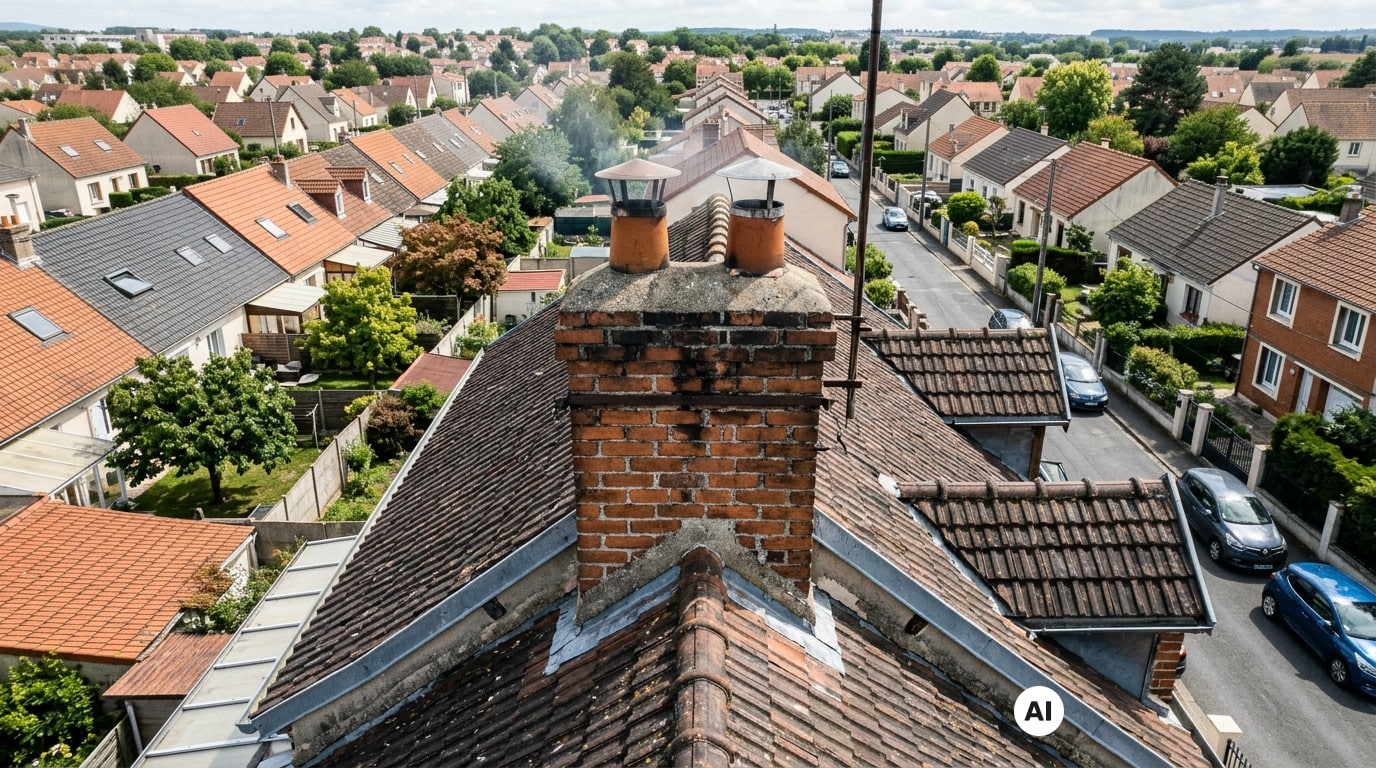
Temperatures drop, blankets come out of the closet, and the lure of lighting a good fireplace becomes hard to resist. Yet, before striking the first match of the season, one administrative detail deserves your full attention, and it could spare you a very nasty surprise. This document, often tucked away in a drawer and forgotten as soon as it arrives, is in fact a key piece of your protection in case of fire. Without it, your insurer has a rock-solid argument to deny compensation, even if the incident has nothing to do with the maintenance of your chimney. A topic affecting millions of French households equipped with a stove, an insert, or a traditional fireplace, and one that deserves to be clarified before the first frost arrives.
- The chimney sweep certificate, issued by a qualified professional, proves the maintenance of the flue and conditions compensation in case of a fire
- Departmental sanitary regulations generally require two chimney sweeps per year, including one during the heating season
- Without a valid certificate dated within the last year, the insurer may refuse or reduce compensation, and civil liability may be engaged if the fire spreads
- Why the chimney sweep certificate is essential for your home insurance
- What the departmental sanitary regulations say about the frequency of chimney sweeping
- How a compliant chimney sweep is carried out and what proof to require from the professional
- The consequences of a claim without a valid chimney sweep certificate
- Best practices to keep and present your certificate when needed
Why the chimney sweep certificate is essential for your home insurance
The chimney sweep certificate is not merely a decorative piece of paper to keep for organizational reasons. It is official proof that your wood-heating installation has been properly serviced by a qualified professional, following established practice. Yet home insurance policies almost invariably include a clause requiring regular maintenance of the flue. In the event of a domestic fire linked, even indirectly, to a lack of chimney maintenance, the insurer can invoke this clause to reduce, or even deny altogether, the indemnity. In other words, this document becomes your best ally the day things go wrong, and its absence can turn an already painful incident into a financial abyss.
It’s not just a matter of paperwork: regular chimney sweeping genuinely lowers risk. The soot and creosote deposits that build up in the flue over time are highly flammable and represent the leading cause of chimney fires. An inadequately maintained chimney can ignite violently, with potentially dramatic consequences for the timber frame and the entire dwelling.
What the departmental sanitary regulations say about the frequency of chimney sweeping
Contrary to a common belief, there is no single national law establishing a universal frequency for chimney sweeping. It is the departmental sanitary regulations, specific to each French department, that govern this obligation. Most departmental sanitary regulations require two sweeps per year, one during the heating season, with a certificate issued by the professional to be kept safely. This two-step approach follows a simple logic: a visit before the cold season to check the overall condition of the flue, and a second during the months of intensive use, when deposits accumulate more rapidly.
Some departments may adapt this rule, particularly for pellet stoves or installations used infrequently, but the general trend remains the same across the country. It is therefore strongly recommended to check the applicable departmental sanitary regulation for your municipality, available at the town hall or prefecture, to ensure you meet the precise local requirements rather than relying on memory or approximate practices.
How a compliant chimney sweep is carried out and what proof to require from the professional
A compliant chimney sweep is not simply a quick brush through the chimney. The professional uses appropriate equipment, most often a metal or nylon brush mounted on rods, to mechanically remove the soot deposits accumulated along the entire height of the flue, from the firebox to the roof outlet. This operation must be carried out by a professional chimney sweep with a recognized qualification, and not by the homeowner themselves, because only a certificate issued by a professional holds legal and insurance value.
At the end of the intervention, the chimney sweep provides a chimney sweep certificate that lists several essential details, which you should check before filing the document away:
- the exact date of the intervention
- the full address of the dwelling concerned
- the type of appliance and flue swept
- the explicit indication of conformity or, if applicable, any anomalies observed
- the name, contact details, and company registration number
An incomplete or approximate certificate could be deemed insufficient by an insurer in case of dispute. It is therefore wiser to ensure that all these mentions appear clearly on the document before you file it away.
The consequences of a claim without a valid chimney sweep certificate
Imagine the scene: a chimney fire breaks out, firefighters respond, damages accumulate in the living room and potentially in the roof structure. You contact your insurer to report the claim, convinced that your policy covers this type of incident. But during the assessment, the absence of a chimney sweep certificate dated within the last year changes the situation completely. The insurer may then consider that the contractual obligation to maintain the chimney was not met, and apply an exclusion of coverage.
Practically, this means that repairs, sometimes amounting to tens of thousands of euros for a damaged roof structure, would not necessarily be fully borne by the owner. Even more concerning, if the fire spreads to a neighboring dwelling in the case of a building or a semi-detached house, the insured’s civil liability could be engaged, with far heavier financial consequences. This scenario is not exceptional: every year, households discover, too late, at the worst moment, that this seemingly secondary document actually governed their entire indemnity.
Best practices to keep and present your certificate when needed
The good news is that avoiding this kind of misadventure requires neither tremendous effort nor excessive expense. The first reflex is to schedule the two annual chimney sweeps in a location that is easy to consult, for example in a calendar or a digital reminder, so you never miss the due date. Some chimney sweeps even offer annual maintenance contracts that greatly simplify this organization.
The second reflex, just as important, is to store each certificate in a dedicated folder that brings together all documents related to the home and to the insurance. A digital copy, photographed or scanned and then backed up to the cloud, provides an additional layer of security in case the paper document is lost or a fire damages the physical archives of the residence. Finally, it can be useful to send a copy of the certificate to your insurer as soon as you receive it, since some contracts explicitly request it as annual supporting documentation. This simple gesture, taking only a few minutes, can literally make the difference between full indemnification and outright denial on the day the flames find your home uninvited.
Before fully enjoying the reassuring crackle of the logs this winter, a quick look through your administrative archives is therefore in order. This seemingly small habit protects both your safety and your wallet.
