
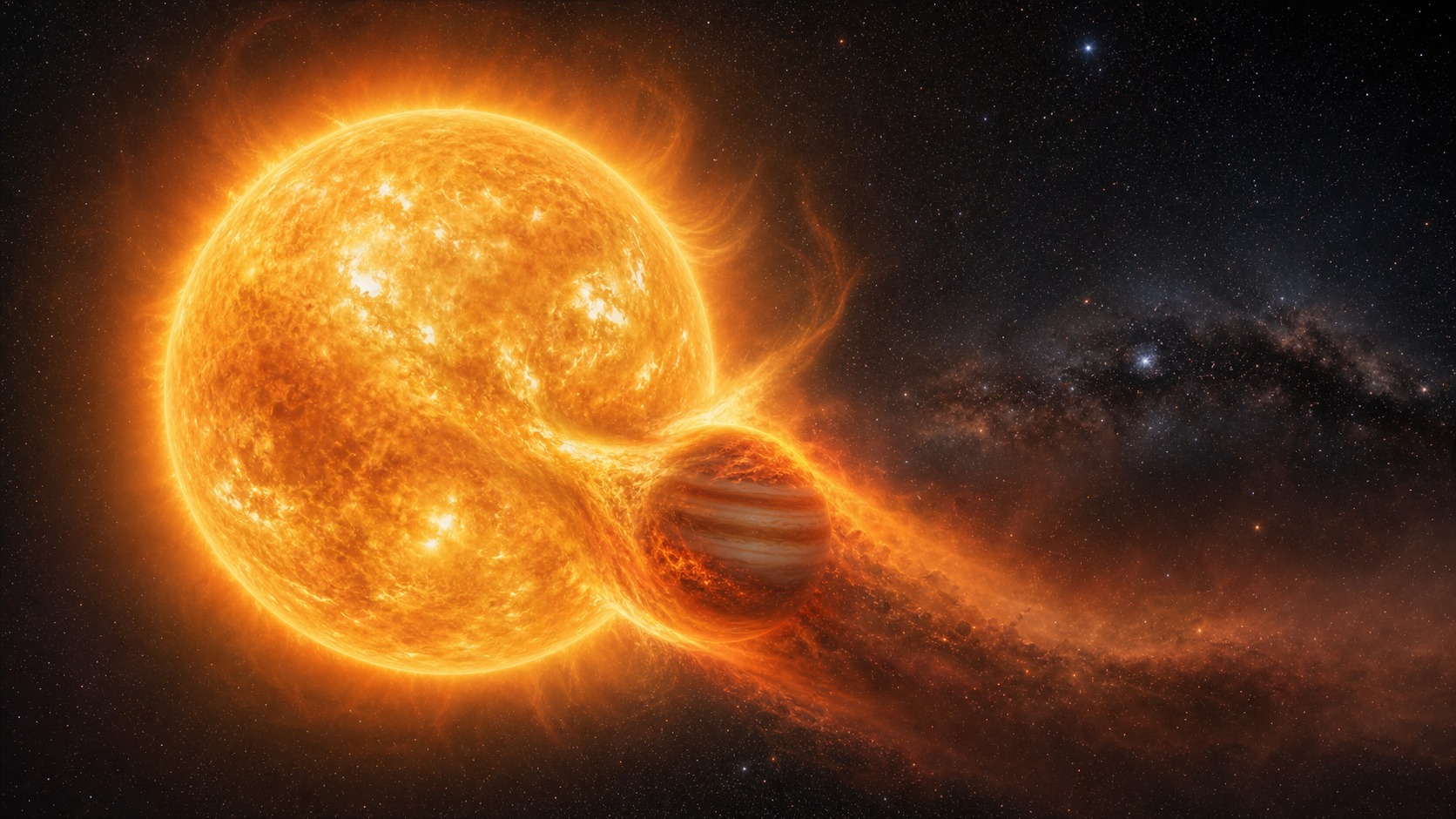
For decades, astronomers had predicted what would happen when an aging star expanded far enough to consume a nearby planet. They had found stars that appeared to have swallowed planets in the past, but the decisive moment itself had always escaped observation.
That changed with an object called ZTF SLRN-2020. A brief burst of visible light followed by a long infrared glow gave researchers the first direct evidence of a Sun-like star engulfing one of its planets. The discovery did not come from a close-up photograph; it was reconstructed from the star’s changing light, spectrum and surrounding dust.
An outburst that did not resemble an ordinary stellar explosion
The event was first detected by the Zwicky Transient Facility, a survey that repeatedly scans the sky from Palomar Observatory in California. The star suddenly brightened in visible light, prompting researchers to investigate what initially looked like another type of stellar eruption.
Its behaviour soon became difficult to explain. The outburst was much fainter than the merger of two stars, yet it was followed by an unusually persistent infrared signal. Archived observations from NASA’s NEOWISE mission showed that the system had begun producing dust before the visible flash and continued glowing in infrared afterwards.
That combination was the crucial clue. Something smaller than a second star had entered the host star’s atmosphere, heated surrounding material and expelled gas that later cooled into dust.
The planet was probably a gas giant
In the study published in Nature, the team concluded that the swallowed object was a planet with a mass of less than roughly ten times that of Jupiter. Its host was described as a Sun-like star located in the Milky Way.
The planet had probably orbited extremely close to the star. As the star evolved and expanded, its outer atmosphere reached the planet’s orbit. Drag then removed orbital energy, causing the planet to spiral inward faster until it plunged into the stellar envelope.
During the final descent, the planet transferred energy to the surrounding gas. Part of that material was thrown outward, producing the optical flash. As the ejected gas expanded and cooled, molecules and dust formed, creating the infrared glow detected over a much longer period.
What “observed” means in this astronomical first
Astronomers did not resolve the surface of the star and watch a visible planet disappear into it. The system was far too distant for that. Instead, several independent signatures captured the process while it was happening: the short optical outburst, the evolving spectrum, the lower-than-expected energy and the later infrared emission from dust.
Previous studies had identified stars whose chemistry suggested that rocky material had already fallen into them. Others had detected planets orbiting dangerously close to expanding stars. ZTF SLRN-2020 was different because researchers caught the luminous transient associated with the engulfment itself.
This is why the result was described as the first direct observation of planetary engulfment, even though the published images are measurements and scientific reconstructions rather than a conventional photograph of the planet.
This may happen several times in the Milky Way each year
The phenomenon is not expected to be exceptionally rare. The Nature study estimated that similar faint red transients could occur in our galaxy at a rate ranging from about one every ten years to several each year. Many may have been missed because they are dimmer than stellar mergers and can fade quickly in visible light.
Future surveys should make them easier to identify. The Vera C. Rubin Observatory, for example, is designed to monitor enormous areas of the sky repeatedly. Combining optical surveys with infrared telescopes will help astronomers distinguish swallowed planets from novae, stellar mergers and other transient events.
A larger sample could reveal which planets are most vulnerable, how much matter stars eject during engulfment and whether the process changes the star’s rotation or chemical composition.
A distant preview of the Solar System’s future
Our Sun will eventually exhaust the hydrogen in its core and expand into a red giant. Mercury and Venus are expected to be engulfed. Earth’s exact fate remains more difficult to calculate because the Sun will lose mass while tidal forces pull the planet inward.
ZTF SLRN-2020 does not provide a direct prediction for Earth, but it confirms that planetary engulfment is a real and observable stage in the evolution of planetary systems. A world can orbit for billions of years before its star’s expansion brings that history to a sudden end.
For astronomers, the discovery turns a long-standing theoretical expectation into a phenomenon that can now be searched for systematically. The final moments of planets are no longer hidden entirely inside the glare of their stars.
