
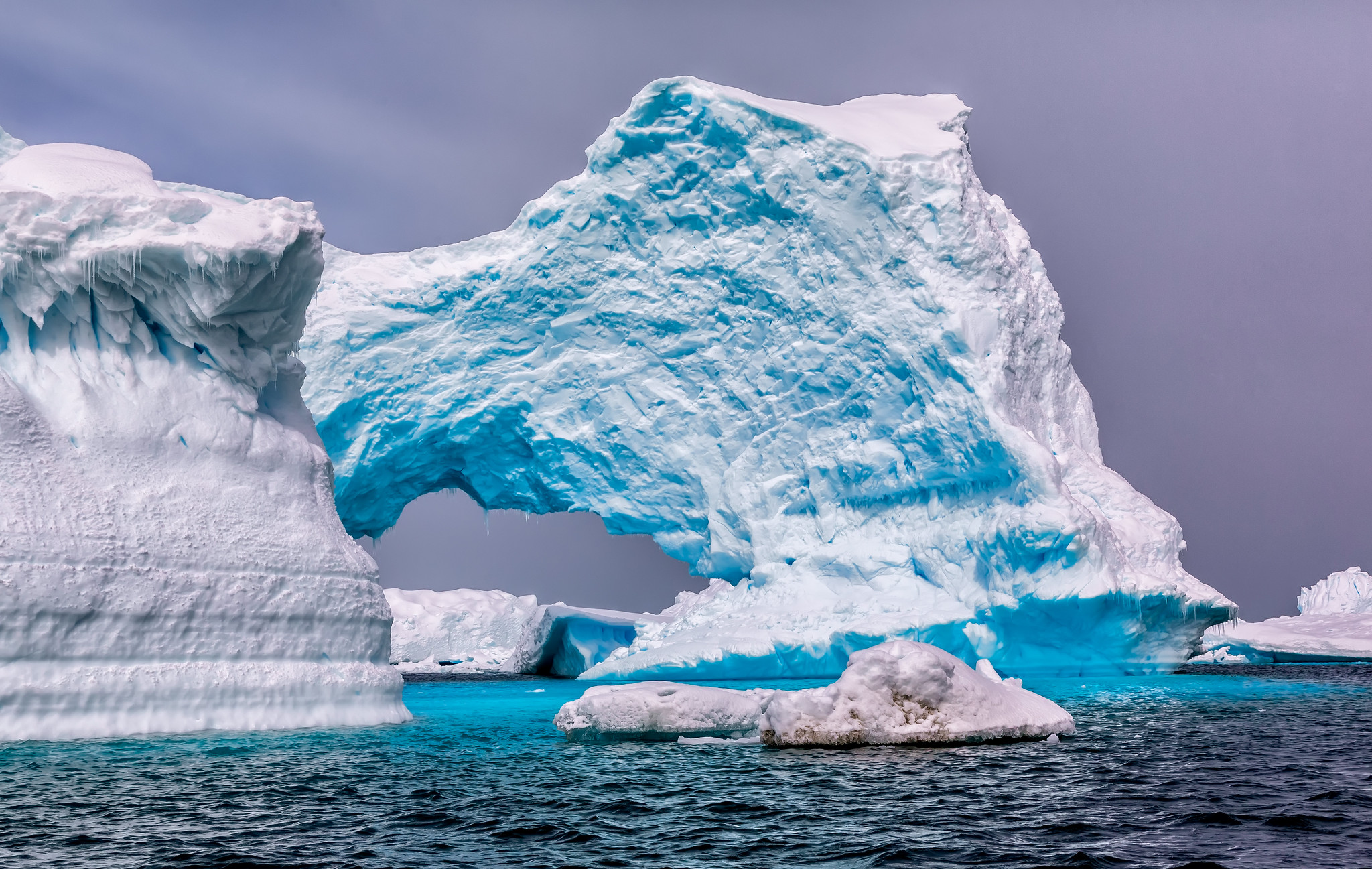
Based on work conducted by a physicist at the European Space Agency (ESA), a Dutch company is considering artificially thickening the Arctic’s ice arches. The aim is to reinforce the natural barriers of the sea ice that has suffered from climate warming. In theory, this solution could prevent the detachment and melting of thousands of square kilometers of ice each year.
The disappearance of 95,000 km² of ice per year
At the origin of the project is Malcolm Davidson, a physicist and researcher at the European Space Agency (ESA), interviewed by New Scientist on August 7, 2026. About fifteen years ago, the researcher flew over Nares Strait, which separates Greenland from Canada, and observed a major natural structure: the ice arches. In winter, these arches form as large chunks of ice detach and interlock. The arches thus constitute a kind of natural barrier that holds back the thick old ice in the frozen Arctic Ocean.
However, due to the current warming of the climate, the ice arches break too early or do not form at all. Without this type of barrier, the pack ice tends to escape toward the south, racing through Nares Strait and melting in the warmer waters. Each year, approximately 95,000 km² of ice escape in this way before disappearing.
Based on Malcolm Davidson’s observations, the Dutch startup Arctic Reflections is exploring the possibility of targeted interventions. Here, the idea is not to refreeze the entire ocean but to reinforce only the pivot points of the arches. The goal is therefore to keep the barrier closed longer in order to prevent the ice from drifting southward.
Towards the development of an ambitious technological solution
Arctic Reflections is considering the use of seawater pumps. Concretely, the plan involves drilling holes in the existing thin ice in order to pump the water from below and discharge it to the surface. Thus exposed to the polar air – averaging around -25°C in winter – the water freezes very quickly. According to the startup, the technique would artificially add about one meter of thickness to the ice, making it far more resistant to both pressure and the coming summer heat.
It should be noted that the project rapidly progressed from theory to practice thanks to concrete field tests, funded notably by the British government – amounting to €11.6 million. In 2024, Arctic Reflections carried out a first test near the Svalbard archipelago (Norway), which increased the ice thickness from 90 cm to 116 cm in a matter of days. Since the start of 2026, another test is underway in Canada, in the Inuit village of Qikiqtarjuaq. The aim is to study the resistance of the added ice under the strong mechanical pressures of the strait.
Ultimately, the startup is expected to trigger the final phase of its plan, namely the development of autonomous drones. These machines will be tasked with drilling and pumping water without human intervention, with the ultimate aim to thicken up to 100,000 km² of ice per year. However, officials have stressed that their solution is only a temporary patch to limit the melting of Arctic sea ice and, in particular, to protect the ecosystems hosting Indigenous populations and local wildlife. In other words, this is by no means a means to solve the current climate crisis.
