
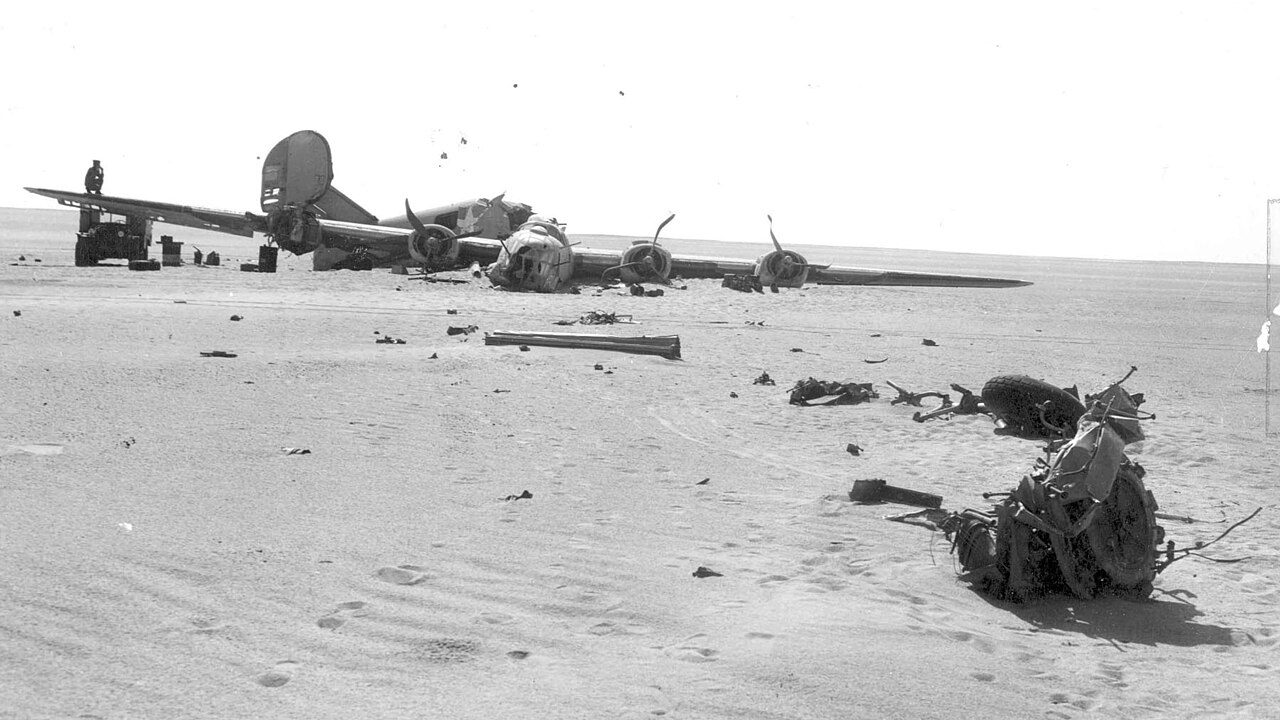
On April 4, 1943, a B-24 Liberator of the US Army Air Forces took off from a Libyan base to bombard Naples. It never returned to its point of departure. For fifteen years, the American military logged the aircraft and its nine crew members as lost at the bottom of the Mediterranean. In reality, its wreck lies hundreds of kilometers away, buried in the sands of the Libyan desert.
Nine men composed this crew that day.
This flight marked their very first combat mission. Referred to as Lady Be Good, the aircraft belonged to a bombardment group of the USAAF stationed in Libya, a region then at the heart of Allied operations against fascist Italy. On the return from the Naples raid, a sandstorm swept the area, obscuring all navigation references. The crew, still inexperienced on this theater of operations, overshot their base without realizing it and continued south, out into the desert.
- The Lady Be Good bomber crashed in the Libyan Sahara on April 4, 1943 following a navigation error.
- The nine crew members bailed out thinking they were above the Mediterranean and none survived.
- The wreckage was discovered on November 9, 1958 by a BP exploration team, fifteen years after the crash.
A navigational error that becomes a catastrophe
The flight continued for many hours, far from the sea that the crew believed they were over. Fuel finally ran low. With no alternatives, the nine men jumped by parachute over the Libyan Sahara, convinced they could reach their base on foot after landing.
None of the nine men survived.
Persuaded they had jumped above the Mediterranean, the aviators walked through the sand seeking help. They encountered neither runway nor oasis, nor any sign of life. The mission devolved into a silent tragedy, far from any witness and without a single radio message to alert rescuers.
Fifteen years classified as “lost at sea”
The command staff closed the file with a simple hypothesis: the aircraft had crashed at sea on its return from the Naples raid. No wreckage was recovered, no trace reported along the Mediterranean coasts. The families of the nine airmen received the official notification of a disappearance at sea, never learning the truth of what had actually transpired in the desert. The Lady Be Good mystery thus settled into the archives as a case of unexplained loss for fifteen years.
Yet this story never entirely faded from memory. It even inspired American television: in 1960, the series The Twilight Zone aired an episode centered on a bomber missing in the desert, a barely veiled nod to a case that continues to haunt the imagination.
A purely fortuitous discovery in the sea of sand
The wreck resurfaced on November 9, 1958.
That day, a BP oil-prospecting team overflew the Calanshio sea of sand, a remote and hostile stretch of the Libyan desert. The prospectors were not searching for a missing aircraft; they were looking for oil. It was purely by chance that they spotted the bomber’s remains in the middle of the desert, hundreds of kilometers from the Mediterranean, where the army had long believed the crash occurred.
The irony is total. It was not military searchers who resolved the mystery, but geologists prospecting for oil who stumbled upon the aircraft during a routine flight. The Lady Be Good, which everyone had assumed lay underwater since 1943, actually rested in the heart of the Sahara, precisely opposite the spot where the search had persisted for fifteen years.
Sources : migflug.com | fr.wikipedia.org
