
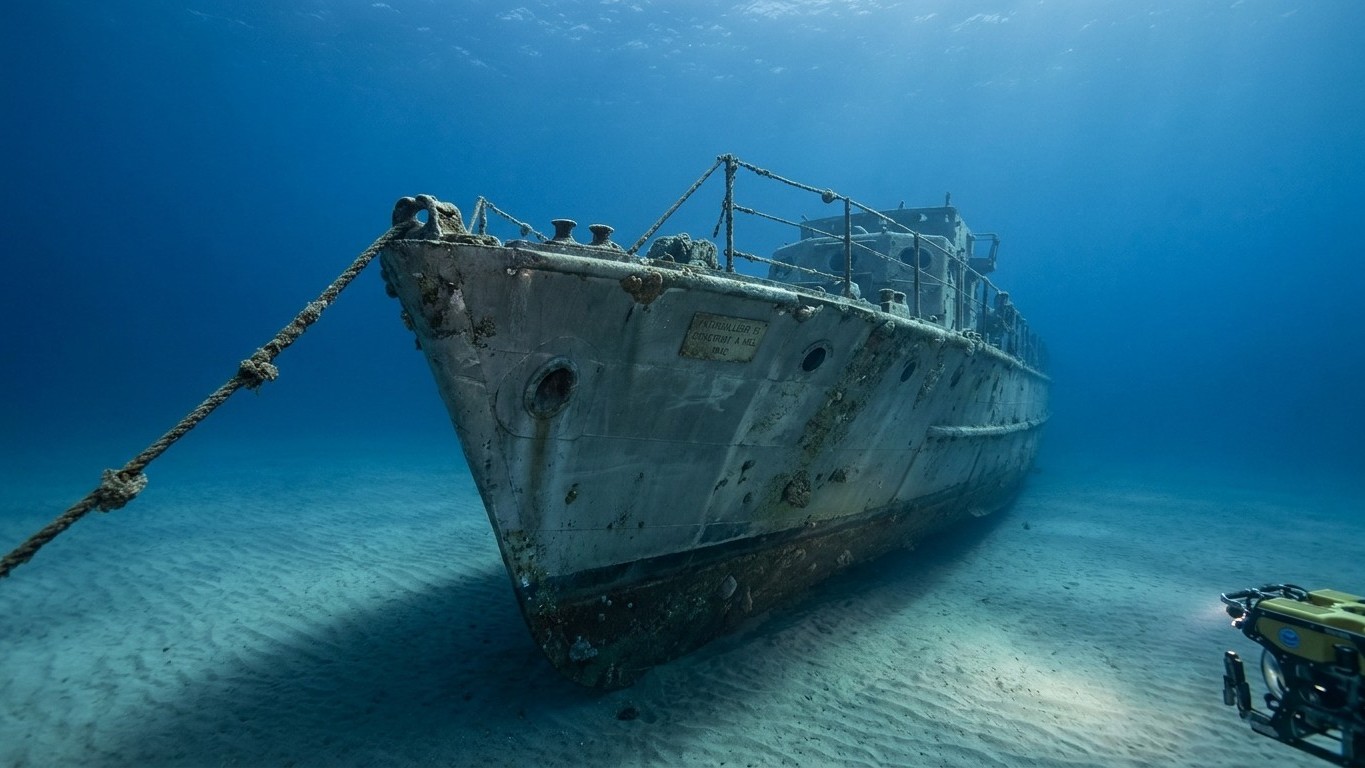
Eighty-three years spent at the bottom of the Ionian Sea, and yet its hull has hardly moved. Divers discovered that the vessel lay almost upright on the sandy seabed, in remarkable preservation. The German patrol boat LS 6, sunk in September 1943, has been formally identified off Preveza, Greece, and it is none other than the last known example of this type of craft in the world.
Key takeaways
- A German World War II wreck remained missing for 80 years
- An aluminium hull thought not to endure underwater, yet preserved to perfection
- The last vessel of its kind in the world: an underwater archaeological treasure
A thirteen-year investigation launched by a single archival clue
The search began in 2013, after German naval historian Peter Schenk shared archival information about a small Kriegsmarine vessel lost in the Ionian Sea, with an approximate position and depth. One detail. Almost nothing. But for Greek historian Giorgos Karelas, it was enough to trigger a decade of cross-checking. It was ultimately Lefkada’s wreck hunter, Dimitris Giannoulatos, who spotted a sonar target 96 meters inside the area outlined by the archives, before the AegeanTec team organized a closed-circuit identification dive using underwater scooters.
The confirmation did not come instantly. A camera lowered through a hatch in the engine room recorded the outlines of two Junkers Jumo 205 diesel engines, while divers also documented a stern door associated with the boat’s depth-charge system. The detail that tipped the balance from doubt to certainty lay at the bow. The strongest link to the documented loss of LS 6 was found there: a portion of the tow cable was still attached, the remainder trailing on the sea floor. A tow cable, intact after eight decades. Such a detail can give a wreck diver’s head a turn.
A warship built like an aircraft
What makes LS 6 unique isn’t just its rarity, but a technical choice almost heretical for the era. Built by Dornier in Friedrichshafen and put into service in October 1941, LS 6 displaced about 12 tons; its aluminium alloy hull drew heavily on aeronautical construction techniques and allowed the engines to push the boat to a stated top speed of 37 knots. To put that in perspective: at that speed, a modern pleasure boat of similar size would look pale by comparison.
The Leichte Schnellboote, literally “fast light boats,” were not originally designed as autonomous units. The LS boats were conceived as miniature torpedo boats that could be carried aboard larger ships. LS 6 and its sister ship LS 5 later enjoyed a second life. Converted for anti-submarine warfare, they were sent to Greece in 1943, transported by land and rail because the Allies controlled the Strait of Gibraltar; their original rear torpedo launcher had been replaced with an internal depth-charge system, while a 20 mm gun provided close-range defense. A torpedo boat transformed into a submarine hunter, hauled by road to the Mediterranean: the journey itself reads like a novel.
A sinking without combat, almost absurd
LS 6 never truly had the chance to complete its anti-submarine mission. Accounts differ slightly on the exact circumstances of the initial damage, but converge on the sequence that followed. According to reconstructions by Karelas and Giourgas, LS 6 was attacked on September 24, 1943 while moving from Igoumenitsa to Corfu; the most probable hypothesis attributes the attack to six Italian Reggiane Re.2002 fighter-bombers; nearby explosions disabled the vessel and severely damaged its hull. With no propulsion, the only option was towing.
It was precisely this improvised rescue that doomed it. The Kriegsmarine then attempted to tow LS 6 from Corfu to Piraeus for repairs, with the tow provided by the minelayer R-194, aided by the landing barge F-331; cracks in the aluminium hull widened under pressure, water rapidly entered, and the boat sank in deep water near Mytikas, off Preveza. The very material that gave it speed and lightness, aluminium, eventually betrayed it under the strain of the tow cable. An iron hull might have held. This one failed.
The sole surviving exemplar in the world
What strikes underwater archaeologists today is less the tale of the shipwreck and more the condition of the wreck itself. The boat lies upright at a depth of 96 meters in the Ionian Sea, its bow pointed northwest, and researchers estimate that it is the only known ship of its type to have survived. No other Leichte Schnellboot has been found or preserved anywhere else. This status as a one-of-a-kind turns a routine dive discovery into a premier heritage object.
The geographic location is not incidental either. The wreck sits at 96 meters in the waters between Lefkada and Preveza. A zone that, one imagines, will now attract the attention of German naval historians as well as the most experienced technical divers able to reach such depths. One question remains that the researchers have not yet fully answered: how many other wrecks of this type, deemed lost forever in military archives, might still lie intact beneath tens of meters of Greek water?
Source: slate.fr
