
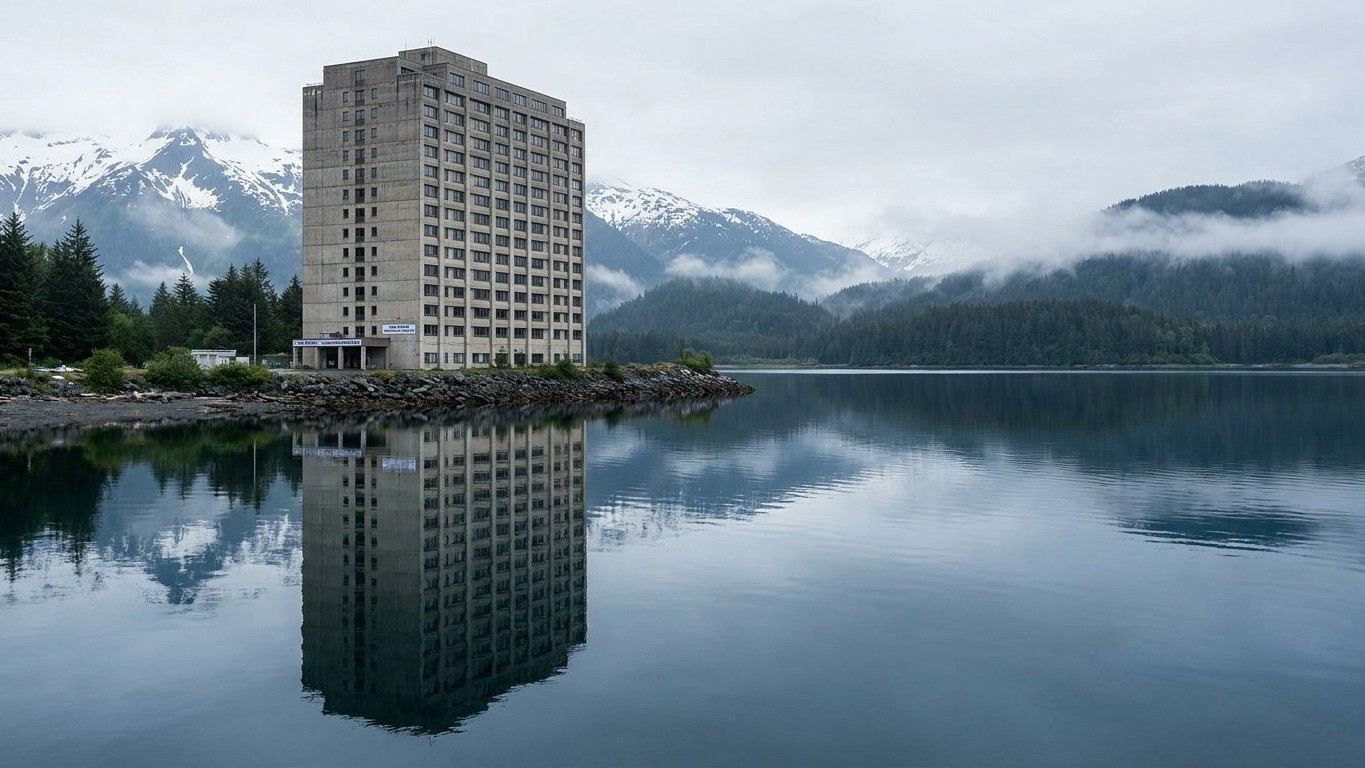
On the shores of an Alaska fjord, since 1957 almost all of Whittier’s residents have lived under the same roof in Begich Towers.
Two hundred and seventy-two people. One building. That’s about all you need to know to understand Whittier, this small town tucked at the far end of a fjord in Prince William Sound, roughly 100 kilometers southeast of Anchorage. Whittier, Alaska, counts around 272 inhabitants, most of whom reside in the Begich Towers. Not a neighborhood, not a subdivision: a fourteen‑story edifice perched beside the water like a concrete lighthouse facing the mountains.
The story begins during World War II. Fearing a Japanese invasion, the U.S. Army built here a strategic port, accessible only by a railroad tunnel cut through Maynard Mountain. The building that would become Begich Towers went up a little later: the initial work dates to 1956, when the construction aimed to house recently arrived military personnel. Originally it was called Hodge Building. The Army abandoned it in 1960, before Whittier bought it back in 1972.
Key takeaways
- Why did 272 people choose to live under one roof in an Alaska fjord?
- What is this single tunnel that isolates the town at night?
- How did a teenage girl document this extraordinary life and make it go viral online?
A building that contains an entire town
The striking thing isn’t the building’s height—quite ordinary for an urban tower—but rather everything it holds within. The residents benefit from the fact that the structure nearly doubles as the town itself, home to a health clinic, a police station, a post office, a church, a playground and a grocery store, all under one roof. Add to that a hair salon, a laundromat and even an interior garden, and you have a kind of vertical mini-city where, theoretically, one could live without ever braving the chilly outdoor wind.
The school, for its part, sits in a separate building, yet it’s linked by an underground corridor. Today the facility welcomes about fifty students, aged 3 to 18 years. One school, all grades consolidated under the same administrative roof as the rest of the town. It’s hard to imagine a mayor in France who could cross paths with every resident in the lobby each morning. Here, it’s everyday life.
The current mayor, Dave Dickason, lives in the tower with his family. His daughter Jenessa, aged 18, has even begun documenting this unusual life on social media, where her videos have gathered millions of views. It’s proof that curiosity about this way of life travels far beyond Alaska’s borders.
A single tunnel to exit the fjord
Whittier is connected to the mainland solely by a road, itself dependent on a tunnel that is one of a kind. The Anton Anderson Memorial Tunnel, also known as the Whittier Tunnel, stretches about 2.5 miles (roughly 4 kilometers) and represents the only land route into the town. It is the longest road tunnel in North America, functioning with a single lane shared by trains and vehicles. In practice: you cannot travel in both directions simultaneously, nor can you encounter a train inside.
The system operates like clockwork, quite literally. Since the summer of 2026, vehicles leaving Whittier typically depart at the exact hour, while those entering from the Bear Valley/Anchorage side leave at the half-hour. Missing your slot means waiting for the next one. And in winter, the margins tighten: in freezing conditions, traffic is limited to a five-minute window.
At night, everything stops. There is no road circulation between evening closure and morning reopening. Whittier becomes literally cut off from the world by road, somewhat like an island that closes its single bridge every night. This detail changes everything for residents: you cannot head out on a whim after 11 p.m., nor can outside responders reach in before dawn in case of trouble. The tunnel opened to automobile traffic in 2000, which facilitated access to the town and boosted tourism, turning Whittier into a gateway for cruises and excursions in Prince William Sound.
Living without ever stepping out, or almost
The combination of a single building and a single tunnel creates a rare effect: the ability to go through months almost without facing the outdoors. With Begich Towers’ “everything under one roof” approach and the underground tunnels, Whittier’s residents can avoid stepping outside for extended periods, sometimes even years if they wish. In winter, when the winds can reach extraordinary speeds and snow piles up on the surrounding slopes, this architecture is not a whim: it’s a direct response to a climate that spares nothing.
Some residents view this lifestyle as a genuine choice, almost a philosophy. “We don’t need all those big stores, we don’t need all those so‑called conveniences of a big city,” summarized Mayor Dave Dickason. Others, who arrived from California, Hawaii, or even Guam, describe settling here as a real culture shock, gradually transformed into a sincere affection for this fjord‑side corner.
The town also hosts a tourist flow unmatched by its permanent population. Every summer, more than 700,000 visitors come to enjoy glacier cruises and kayaking in Prince William Sound. This turns the village-building into a lively waypoint for several months each year, before the tunnel again closes its doors to winter and the 272 residents reclaim their vertical quietude.
Sources: alaska.org | alaskaroadtrip.com
