
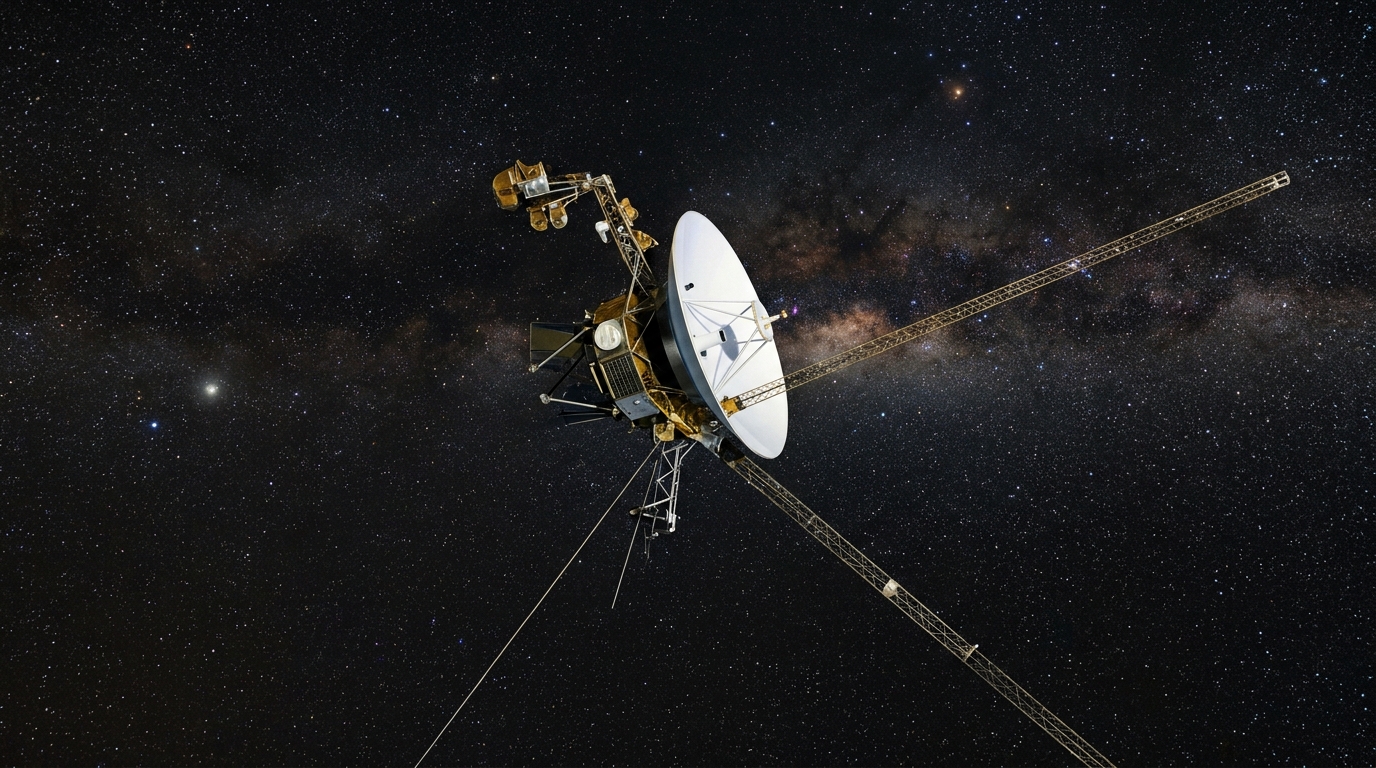
There are objects that travel through time without ever stopping, rushing forward for decades, indifferent to fashions and borders. Space is full of these silent travelers, but only one of them was conceived from the start as a letter addressed to recipients we might never meet. Since 1977, the Voyager 1 probe has been venturing into interstellar space, carrying with it a curious message engraved on a golden disk. Among the images chosen to tell humanity to hypothetical extraterrestrial civilizations, one photograph disappeared at the very last moment, falling prey to a censorship as revealing as it was unexpected.
The Golden Record, a time capsule launched toward the unknown
When the two Voyager probes left Earth in 1977, they carried not only scientific instruments intended to observe the giant planets of the solar system. Each also carried a copper disk plated with gold, designed as a true time capsule. Under the direction of the astronomer Carl Sagan, then a researcher at Cornell University, a scientific committee carefully selected 116 images encoded in analog form, as well as sounds, music from around the world, and greetings in several languages. The objective was ambitious: to offer a faithful glimpse of Earth’s life and culture to any extraterrestrial intelligence that might someday cross paths with these craft.
Today, this somewhat audacious gamble continues on its way. Voyager 1 and Voyager 2 are now the two only human-made objects to have reached interstellar space, the region beyond the direct influence of the Sun. By March 2012, Voyager 1 stood more than 17.9 billion kilometers from the Sun, traveling at roughly 61,000 kilometers per hour, while Voyager 2 was over 14.7 billion kilometers away. Carl Sagan himself had warned that this message would probably never be received, lacking a civilization sufficiently advanced on its trajectory, but that it carried above all a message of hope about the existence of life on Earth.
This photo that nearly represented humanity in the eyes of extraterrestrials
Among the photographs considered for this extraordinary disk, one was meant to show something universal and deeply human: the birth of life itself. The scientific committee had indeed chosen a photograph depicting a naked man and a naked pregnant woman. The idea was not provocative to its designers: it was simply to illustrate human reproduction as honestly as possible, without artifice or excessive modesty.
But at the very last moment, before launch, NASA forbid this image. This decision did not come from nowhere: it directly echoed criticisms faced a few years earlier by Pioneer 10 and 11 probes, which already carried a plaque engraved by Linda Salzman Sagan, depicting naked human silhouettes. Faced with the controversy at the time, the American space agency chose prudence for Voyager, merely discarding the original photograph despite the work of the scientific committee.
Why NASA preferred a sketch to a real photograph
Unable to reach agreement over what was deemed too explicit, a compromise was finally found in the urgency. Rather than abandoning entirely the idea of depicting human reproduction, the team opted for a simple outline, a silhouette of the couple, with a fetus positioned in the woman’s belly. This pared-down drawing, less frontal than a photograph, was enough to soothe the agency’s concerns while preserving the original intention of the message.
It should be noted that the Golden Record did not entirely abandon human anatomy. It still contains a diagram of vertebrate evolution, created by the illustrator Jon Lomberg, which includes anatomically correct drawings of a naked man and woman, with visible external organs. A paradox that shows clearly that the limit set by NASA was not so much nudity itself as the photographic realism associated with sexuality and pregnancy.
What this censorship reveals about our relationship with the body and science
This anecdote, almost humorous in hindsight, reveals a great deal about the tensions already threading through American society in the 1970s between scientific rigor and cultural modesty. Wanting to present humanity truthfully to potential observers from elsewhere, while fearing Earth’s public reaction to a naked body, illustrates how much the representation of the human body remains a sensitive subject, even when communicating with the entire universe.
The final choice, that of a stylized sketch rather than a photograph, represents a form of compromise quite familiar: the balance between scientific accuracy and the social norms of the era. Ironically, it is ultimately the anatomically more detailed drawings, those by Jon Lomberg on vertebrate evolution, that ended up traveling unscathed aboard the two probes, proving that the line between what is deemed acceptable or not can hinge on very little.
Nearly fifty years after their launch, Voyager 1 and Voyager 2 continue their silent journey, well beyond our solar system. In about 40,000 years, Voyager 1 will pass at roughly 1.6 light-years from the star Gliese 445, while Voyager 2 will approach the star Ross 248. By then, their message will keep drifting through the cosmos’s silence, with its small imperfections, its human compromises, and that hastily drawn silhouette, the ultimate trace of a history that was never quite closed between science and our relationship to the body. Who knows what future readers from another star system might think if they ever encounter this golden disk lost in the vastness?
