
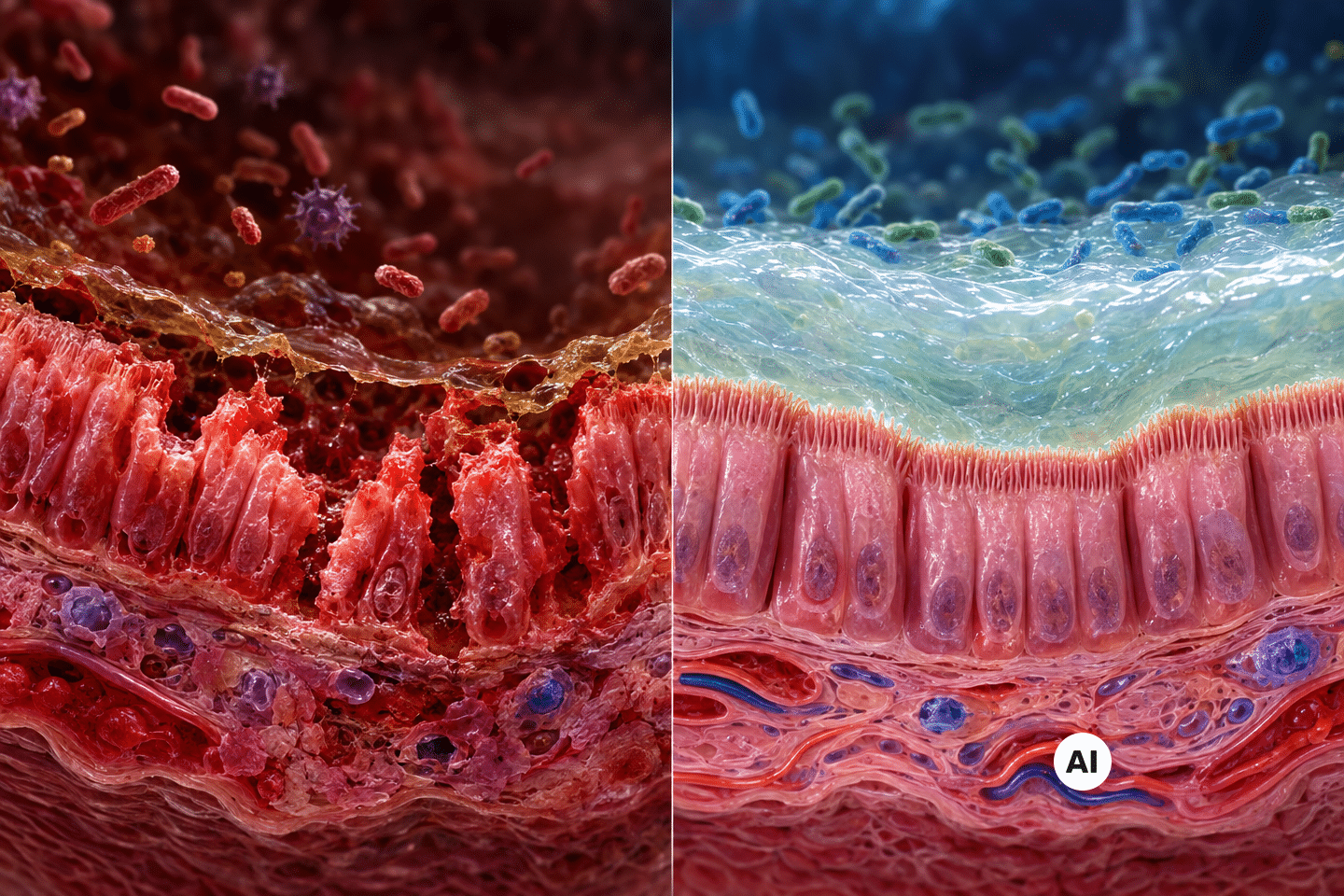
Dietary fibers are plant-based components that the body cannot digest, yet the gut bacteria know how to use. When they run low, these same bacteria switch tactics and target the intestinal wall. A Princeton team has documented this mechanism in mice.
The findings, published in the journals PNAS and Nature Metabolism, illuminate the processes by which proteins and plant fibers generate chemical substances that are beneficial to health in the bloodstream. The work sheds light on the ongoing dialogue between what we eat and the billions of bacteria that inhabit our digestive tract.
Molecular biologists Jenna AbuSalim and Joshua Rabinowitz, who led the study, aimed to understand a precise mechanism. How do fibers and certain plant-derived proteins manage to produce metabolites favorable to our body after being transformed by the gut flora?
When the gut microbiome turns against its host due to a lack of fiber
To grasp the stakes, one must first understand what normally happens in the intestine. As digestion proceeds, the resident bacteria produce phenolic metabolites from two amino acids, tyrosine and phenylalanine. These compounds then enter the bloodstream.
The problem is that not all of these molecules are created equal. Some are beneficial, others potentially harmful. And it is precisely the presence or absence of fiber that seems to tilt the balance toward one side or the other.
Mouse experiments are, in this regard, quite enlightening. When rodents’ diets are severely deficient in fiber, their gut bacteria do not stay idle. They turn to another available local source of nourishment—the mucus that lines the intestinal wall.
By nibbling at it, the bacteria produce compounds that are potentially harmful.
Unforeseen plant proteins that imitate fibers and shift the metabolic balance
The researchers also identified a family of non-digestible plant proteins, dubbed Prif, for protein imitating fiber—proteins that mimic fibers. Their behavior in the intestine closely resembles that of the fibers themselves.
Concretely, the fibers and these Prif proteins steer the production of phenolic metabolites toward the beneficial variety, the one derived from phenylalanine, rather than toward the potentially harmful variety derived from tyrosine. It’s as if they provide the bacteria with a direction to follow rather than granting them total freedom.
Even more surprisingly, the beneficial compounds observed originate almost exclusively from these Prif proteins. They do not act alone, however. Their effectiveness rests on synergy with the fibers, the two elements working together to steer bacterial metabolism in the right direction.
The researchers see the outlines of a new class of dietary nutrients, previously overlooked, capable of influencing the composition of the gut microbiota and, more broadly, metabolic health. In the longer term, there could even be labeling on food packaging indicating Prif content, just as fiber content is indicated.
Metabolites once believed to be exclusively bacterial, in fact produced by our own cells
The study yields a second surprise, challenging a widely held assumption. Some beneficial metabolites, such as indole-3-lactate and indole-3-acetate, had previously been attributed solely to the work of gut bacteria.
Yet the work shows that these same compounds can also be produced by other cells in the body, not only by the microbiota. This was confirmed in mouse and rat cells, as well as human cells.
This discovery slightly alters how we interpret the dialogue between diet, bacteria, and the body. The body would not be merely a spectator of what its bacteria manufacture; it would participate in producing some of these beneficial compounds itself.
For the researchers, the implications go beyond pure scientific curiosity. They could prove useful in developing future treatments targeting the gut microbiome, and in better interpreting ongoing dietary interventions.
These results already sketch a more nuanced picture of what our fibers and plant proteins actually do, far beyond the long-standing view of their role as simply facilitating transit.
Article prepared with the help of AI · Our method
