
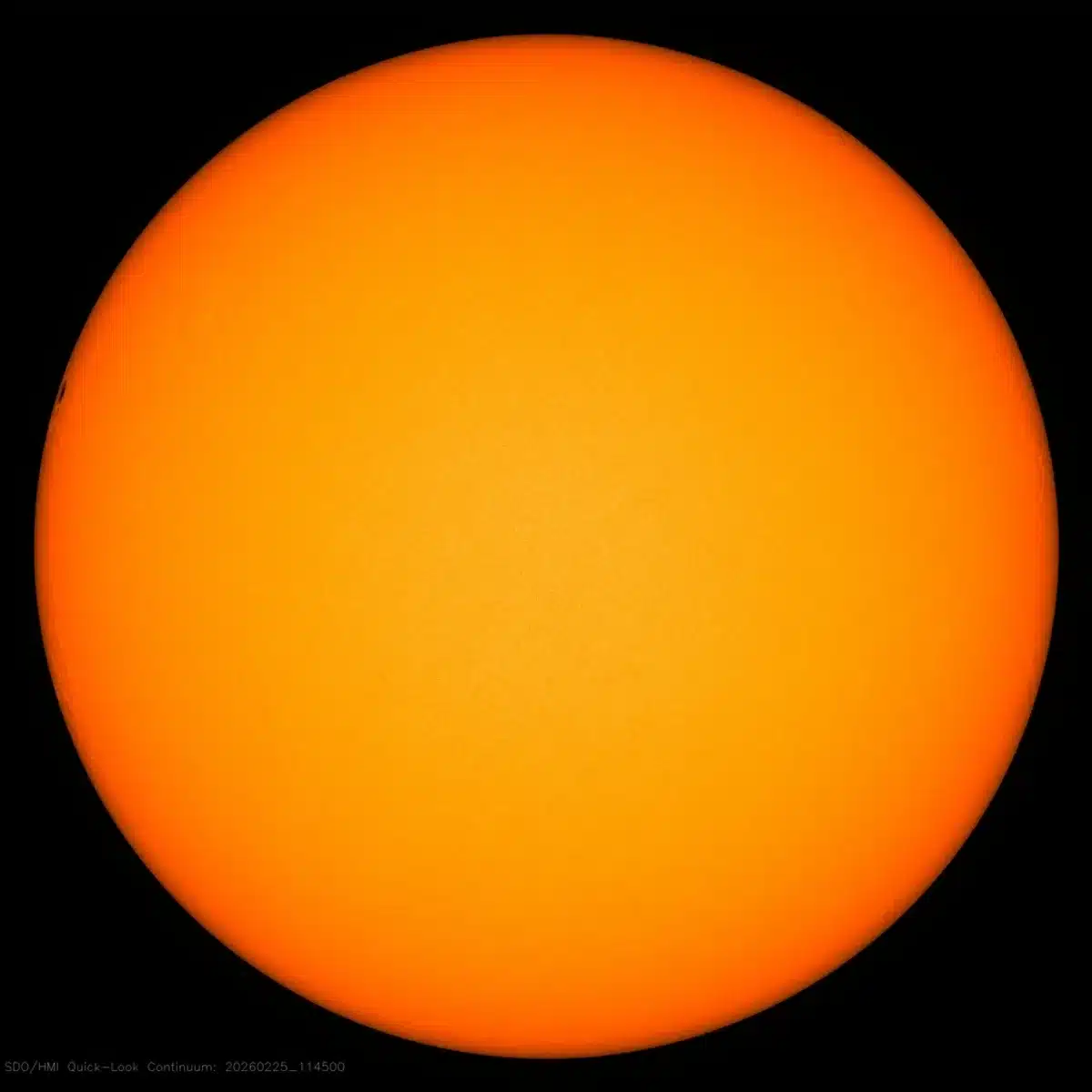
Between February 22 and 24, 2026, the Sun displayed a face not seen since June 2022: a perfectly smooth surface, devoid of the slightest sunspot. This magnetic quietude, the first observed in four years, marks a decisive turning point in the life of our star. As Cycle 25 has just passed its peak of activity, this sudden respite heralds the start of a long journey toward solar minimum, radically altering Earth’s space environment.
The Mystery of the Vanished Sunspots
Sunspots are not mere aesthetic details. They are regions where the magnetic field is so intense that it prevents heat from rising, creating cooler and darker zones. Their presence acts as the barometer of the star’s magnetic health.
For three consecutive days, the visible face of the Sun displayed none. This phenomenon indicates that the frenzy phase, launched during the solar maximum of October 2024, is giving way to a more stable magnetic arrangement.
Yet, this calm is relative. Solar physicists, such as Rachel Howe from the University of Birmingham, remind us that these 11-year cycles are shaped by polarity reversals. The Sun’s magnetic poles have tipped, an invisible yet fundamental process that resets the “solar engine” for the coming decade.
The Long Descent Toward 2030
If the absence of sunspots marks the end of the euphoria, the Sun has not, for all that, entered hibernation. The solar minimum, the lowest point of activity, is not expected before 2030. We are thus entering a four-year transitional phase.
History teaches us that caution remains essential. In 2017, during the previous cycle, one of the decade’s most violent eruptions occurred while the star was already heading toward its minimum. The Sun can still unleash massive coronal mass ejections.
Monitoring remains constant because activity never truly ceases. By February 25, observation satellites had already spotted a new sunspot appearing on the edge of the solar disk, proving that the star still harbors a few tremors before its grand sleep.
The Early Signs of the Future
The most fascinating aspect for the scientific community is not merely this current calm, but the early signals detected for what lies ahead. Researchers have identified magnetic anomalies at high latitudes, signatures of Cycle 26, the one that will succeed the current cycle.
These regions show a polarity inverted relative to the sunspots of Cycle 25. This is the undeniable signature of a new generation of storms in the making, though their actual eruption is not slated for several years.
The move toward solar minimum is a favorable window for satellites and terrestrial power grids, as they are less exposed to geomagnetic storms. It is also a unique observational window to understand how our star is preparing for its next great awakening.
Source: CESAR News – Spotless Sun!! no spots on the Sun during two days (cesar.esa.int)
Article prepared with the help of AI · Our method
