
Design projects for future human settlements on the red planet are multiplying. One of them notably envisages using autonomous 3D printing on Mars.
Martian regolith and inflatable pods
As NASA gears up for its first crewed mission to Mars, design projects are multiplying. What will the first Martian buildings look like, and what functions will they serve? Among existing concepts, Hassell Studio’s design stands out, developed in collaboration with the structural engineers of Eckersley O’Callaghan (EOC) and as part of NASA’s International 3D Printed Habitat Challenge.
According to an official release, the plan calls for a massive external shell that will be manufactured from Martian regolith. For context, regolith is the layer of soil covering bedrock, which can include loose material—dust or soil—as well as sound rocks. This term gained prominence in 2018 with the European Space Agency (ESA) project aimed at building a lunar colony using 3D printing and lunar regolith.
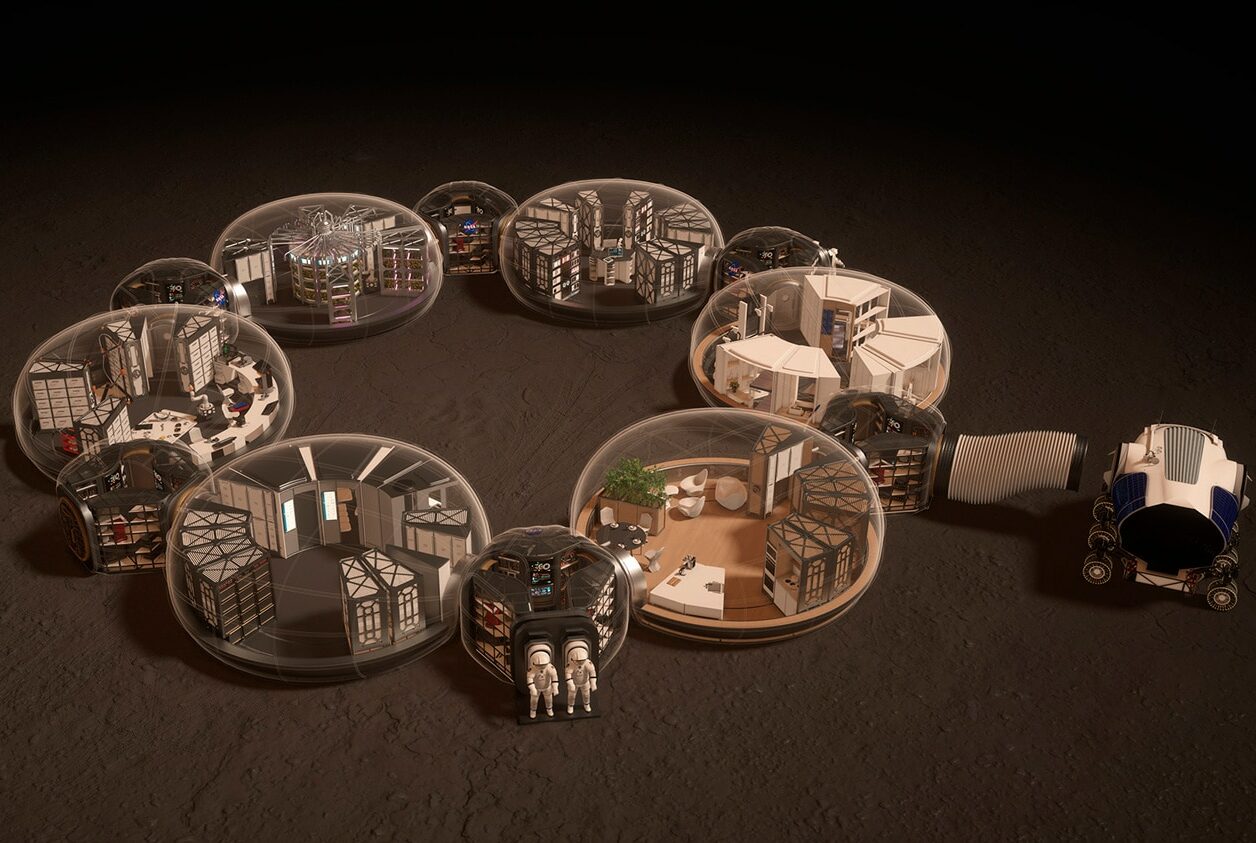
Beyond the use of Martian regolith, Hassell Studio envisions a small army of autonomous robots employing 3D printing to construct the famous external shell designed to house the habitats. The first humans arriving subsequently will take care of interior setup, notably through “inflatable pods” (see below).
Pods, each with its own purpose
According to the studio, this project goes beyond merely meeting the safety and survival requirements necessary for establishing a Martian colony. concretely, it involves six pods, each with its own utility and interconnected by a sort of airlock. There will therefore be a pod for the settlers’ living quarters, another housing a storage area and a small hospital, and another containing private quarters and a gym. The remaining three pods will house a laboratory, a greenhouse for growing food, and a workshop.
Finally, it should be noted that Hassell Studio’s project is part of a NASA-selected shortlist of ten Martian human-settlement concepts. Other entries include SEArch+/Apis Cor (the winner), Zopherus Design, and the Mars Incubator team.
Here is the presentation of the Hassell Studio project in video:
