
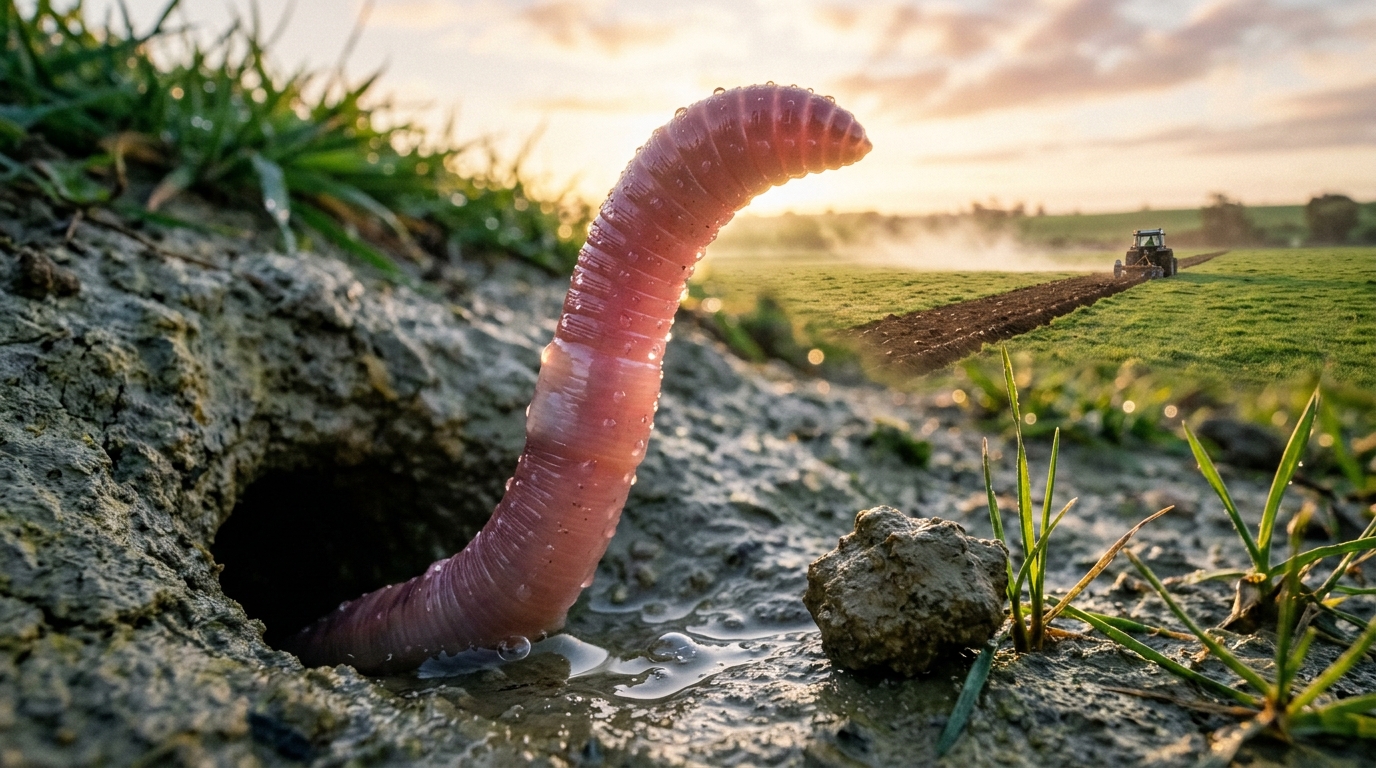
In southeastern Victoria, Australia, there lives an earthworm that averages about a meter in length, a creature that almost nobody has ever seen. Yet it betrays itself with a gurgling, a suction-like sound produced as it plunges into its burrows. This species, the Gippsland giant earthworm, exists only in this region and is among the threatened species. In 2025, a census invited landowners to document its habitat and report this sound.
A One-Meter Giant That Lives Across Only 40,000 Hectares
The Gippsland giant earthworm (Megascolides australis) is nothing like a garden worm. According to Museums Victoria, its average length ranges from 80 to 100 centimeters with a diameter of about 2 centimeters, and its body contains 300 to 500 segments. Individuals of three meters have been reported, but museum teams have never found a specimen approaching that size. The museum record lists 200 centimeters as the maximum.
The species is endemic to a zone of roughly 40,000 hectares in the western Strzelecki Ranges, in the south and west of Gippsland. It occupies the Bass River valley, between Loch, Korumburra, and Warragul. It lives in blue-grey clays, up to 1.5 meters deep, near waterways, seeps, and springs.
It is very difficult to observe. In the landmark 1992 study by Beverley Van Praagh, systematic sampling found worms in only 6% of the squares studied. More than 80% of the inhabited squares were located within 40 meters of river banks or in seepage zones on south-facing slopes. This island-like distribution explains why its surface area remains poorly known.
A Gurgling Sound That Helps Detect It
The worm can be detected by ear. According to Museums Victoria, its rapid movements within its galleries produce a strong suctioning noise, which enables the presence to be detected underground. Beverley Van Praagh compares it to the sound of water draining from a bathtub, and the species protection group describes an animal that sinks deeper to take shelter. This sound is not digestive in origin: it arises from the animal’s movement, and many landowners first notice the species because of it.
This is exactly what the May 2025 census aims to leverage. Led by the Gippsland Threatened Species Action Group with the Landcare networks of South Gippsland, Bass Coast and Latrobe Catchment, Beverley Van Praagh, and a plant ecologist, it invites landowners located within the species’ range to complete an online or paper questionnaire, or to use an app, to map the habitat on their lands. Local press reports that the researcher also asked ranchers to listen for this sound and report it online.
This is the first regional census in more than 45 years, i.e., since the Museums Victoria survey conducted with landowners in the late 1970s and early 1980s. The 1992 study, by contrast, was an ecological study focused on a specific question rather than a census.
A Fragile Species on Agricultural Lands
The species is listed as Vulnerable under the Australian federal EPBC Act, Endangered on the Victorian Flora and Fauna Guarantee Act list, and Vulnerable on the IUCN Red List (an older assessment). Its range today is largely composed of cleared agricultural lands, and habitat disturbances threaten it directly.
Its slow reproduction makes it vulnerable. In spring and summer, each individual produces a single large amber egg 4 to 7 centimeters long, which takes more than a year to hatch. According to Van Praagh (1992), these cocoons are laid singly, at an average depth of 220 millimeters and at a density of 1.6 per cubic meter of soil. At that depth, plowing or drainage can reach them, undermining the renewal of the population.
Because most of the habitat lies on private properties, protection largely depends on the cooperation of landowners. A project carried out in 2024–2025 by the GTSAG, Bass Coast Landcare and partners provided financial support to four properties in southern Gippsland to test habitat-protection measures. Native plantings days are also organized adjacent to known colonies.
Sources :
- Giant Gippsland Earthworm – Museums Victoria Collections
- Van Praagh B., The biology and conservation of the Giant Gippsland earthworm, Soil Biol. Biochem. 24(12), 1992 (summary)
Article prepared with the help of AI · Our method
