
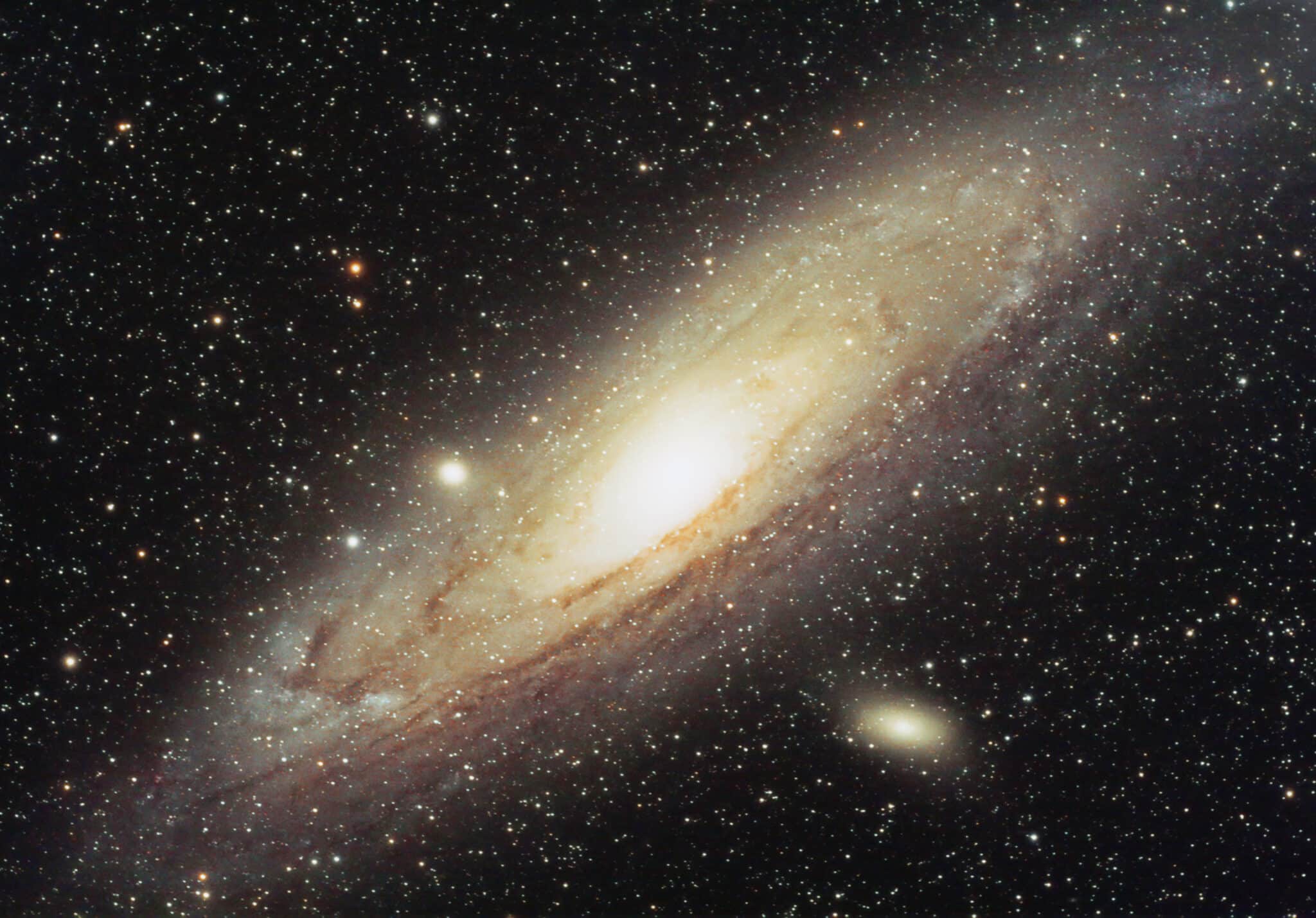
An odd asymmetry is sowing doubt in our understanding of the Universe. Our galactic neighbor, Andromeda, does not host its satellites in a balanced manner as cosmological models predict. In fact, almost all of its small satellite galaxies appear to be oriented… toward us. Coincidence? Perhaps not.
A universe expected to be symmetric… in theory
According to the standard model of cosmology — our dominant theoretical framework for explaining the structure and evolution of the Universe — large galaxies like the Milky Way or Andromeda grow by gradually capturing a multitude of small dwarf galaxies. These satellites, bound by their strong gravity, should then be distributed roughly randomly around them, forming spherical halos of dark matter and stars.
But what astronomers observe around Andromeda completely defies these expectations.
A lopsided family
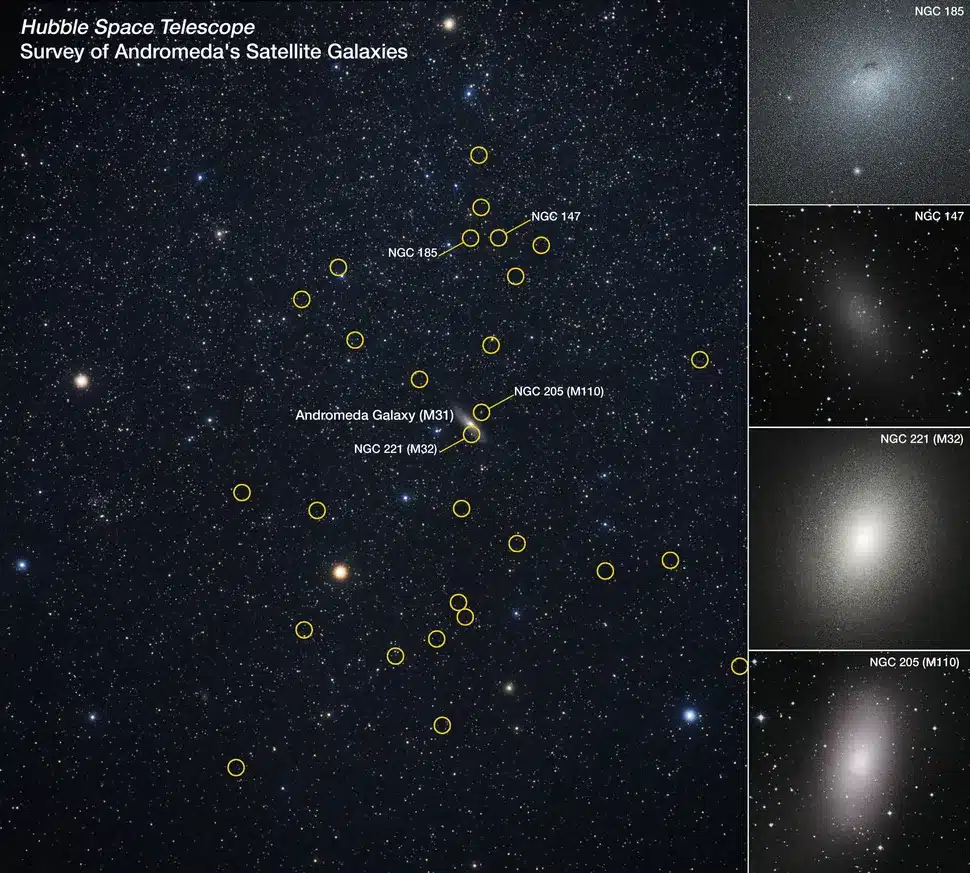
A team of researchers from the University of Potsdam, led by cosmologist Kosuke Jamie Kanehisa, studied the distribution of the 37 brightest satellites of M31 (Andromeda’s scientific name). Their finding: 36 of them lie on the same side of the galaxy — the side facing our Milky Way. The sole exception: Messier 110.
According to the simulations performed, such an asymmetry has less than 0.3% chances of occurring if one trusts the standard model. It isn’t impossible, but it borders on the inexplicable.
“ M31 is the only system to our knowledge that demonstrates a degree of asymmetry so extreme,” explains Kanehisa. This raises a fundamental question: if this phenomenon is not supposed to exist, why do we observe it?
An alignment too perfect to be a coincidence ?
This isn’t the first anomaly that Andromeda presents. For several years, astronomers have known that a large portion of its satellite galaxies do not form a sphere, but seem to be organized in a thin, flattened plane around M31. A similar phenomenon is observed around the Milky Way — and perhaps also around other nearby galaxies, such as Centaurus A.
But this directional alignment toward Earth is even more troubling. Simulations show that such a clustering, with all satellite galaxies on one side, is not expected to exist in a universe governed solely by the known laws of gravity and dark matter.
So, giant coincidence or hint of an unknown mechanism?
Des pistes… mais peu de certitudes
Une des hypothèses avancées par Kanehisa est qu’Andromède aurait vécu une fusion majeure il y a deux à trois milliards d’années. Cette collision avec une galaxie de taille intermédiaire aurait pu entraîner une perturbation importante, jetant un grand nombre de petites galaxies dans une configuration temporairement déséquilibrée.
Cette idée est séduisante, d’autant que le télescope spatial Hubble a récemment permis d’observer des flux d’étoiles désordonnés dans la structure de M31 — vestiges possibles de cette fusion. Mais même avec ce scénario, une question demeure : pourquoi tous les satellites se retrouvent du côté de la galaxie tourné vers la Voie lactée ?
Pourrait-il s’agir d’une influence gravitationnelle de notre propre galaxie ? Peu probable, répond l’équipe. La Voie lactée ne présente pas de déséquilibre similaire dans sa propre population de satellites, et les forces de marée entre les deux galaxies ne sont pas suffisamment puissantes pour provoquer un tel regroupement.
Toward a rethinking of the standard model ?
At this stage, researchers remain cautious. Several factors limit the reach of the current conclusions:
-
We only know the precise motions of 4 to 5 of M31’s satellites. New data, anticipated in the coming years thanks to the Gaia mission, should allow a better understanding of their trajectories over time.
-
There are probably many faint, undetected satellite galaxies that could rebalance — or worsen — this asymmetry if discovered. The faintest galaxy currently known around Andromeda, Andromeda XXXV, is actually… on the other side.
Kanehisa sums it up this way: “We have to wait and see whether the global asymmetry persists with the detection of new dwarfs. But if only the brightest are involved, that would raise a new question: why?”
What this puzzle says about our science
This anomaly, reported in Nature Astronomy, is more than a mere statistical detail. It tests one of the pillars of modern cosmology. If the Universe does not behave as predicted at our doorstep, it may be because our models do not yet describe the full history.
It also reminds us of a simple yet essential truth: sometimes our nearest neighbors hold the deepest mysteries.
And as is often the case in science, it will take time, patience, and data to understand whether this anomaly is a product of chance… or a sign that another paradigm awaits us.
Sources: Satellite galaxies gone awry: Andromeda’s asymmetrical companions challenge cosmology (aip.de) | Andromeda’s asymmetric satellite system as a challenge to cold dark matter cosmology (nature.com)
Article prepared with the help of AI · Our method
