
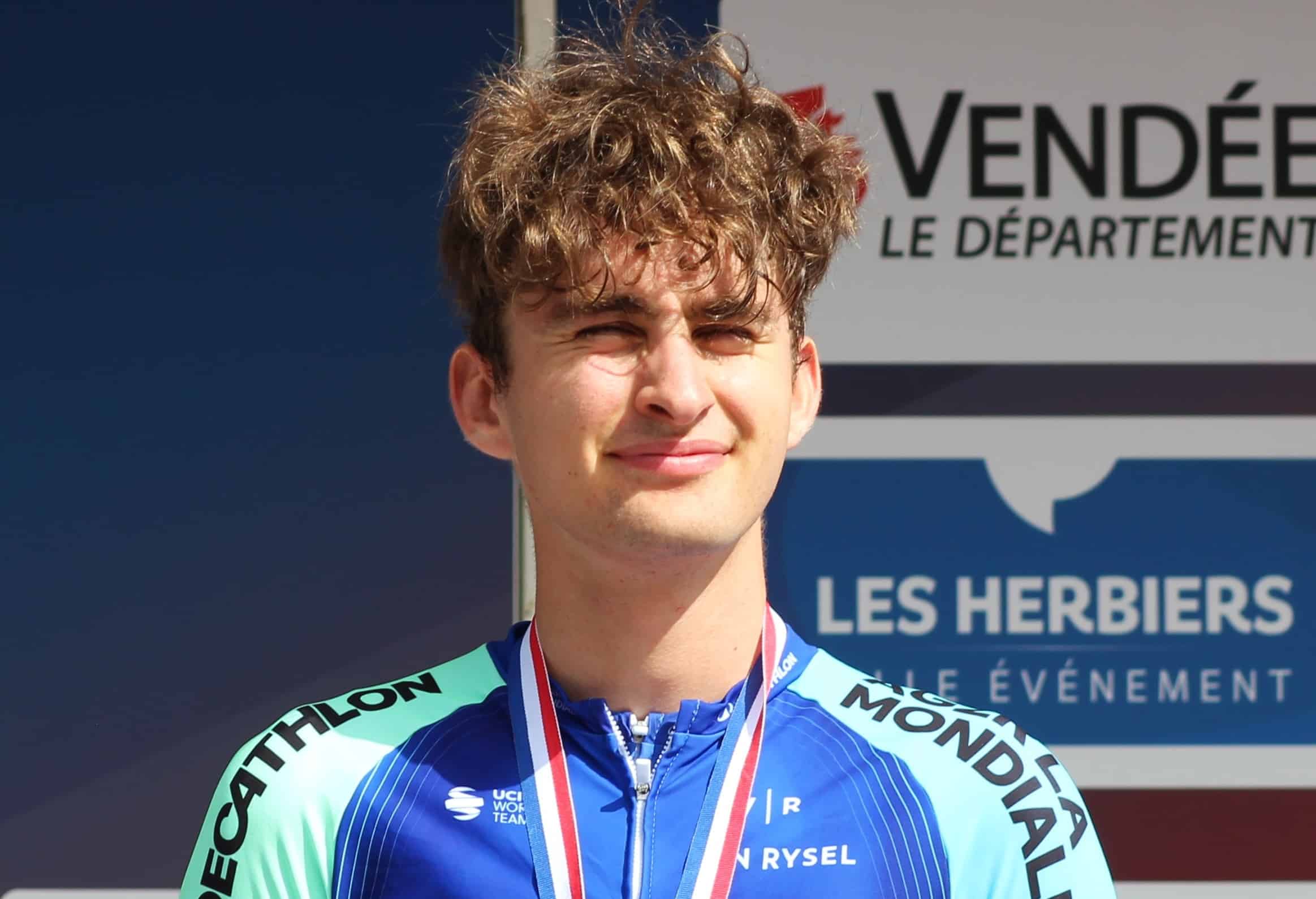
At the summit of a July-col burning under the sun, a nineteen-year-old outpaces riders who could be his older brothers. Paul Seixas, the Lyonnais prodigy, leaves everyone stunned. For a long time, people believed that this physical insolence was only a matter of relentless work, of miles swallowed, and altitude training. Yet his coach Arnaud Cornet points to a far subtler ingredient: a largely innate aerobic capacity, that no training could manufacture from scratch.
Behind every Seixas feat, a motor we cannot see at work
To watch him climb, you’d think a metronome had decided to ignore gravity. Seixas is already the youngest rider to start the Tour de France since 1937, and he crossed the starting line at nineteen years and nine months. This year, in his second professional season, he won the Tour of the Basque Country, becoming the first Frenchman to win a World Tour stage race since 2007. It’s enough to turn heads.
In the face of these results, the temptation is strong to explain it all by discipline. More work, still more work. But a engine, however finely tuned, is limited by its displacement. And that is precisely where the key lies. Christian Prudhomme, the head of the Tour, goes as far as to compare him to Bernard Hinault, claiming he has never seen a French champion like this since. The last French winner of the Tour de France dates back to 1985.
PMA deciphered: that five-minute figure changes everything
To understand, one must dwell on three letters that make sport physiologists tremble: PMA, for maximal aerobic power. In short, it is the power an athlete can sustain for about five minutes, when the body is consuming oxygen at full tilt. A kind of biological glass ceiling. The higher it is, the more watts the rider can push without suffocating.
Think of a car: training is the driver, the gearbox, the aerodynamics. But PMA, it corresponds to the engine size. You can refine the driving to infinity; a small displacement will never rival a big block. This five-minute figure explains why some talents soar while others, no matter how hardworking, plateau. And Seixas, evidently, possesses an exceptional engine.
Arnaud Cornet reveals the truth no one dares tell young talents
This is where the blunt gaze of his coach comes into play. According to Arnaud Cornet, this five-minute sustained maximal aerobic power is largely inherited, largely determined by genetics. In plain terms: you are born with it to a large extent, or you are not. Here lies the truth that few dare to articulate before adolescents dreaming of the yellow jersey.
This revelation is dizzying. It means that no training camp, no matter how intense, can grant a rider what the biological lottery denied him. You can polish, optimize, push back boundaries, but the foundation remains. Seixas thus received, at birth, a portion of his advantage. The rest is years of sweat that transformed him into a champion.
What training can really do when nature has already decided
Should we conclude that training is useless? On the contrary. If nature fixes the engine’s displacement, it is indeed the work that decides how this engine expresses all its power. Endurance, threshold, recovery, tactical management: all of this can be cultivated and often makes the difference between two athletes, even if they started with the same machinery.
Cycling has, moreover, seen the age of entry into the elite fall by a decade in twenty years, due to early detection and personalized training. Tadej Pogačar was twenty at his first Grand Tour, Remco Evenepoel twenty-one. Warren Barguil says it will become increasingly normal to see juniors explode at nineteen or twenty. Science now hones talents like never before, while never being able to manufacture the raw material from nothing.
So, observing Seixas crush the climbs this summer, let us remember that his talent rests on a delicate balance: a rare biological heritage, sublimated by methodical work. The real question, perhaps now, lies elsewhere: how far can an exceptional engine, entrusted to the finest performance engineers, push the frontiers of world cycling?
Source: PAUL SEIXAS: a fast ascent! Revolution in cycling? (velonews.be)
Article prepared with the help of AI · Our method
