
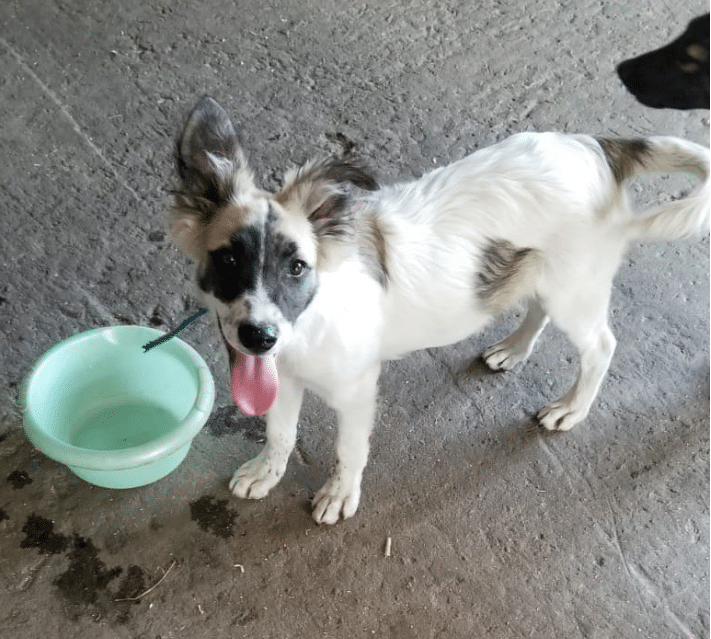
The Clean Futures Fund, an animal protection organization, recently launched a rescue and adoption program to give the dogs of Chernobyl a second chance. About fifteen puppies have already found a new home.
At dusk, the packs of Chernobyl dogs howl at the Moon. During the day, some bask in the sun, while others chase the hundreds of workers who come every morning to clean up the remnants of the nuclear power plant accident. These humans, who share their meals with them, provide their main source of food.
These dogs — more than a thousand, according to estimates, descended from animals abandoned during the disaster — live in harsh conditions. Most of them don’t even reach four years old. “If we see a five-year-old dog, we call him grandpa,” explains to Neesweek Lucas Hixson, environmental radiologist in Chernobyl. “Their main threat is not radiation, he says. It’s the freezing temperatures. Those who survive winter must face predators such as wolves and wild boars roaming freely in the exclusion zone.”
That is why The Clean Futures Fund, an organization co-founded by Hixson, launched a rescue and adoption program to give these dogs a second chance. In early July, around fifteen dogs arrived in New York, ready to meet their adoptive families.
Before the dogs arrive in their new homes, radioactive dust is brushed off their coats. They are then quarantined for a few weeks and undergo a thorough examination. “They no longer pose any significant risk to anyone handling them,” assures biologist Tim Mousseau. Some dogs ingested small amounts of radioactive cesium-137 particles, one of the main contaminants present at Chernobyl. But this particle is metabolized and removed from an animal’s system after weeks — or at most a few months — when fed a non-contaminated diet.
All dogs in the adoption program are neutered (no possibility of passing on their genes). Among them you will find Freddy, three months old, found in a maintenance hangar a few steps from the nuclear reactor — the very one that exploded on April 26, 1986. There is also Dvaa, (“two” in Russian), adopted by Lucas Hixson: “She has a really beautiful and curious personality,” says he “She has definitely stolen my heart”. She now lives in the suburbs of Chicago.
“Animals play an important role in our lives. I think that until you have an animal, it is very hard to understand how much they can mean to you, how much they can provide. It’s an incredible symbiotic relationship,” the researcher concludes. “These dogs are like any other puppies. They love attention. They need love.”
Source
Related articles:
