
On November 14, 2023, Voyager 1 ceased sending readable scientific data from interstellar space. The signal continued to arrive, but with no exploitable content: the probe had suddenly and unexpectedly stopped transmitting scientific and technical data to Earth, triggering a months-long diagnostic process on a spacecraft billions of miles away. A blank radio signal. Like receiving a sealed envelope containing only a blank sheet, 46 years after the mailman first departed.
A Desktop Calculator-Sized Computer, 24 Billion Kilometers Away
Voyager 1 carries three onboard computers built in the 1970s. The “Flight Data Subsystem” (FDS) collects scientific and technical data, aggregates it, and then transmits it to the radio unit. With only 68 kilobytes of total memory, the FDS processes about 8,000 instructions per second. A modern smartphone handles roughly 100 billion. This is the computing hardware engineers at NASA’s JPL had to work with to repair the most distant spacecraft in human history.
In April 2024, engineers determined that the fault lay in a memory bank of the FDS, likely struck by a high-energy particle or simply worn after 46 years of service. The FDS no longer communicated correctly with the telemetry modulation unit, which began emitting a repetitive sequence of ones and zeros indicating a locked state. In plain terms: the probe was indeed sending a radio signal, but that signal carried only noise.
A diagnostic command sent in March 2024 established that about 3% of the FDS memory had been corrupted. Three percent. The figure may seem small, but the total memory is only 68 kilobytes, and there was no room to squeeze in an extra 256 bits. To grasp the scale, it was like trying to repair the heart of a commercial airliner by manipulating the equivalent of half a page of text.
A Surgical Intervention with a 45-Hour Delay
Unable to repair the defective chip, the team decided to move the affected code to other areas of the FDS memory. But no single location could hold the entire code: they devised a plan to split it into segments and store them in different spots within the FDS. A software puzzle reconstructed across the interstellar void.
To make it work, engineers also removed code that had become unusable, for example instructions used to transmit Jupiter data, which were incompatible with the current transmission rate. A calculated sacrifice. The command was sent on April 18, 2024. A signal takes about 22 hours 30 minutes to reach Voyager 1, and the same amount of time for the reply to come back to Earth. On April 20, the team found that the change had worked: for the first time in five months, they could verify the spacecraft’s health. Forty-five hours of waiting to know whether a remote software repair had succeeded. Few occupations demand this level of patience.
On May 22, NASA announced that Voyager 1 had resumed transmitting scientific data from two of its four instruments. On June 13, it confirmed that the probe was again transmitting from all active instruments. The crisis seemed resolved. But the story did not end there.
The Impossible Balance: Repair the Probe or Shut It Down Piece by Piece
In October 2024, the probe turned off its X-band radio transmitter, the main channel to the Deep Space Network, following an automatic trigger from the protection system. The data rate dropped, but the signal was recovered. Then, on October 19, the transmission stopped again, and the system switched to the S-band transmitter, the one that had not been used since 1981. Each solution leads to a new problem.
In September 2024, NASA carried out a “thruster swap,” moving from a cluster of clogged thrusters to others less obstructed that had not been used since 2018. In May 2025, the team managed to revive the backup thrusters for roll motions, unusable since 2004. We are not talking about new hardware: dormant parts are awakened after twenty years, in the hope that they still respond.
The real adversary is energy. Each year, Voyager 1 loses about 4 watts, forcing engineers to deactivate nonessential instruments to preserve communication. At launch in 1977, its three generators produced a total of 470 watts; this figure had fallen to 250 watts by 2023. On February 25, 2025, Voyager 1’s cosmic ray detector instrument was deactivated. By 2026, only two instruments remained operational: the plasma wave subsystem and the magnetometer.
Between May 2025 and February 2026, Deep Space Station 43 in Canberra, Australia, the sole antenna able to send commands to Voyager 1 and 2, was out of service for major renovations, with only brief operational windows in August and December 2025. This created a critical constraint for engineers, who had to revive the backup thrusters before any total loss of communication. During these months, the team could hear the probe speak, but could not reply.
What the Probe Still Murmurs From Interstellar Space
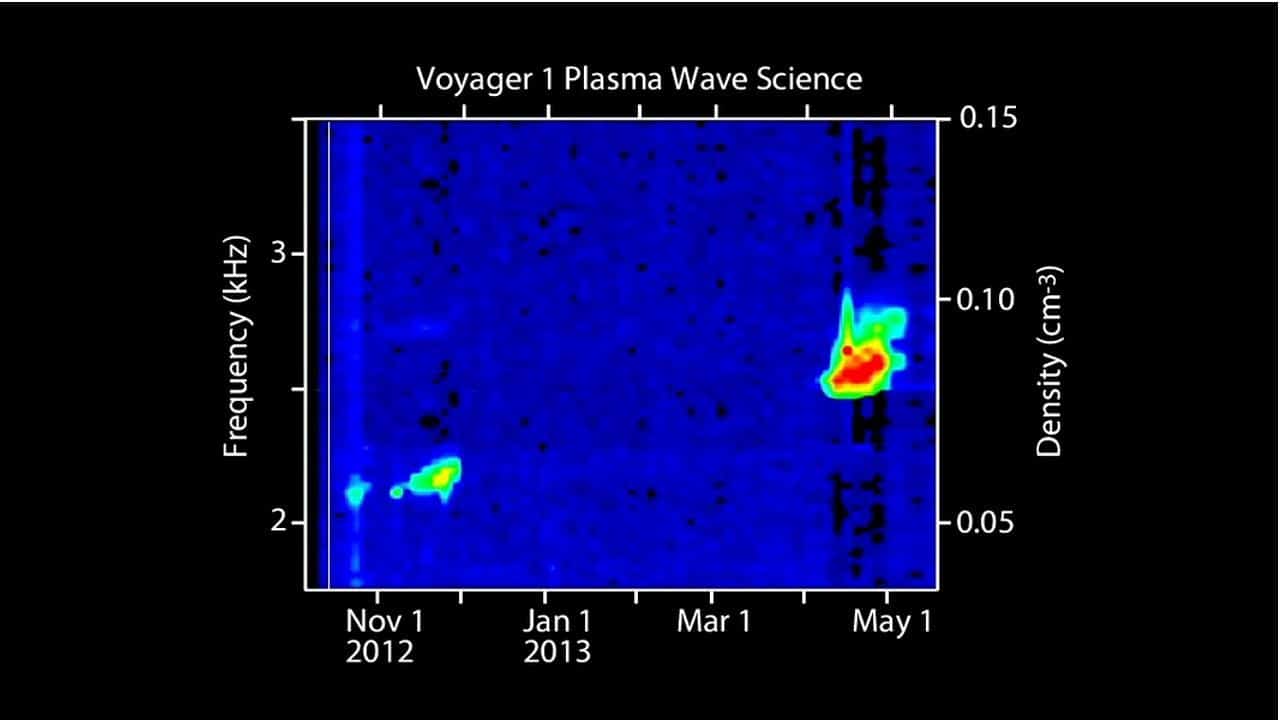
Voyager 1 measures plasma waves and magnetic fields in a region no other instrument has ever reached. Those data remain unique in the world, which justifies every rescue operation, however perilous. JPL teams are currently working on a reconfiguration plan nicknamed “Big Bang,” aimed at rerouting some older systems through less energy-intensive alternatives. Tests are planned on Voyager 2 in spring 2026; if those tests are successful, a similar operation could be launched on Voyager 1 as early as July.
In addition, the probe is approaching a milestone no one expected at launch: by mid-November 2026, it will become the first human-made object to be exactly one light-year from its starting point. Its radioisotope thermoelectric generators could provide enough energy to transmit technical data until around 2036. What no one predicted, however, is that mission engineers would be debugging code written before the birth of some of them in 2026, using yellowed technical manuals, knowing that the original designers are largely dead or retired, and only a few aging specialists still master the programming languages of the era.
Sources: Voyager 1 will reach the distance of one light-day in 2026 (hellobiz.fr) | Voyager 1, the legendary probe, is about to cross the historic milestone of the light-day (enerzine.com)
Article prepared with the help of AI · Our method
