
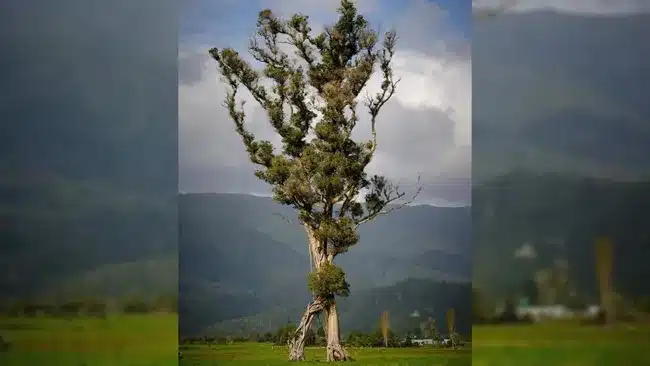
An unusual North rātā tree, nicknamed “the walking tree,” has been crowned New Zealand Tree of the Year 2024. This centuries-old tree, which seems to stride across a vacant field with its trunk-like limbs, bears an uncanny resemblance to an Ent from The Lord of the Rings.
A Remarkable Tree
The North rātā (Metrosideros robusta) is among the tallest species of flowering trees in New Zealand. It can live up to 1,000 years. With its roots and long, arm-like branches, one of these giant trees with a strikingly unusual appearance stands alone in the middle of a large enclosure near Karamea, on the West Coast of the South Island. According to the New Zealand Tree Register, it stands at roughly 32 meters tall, about the height of a seven-story building.
This walking tree won 42 % of the public vote during the 2024 edition of the New Zealand Arboricultural Association (NZ Arb) Tree of the Year award, surpassing five other finalists.
A Fascinating Story
We do not know the exact age of this North rātā. We only know that it is the sole survivor of a forest cleared about 150 years ago by a family of farmers.
Note that North rātā are epiphytes — a type of tree that is born and begins life on the surface of another tree, called the host. Initially, these trees grow in the canopy of their host, feeding themselves from the air and rainwater. Over time, they develop aerial roots that extend down to the ground, enabling them to establish themselves independently.
In the case of the walking tree, the distinctive arrangement of its roots results from its growth around its host, which would likely have followed a structure that is no longer present today.
A Threatened Species
North rātā are endemic to New Zealand and used to be among the most common tree species in the country’s forests. However, their distribution has diminished over recent decades. They are now listed as nationally vulnerable, according to the New Zealand Plant Conservation Network.
In addition to deforestation, the principal threats facing the North rātā include the invasive common possums (Trichosurus vulpecula), which strip leaves and gnaw at roots.
These trees are also threatened by hybridization with pōhutukawa (Metrosideros excelsa), to which they are closely related. Finally, they are sensitive to Myrtle rust (Austropuccinia psidii), a pathogenic fungus native to South America.
