
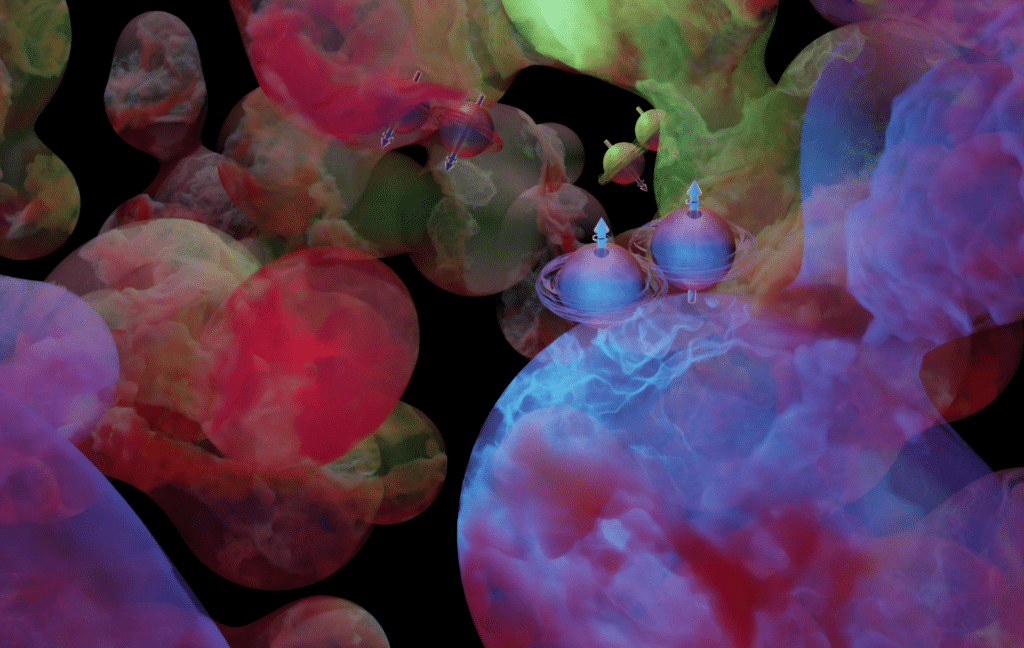
It is one of the most dizzying concepts in modern physics: absolute emptiness does not exist. Even if you removed every atom, every beam of light, and every wave from a box, there would still be “something.” In quantum mechanics, the vacuum is described as a bubbling soup of energy where phantom particles appear and vanish incessantly. Until now, this concept largely belonged to mathematical theory. But for the first time, a team of American physicists has captured direct experimental evidence of this passage from the phantom realm of “vacuum” to our tangible material reality.
The vacuum is a crowded waiting room
To grasp the scope of this discovery published in the prestigious journal Nature, one must shift our view of “nothing.” The quantum vacuum is not a dead space. It is saturated with fluctuating energy fields that give rise to pairs of virtual particles and antiparticles.
Why “virtual”? Because they are ephemeral. They spring from the vacuum and annihilate each other almost instantaneously, so quickly that they cannot normally be detected or interact with matter. They are there, without being there. The challenge for physicists was immense: how to transform these ghosts into tangible matter? The answer lies in a famous equation (E=mc²): one must inject enormous energy to “freeze” these fluctuations and render them real.
The experiment: smashing protons at near-light speeds
It happened at Brookhaven National Laboratory (United States), inside the Relativistic Heavy Ion Collider (RHIC). The researchers of the STAR collaboration induced millions of collisions between protons propelled at speeds close to that of light. The violence of the impact unleashes so much energy that it can literally yank particles out of the vacuum.
In this subatomic chaos, the scientists tracked two very specific kinds of particles: lambda hyperons (matter) and anti-lambdas (antimatter). These particles are valuable because they act as “black boxes”: as they decay, they reveal information about their birth.
Quantum twins with aligned spins
By analyzing the debris from millions of collisions, the team noticed a fascinating statistical anomaly. Normally, in such a crash, the particles should be oriented randomly, like wild tops. Yet the researchers found that when lambda and anti-lambda pairs are born very close to one another, their spins (their direction of magnetic rotation) are perfectly aligned and correlated.
Jan Vanek, a physicist at the University of New Hampshire and a co-author of the study, uses a vivid image: “It’s as if these particle pairs were initially quantum twins.”
The vacuum’s signature revealed
That alignment is no accident. It is the unequivocal proof of the particles’ origin. If they had been born from simple classical interactions, their spins would be disorderly. The fact that they are perfectly synchronized indicates that they come directly from a pair of virtual quarks entangled within the vacuum. In short: before becoming real matter, these particles were already bound in the “void.” By transitioning from virtual status to real status thanks to the collision’s energy, they retained the “memory” of their original quantum link.
A bridge between two worlds
This discovery is historic because it establishes an experimental bridge between quantum physics (the world of the infinitely small and probabilities) and the visible matter that makes up our bodies and the stars. However, the link is fragile.
The study shows that this quantum correlation vanishes as soon as the particles move apart or interact with the environment. The vacuum’s “memory” fades, giving way to classical physics.
Zhoudunming Tu, a Brookhaven Laboratory physicist, summarizes the general excitement: “This work offers us a unique window into the quantum vacuum. It could usher in a new era in how we understand the formation of visible matter.” It is a key piece of the puzzle for understanding the very first moments of the Universe when the primordial vacuum gave birth to all that exists.
Sources: Scientists Capture a Glimpse into the Quantum Vacuum (bnl.gov) | Measuring spin correlation between quarks during QCD confinement (nature.com)
Article prepared with the help of AI · Our method
