
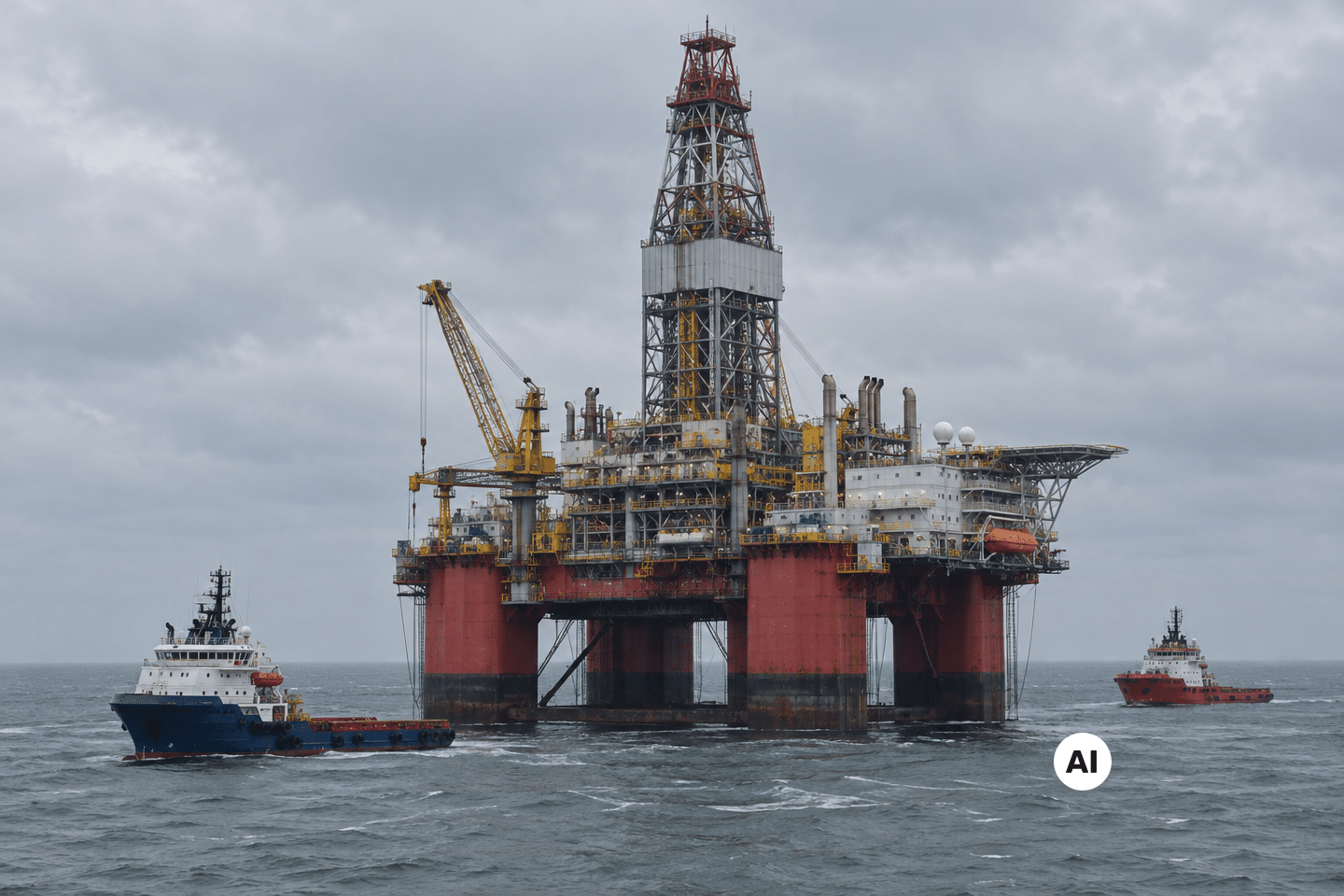
Close to 6,000 meters beneath the waves of the Bohai Sea, China has just secured a natural gas deposit of notable magnitude. CNOOC has succeeded where extreme heat and volcanic rock made predictions precarious. A technical achievement that redraws the frontiers of offshore exploration worldwide.
A well at 5,770 meters depth that upends the codes of offshore exploration
CNOOC, the Chinese national offshore oil company, has just announced the discovery of a high-yield hydrocarbon well. It sits in the deep formations of the central Bohai Sea, near the Bozhong Sag, the largest hydrocarbon-rich depression in that sea.
The figure is dizzying: 5,770 meters, or 18,930 feet below the surface.
At this depth, every meter drilled represents an engineering challenge, far beyond the usual standards of the offshore oil industry.
During testing, the well produced about 800,000 cubic meters of natural gas per day. The productive zone exceeds 120 meters in thickness, directly within the volcanic rock, a milieu notoriously difficult for this type of operation.
According to Xu Changgui, the chief geologist at CNOOC, this discovery opens a new path for ultra-deep offshore natural gas exploration.
La technologie maison qui permet à la Chine de contourner les géants occidentaux
It is worth recalling the geopolitical context in which this feat unfolds. CNOOC appears on several American commercial blacklists, namely the Department of Commerce’s Entity List and the Pentagon’s Section 1260H. These restrictions greatly limit its access to oilfield services, specialized software, and deepwater drilling equipment developed by Western industry giants.
Concretely, players such as SLB, Baker Hughes, or Halliburton remain out of reach for the Chinese company on this type of project. A major obstacle, since these firms have historically dominated deep-drilling technologies on a global scale.
CNOOC therefore had to develop its own tools in-house. The company has developed wide-band, multi-source 3D seismic technologies, as well as new methods for identifying high-quality reservoirs in what geologists call ultra-deep buried hills — complex rock structures that are difficult to map.
Reaching nearly 6,000 meters of depth without relying on these Western suppliers illustrates an embraced technological autonomy. This advance fits into a broader strategy: a five-year plan led by the NDRC and the National Energy Administration aiming for 440 million tonnes of oil and gas equivalent by 2030. Offshore oil production in China rose by 3.5% year-on-year in the first nine months of 2026, according to the Ministry of Natural Resources.
Chaleur extrême et roche volcanique : la face cachée d’un exploit sous haute pression
However, drilling to such depths comes with numerous challenges. Behind the official announcement lies a formidable technical reality that CNOOC teams had to tame step by step.
At around 6,000 meters, the heat becomes extreme. Tectonic activity is intense, and the rock structures prove so complex that reservoir prediction becomes particularly difficult. Imagine trying to guess the shape of a cake by only looking at scattered crumbs — that is somewhat the exercise geologists undertake with these buried formations.
The volcanic rock adds another layer of difficulty, making drilling and estimating gas volumes more complex.
It is precisely to meet these constraints that CNOOC’s in-house seismic tools prove their value. Without a precise subsurface map, no reliable prediction would have been possible in such a hostile environment.
This discovery beneath the Bohai Sea illustrates how deep offshore exploration has become a field of innovation in its own right, where technological mastery matters as much as geological luck.
Source : Reuters
Article prepared with the help of AI · Our method
