
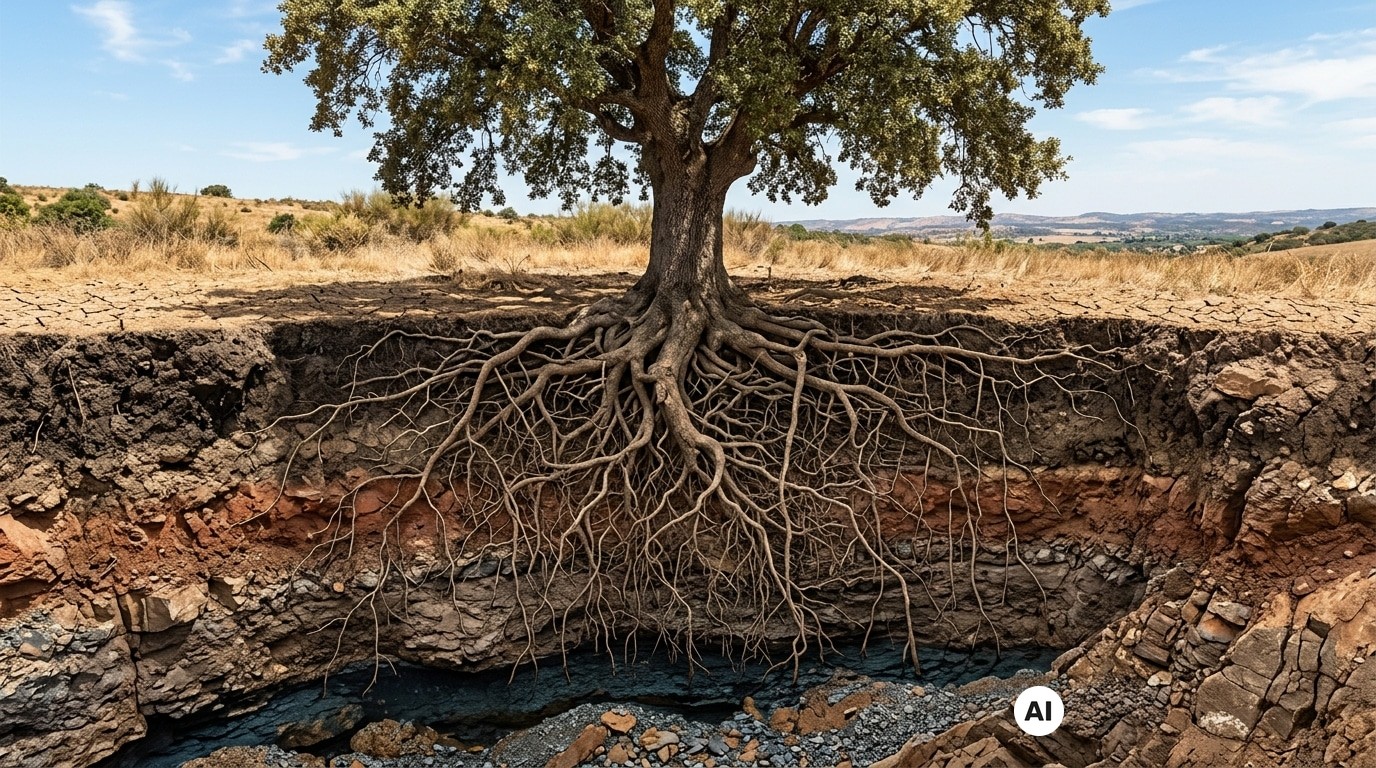
A meter for most trees, over 70 meters for the extreme cases. The reference synthesis, published in the PNAS journal in 2017, compiled 2,200 observations across more than 1,000 species. Rooting depths range from less than 1 centimeter to more than 70 meters, with a frequency peak around 1 meter. The depth reached depends less on the species than on water, oxygen, and soil structure.
The most well-documented record belongs to a tree in the Kalahari.
Records beyond 70 meters, but a much more modest norm
It concerns Boscia albitrunca, the shepherd’s tree, whose roots descend to more than 70 meters. They were discovered by chance, by well drillers. Roots exceeding 20 meters have also been found in caves. Since these discoveries are accidental, the authors of the study consider the deepest roots likely undersampled.
These records do not describe the daily life of a forest. For most trees, roots rarely exceed 1.5 meters in depth, and the bulk of the root system lies within the first 50 centimeters.
Literature syntheses point in the same direction. The study by Canadell and colleagues, published in 1996 and covering 253 woody and herbaceous species, shows that tree roots can exceed 1 meter. They reach several meters in deep, well-drained soils, and stay shallower elsewhere.
Measuring a deep root remains slow, costly, and often destructive.
What drives roots downward: water, air, and the nature of the soil
The terrain’s relief and hydrology weigh more than genetics. In high, well-drained uplands, roots descend to the infiltration depth of rainfall. In waterlogged lowlands, they stay near the surface to avoid oxygen shortage beneath the water table. Between the two, high tree productivity and drought can push roots several meters deep, down to the capillary fringe, the saturated zone just above the water table.
A same species, under the same climate, can thus root at very different depths depending on its position in the landscape. The 2017 study provides examples where individuals of the same species stop near the water table, yet at contrasting depths.
A more recent compilation, published in the Ecography journal, gathered more than 2,400 observations covering over 130 plant families. Worldwide, climate is the primary driver of deep roots, and deep roots are often found in water-scarce regions. Trees root deeper than shrubs. In high-altitude zones, it is not always the water table that matters, but the water stored in the unsaturated zone of the soil.
Three conditions are necessary for a root to progress: water, oxygen, and soil that is not too compacted, or that has sufficiently large voids. All three are present in deep, loose soil, rarely in urban soil. All trees are genetically capable of sinking their roots by several meters, but urban soil compaction often prevents it.
A few deep roots are enough to weather the summer
A fine root captures water only within a radius of 1 to 10 centimeters around it.
Among forest species, a very small amount of deep fine roots can nonetheless provide decisive access to water reserves during drought, when the upper horizons are dry. The abundance of roots and their efficiency do not go hand in hand. A rare, well-placed deep root is worth more than a dense surface network when summer arrives.
Measurements in the tropical forest of Guyana illustrate how this translates in the field. On a soil with vertical drainage, Eperua falcata draws water to at least 3 meters deep, while Dicorynia guianensis relies mainly on the upper horizons. On a soil with shallow and lateral drainage, both species’ root systems are less deep, but Eperua falcata still taps at 2 meters. The hydric status of the two species remained stable between the dry season and the rainy season, despite these different strategies.
In climates with a dry season, some plants develop dimorphic roots: a shallow group that exploits rainfall, and a deep group that seeks groundwater. A single tree can thus drink at two levels.
It remains to contextualize the averages. A review dedicated to deep water uptake by trees cites, for global forest ecosystems, an average rooting depth of 7 meters (plus or minus 1.2) and a maximum exceeding 40 meters. These values describe how far the roots venture, not where water uptake is greatest, which explains the gap with the meter around which most roots are concentrated.
Sources: pubmed.ncbi.nlm.nih.gov | Complementary N Uptake Strategies between Tree Species in Tropical Rainforest (ncbi.nlm.nih.gov)
Article prepared with the help of AI · Our method
