
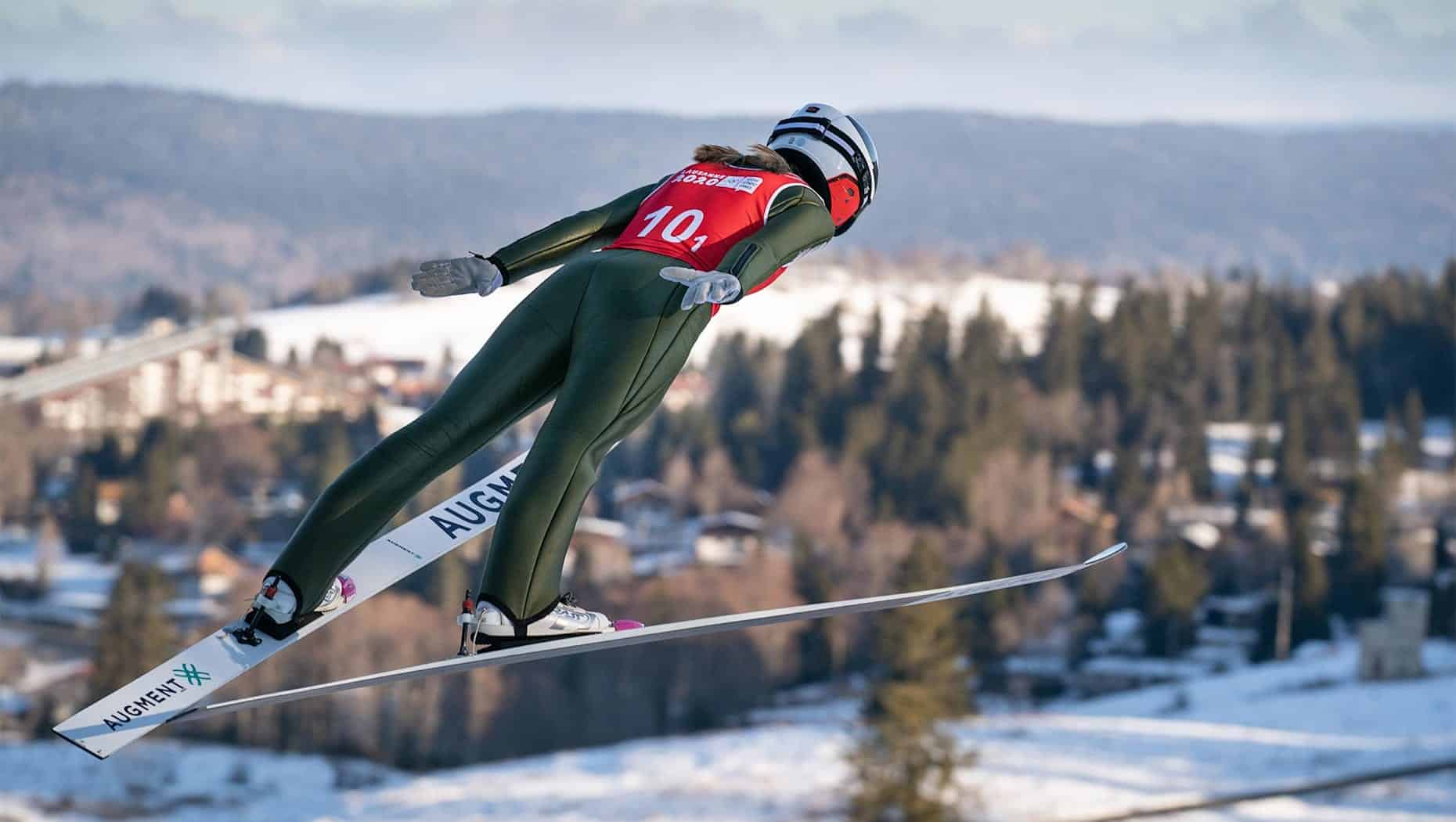
Between the final of the individual event on Saturday, February 12 (won by the Norwegian Marius Lindvik) and the team event on Monday, ski jumpers have once again delighted us. But how do they manage to “fly” so far?
Gravity, Lift, Drag
Ski jumping is perhaps one of the most fascinating events at the Winter Olympic Games. The principle is simple: the winner is the athlete who glides the farthest while delivering the best landing. By means of several techniques developed to work with the laws of nature, ski jumpers are capable of fighting gravity for five to seven seconds while they sometimes travel more than a hundred meters. How do they do it? Three major concepts in physics come into play: gravity, lift, and drag.
Gravity pulls any object in flight toward the ground. It is inescapable. To try to delay the moment, athletes interact with the air as they move. This interaction generates lift. As they move through the air, the surface of an object collides with air particles, pushing them downward. The object is then pushed upward according to Newton’s third law of motion, which states that for every action there is an equal and opposite reaction.
If the lift force balances roughly the gravity force, an object can then glide. To produce lift, you must be in motion. Several factors can then increase this upward force: increasing speed, increasing surface area, or the angle of attack.
The same collisions between an object and the air that provide lift also produce drag, whose job is to resist forward motion of any object, which has the effect of slowing it down. As speed decreases, lift also decreases, limiting the duration of a flight.
Concretely, in ski jumping, the objective is to use a careful body positioning to maximize lift while minimizing drag as much as possible.
Speed and Technique
To begin, the skiers must first reach maximum speed by sliding down a slope. They minimize drag by crouching and carefully steer to reduce friction between the skis and the ramp. By the time they reach the “end of the line,” some can reach 96 km/h. Just before reaching the end of the ramp, which is inclined downward by about ten degrees, the athletes jump. Note that the landing slope is designed so that the jumper is never more than four meters above the ground.
Once in the air, jumpers do everything they can to generate as much lift as possible while minimizing drag. To improve their chances, the athletes align their skis and their bodies nearly parallel to the ground and set their skis in a V shape just outside the body’s outline.
As drag gradually slows the skier, lift decreases. The athletes then begin to fall faster and faster before finally touching the ground, overwhelmed by gravity.
With so much physics at play, many other factors can also affect the quality of a jump, such as wind. You will notice, moreover, that officials sometimes move the starting point up or down the slope depending on the wind speed. Indeed, stronger headwinds will generate more lift and lead to longer jumps that are more likely to cause the jumper to land beyond the designated area.
The length of the skis is also regulated. This length is tied to the jumper’s height and weight. Specifically, skis may measure up to 145% of the jumper’s height, while skiers with a body mass index below 21 must wear shorter skis. Finally, jumpers must wear tight-fitting suits to ensure that clothing does not generate additional lift.
