
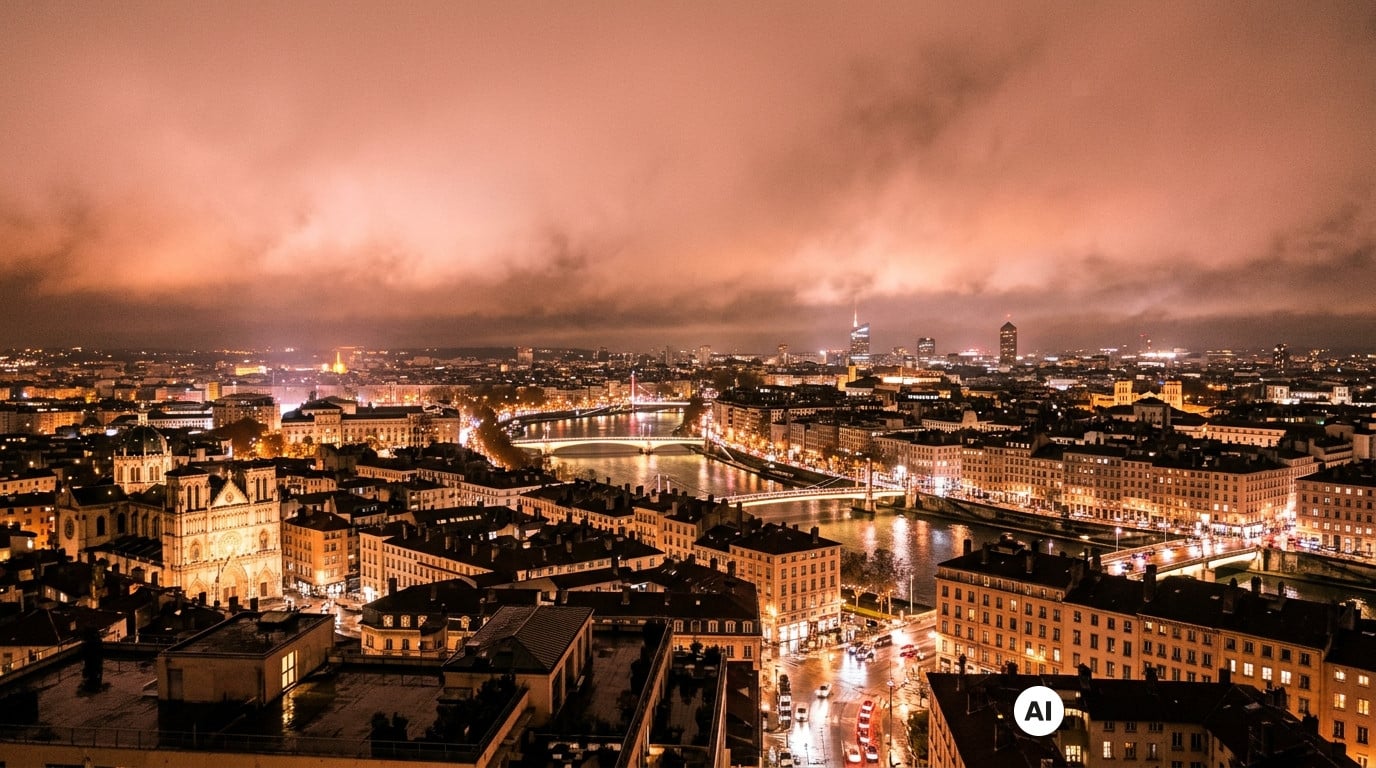
A Night Sky That Changes Its Face Based on What Lights It
Important clarification: the sky does not systematically become brighter when clouds roll in; it depends entirely on where you are. In the countryside, far from any city, clouds tend to darken the night by obscuring the stars. But near urban areas, the opposite happens: clouds can bounce back to the ground a portion of the artificial light produced by city lighting, thereby amplifying the perceived brightness of the night sky. This phenomenon, highlighted by a team from the Free University of Berlin and the Leibniz Institute of Freshwater Ecology, deserves closer attention.
Clouds Play an Inverted Role Between Countryside and City
This reversal lies at the heart of the scientific discovery. Researchers established that the effect of clouds on the brightness of the night sky depends entirely on the local light environment. In rural areas, far from any light pollution, clouds retain their usual role: they block the light from stars and plunge the night into deeper darkness, as one might expect. By contrast, near a city center, urban lighting changes the game completely. The artificial light emitted skyward by urban lighting hits the base of the clouds and then travels back toward the ground, creating a halo more intense than a perfectly clear sky. Concretely, the closer you are to a city, the more clouds become amplifiers of light rather than protective screens.
Berlin Quantifies the Extent of This Light Amplification
To quantify this phenomenon, the team led by physicist Christopher Kyba, from the Institute of Spatial Sciences at the Free University of Berlin, and ecologist Franz Hölker, head of the Loss of the Night project, installed devices called Sky Quality Meters at two different locations. One was 10 kilometers from central Berlin, the other 32 kilometers away. Over five months, in the spring and summer of 2010, the researchers recorded the sky brightness at these two stations. The results, published in 2011 in the journal PLoS ONE, are unequivocal: at the site closest to Berlin, the sky brightness was amplified by a factor of 10.1 when the sky was clouded compared to a clear sky. At the more distant site, located 32 kilometers away, this amplification dropped to 2.8. Caution is warranted with these figures: they describe the exact sites and conditions studied around Berlin, and do not mean that every cloudy night in France becomes automatically ten times brighter. They do, however, give a concrete sense of the magnitude this phenomenon can take near a major urban area.
The Phenomenon Upends Our Understanding of Light Pollution
This finding has implications beyond mere scientific curiosity. Until now, studies on light pollution largely relied on satellite measurements taken under clear skies. Yet these measurements completely neglected the amplification produced by clouds, a phenomenon far from trivial when assessing the impact of artificial light on humans and ecosystems. A takeaway: an urban cloudy sky can actually expose residents, wildlife, and flora to nocturnal brightness far more intense than traditional satellite data suggested. This changes how ecologists and researchers must think about the biological impact of urban lighting on humans and ecosystems.
Toward Global Monitoring of Night Sky Brightness
In response to this finding, the Berlin researchers developed software that can quantify this cloud-related amplification with precision. Their aim goes beyond Berlin: they want to expand this detection network to a global scale. To achieve this, the team issued a call to other scientists, but also to willing citizen volunteers, to build a worldwide database of nocturnal sky brightness. The appeal of this participatory approach largely rests on the tool used: the Sky Quality Meter is inexpensive and easy to use, enabling a broad public to contribute to this monitoring without sophisticated equipment. A welcome development for anyone who wants to understand, no matter where they live, how local lighting shapes the night above their head.
Ultimately, this phenomenon reminds us of a simple truth: the night sky never exists in isolation; it always reflects what is happening on the ground. The next time clouds settle over a city, a quick glance will reveal whether the sky looks brighter than usual, a subtle but telling sign of how much artificial light we are sending, often unconsciously, toward the sky.
Article prepared with the help of AI · Our method
