
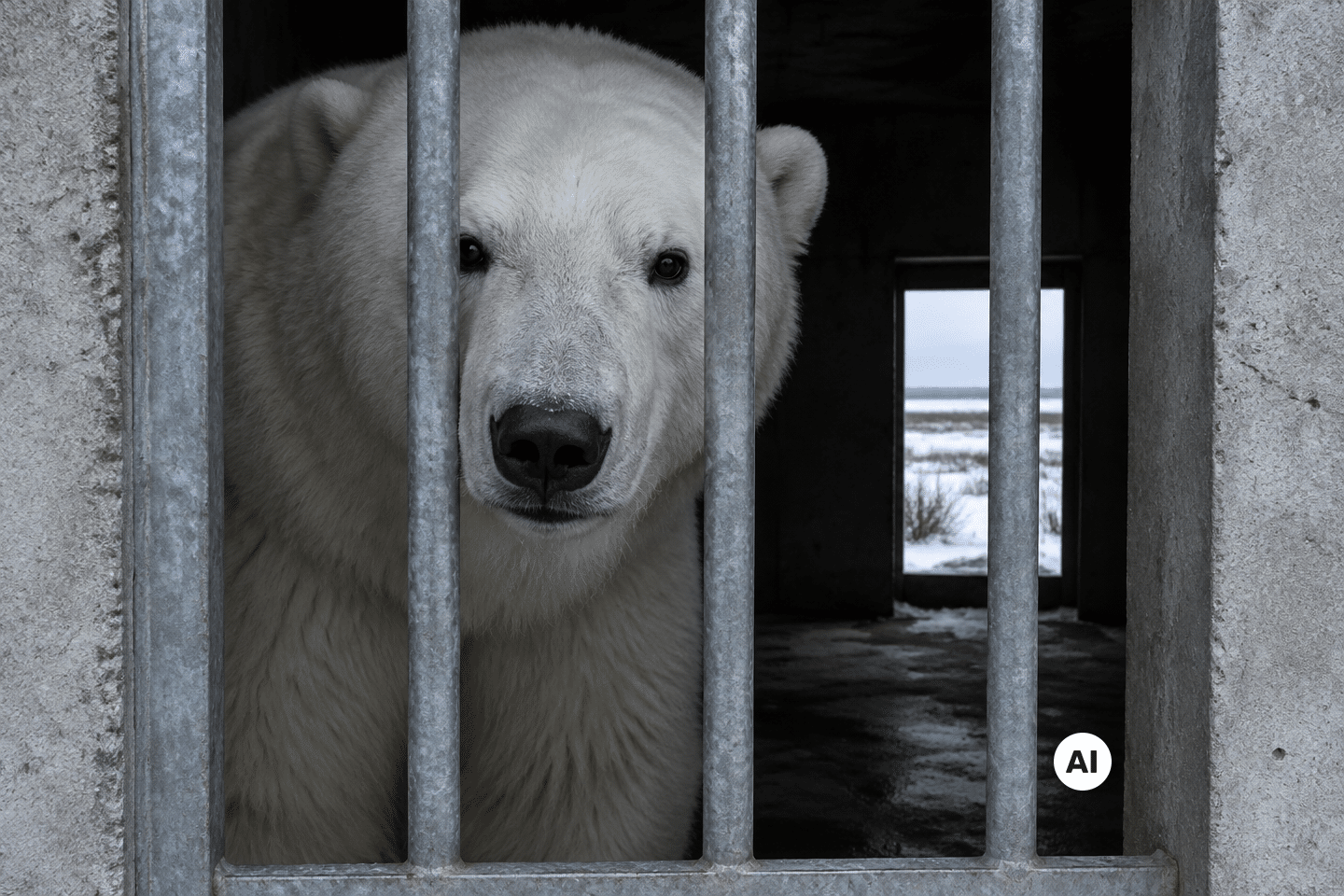
In Churchill, Manitoba, a polar bear captured amid the town does not head straight to the tundra. It is escorted to an old military hangar repurposed as a detention center, where it may endure up to thirty days without a single bite before being released well away from homes. This arrangement replaced the systematic shooting practiced a few decades earlier.
A military hangar transformed into a prison for bears
Churchill holds a distinctive place on Canada’s map. This small Manitoba town sits squarely along the migratory corridor of polar bears, who frequently stroll its streets while waiting for Hudson Bay to freeze over. This forced coexistence has long led to tragedy, until authorities found a solution radically different from shooting.
The building chosen to house bears deemed too close to residences is hardly a purpose-built facility. It is an old military hangar on the town’s edge, near the airport. Rather than tear it down, local authorities opted to repurpose it, giving birth to the Polar Bear Holding Facility, which residents jokingly refer to—though with grim humor—as the polar bear jail.
The facility opened in 1982 and welcomed its first inmate that same year. Before then, a bear considered dangerous or too persistent around homes had only one fate: to be shot. The creation of this center provided an unprecedented alternative, temporarily neutralizing the animal without killing it, giving time to remove it from the urban area.
28 cells and up to 30 days of forced fasting for white-furred intruders
At its inception, the center housed twenty cells, sixteen reserved for solitary bears and four for family groups. As captures increased, capacity was expanded to twenty-eight cells in 2014. The cells are built with concrete blocks, a material chosen for its sturdiness against the strength of an animal weighing hundreds of kilograms.
Two cells are specifically set aside for females with their cubs, to minimize stress from the proximity of unrelated individuals. Several other cells are climate-controlled, a precaution essential during summertime captures, where heat can quickly become dangerous for an animal adapted to polar cold.
Perhaps the most striking aspect of the protocol is the complete absence of food. Bears are given water, but nothing to eat for the entire detention period. The aim is clear: prevent the animal from associating human presence with an easy food source, a conditioning that would inevitably lure it back to the town once released.
The length of stay ranges from two to thirty days, depending on the case. A bear captured only once tends to serve a shorter sentence, while a repeat offender may face a longer detention. This graduated approach acts almost like a deterrent, even though the animal cannot comprehend the reasoning behind it.
Why Churchill releases its prisoners far from any civilization
This detention center does not operate in isolation. It is part of the Polar Bear Alert Program, a scheme run by the Manitoba Conservation Officer Service, tasked with responding to bear sightings around the clock. As soon as an animal comes too close to settlements, a team captures it and transfers it to the hangar.
Once the detention period ends, the bear is not released anywhere at random. It is transported north of Churchill, far from the town, typically after about a month in captivity. The geographic choice is intended to reduce the chances of quick return to homes, while natural conditions—such as the bay freezing—offer the animal alternative avenues for movement.
This program did not emerge from administrative caution alone. It was established by the provincial government after the death of a 19-year-old student who was killed by a bear in 1968. At the time, the program was known as the Polar Bear Control Program, and its protocol called for the shooting of bears deemed problematic, a practice that the detention center gradually rendered obsolete.
This local management operates within a broader and more alarming context. A study published in the journal Science, conducted by the University of Toronto Scarborough and Environment and Climate Change Canada, found that the western Hudson Bay polar bear subpopulation—the one that migrates through Churchill—had declined by roughly fifty percent between 1979 and 2021. The primary cause identified is the loss of sea ice, which deprives bears of their main hunting ground for seals.
This demographic decline reframes the significance of the famous repurposed hangar. The Polar Bear Holding Facility, with its twenty-eight cells and fasting periods that can reach up to thirty days, is no longer merely a local curiosity. It has become a symbol of an increasingly strained coexistence between a shrinking species and a town that, for more than four decades, has refused to revert to shooting as a solution.
Sources :
- Wikipedia – Polar bear jail
- Amusing Planet – The Polar Bear Jail of Churchill
- University of Toronto – Polar bear population decline due to climate change-induced food shortages
Article prepared with the help of AI · Our method
