
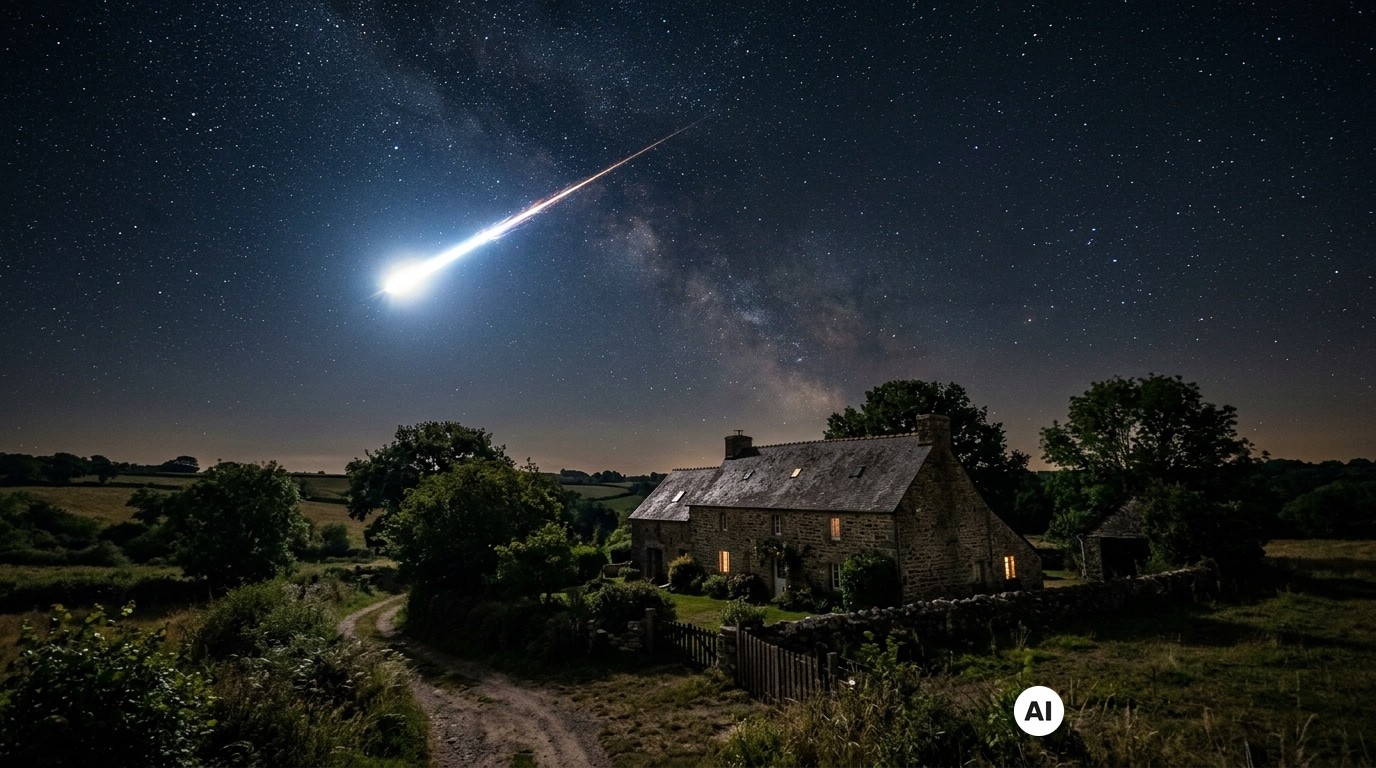
To locate the fall site of a bolide, one intersects the sightlines traced from several observation points: where they intersect in space, the three-dimensional trajectory of the object through the atmosphere is obtained. The trajectory is then extended to the ground by simulating the end of the flight when the object no longer shines. The result is not a single point but a fall ellipse, within which meteorite researchers will search.
In France, this work rests on the FRIPON program.
Two sources of data for the same trajectory
Launched in 2016 by researchers from the IMCCE, the Muséum national d’histoire naturelle, the University of Paris-Saclay and the OSU Pythéas, FRIPON has a precise objective: to detect fireballs likely to yield meteorites, then compute their orbit and their fall zone. The optical network counts around a hundred sites, each equipped with a fish-eye camera that watches the sky at 360°. A radio receiver completes the system, with a 143 MHz transmitter located near Dijon.
The geometric principle is straightforward. Each camera records the start and end of the luminous trail, which defines a plane in which the trajectory lies. Two planes from two different stations intersect along a line: that line is the bolide’s trajectory. The more stations there are, the smaller the uncertainty, and a dense network of cameras covering the sky suffices to reach a kilometer-scale precision on the fall ellipse.
The calculation of the heliocentric orbit, however, derives from the beginning of the trajectory in the atmosphere. It indicates where the meteoroid comes from, not where it lands.
Public testimonies play the role of a secondary sensor. Vigie-Ciel, the citizen science program run by the Museum, collects reports via an online form made available by the American Meteor Society and its partners (International Meteor Organization, PRISMA, Vigie-Ciel). When the sky is overcast and the cameras see nothing, these observations can be enough: in 2020, the night was cloudy in the Jura, and five witnesses allowed a trajectory to be determined that ended between Dijon and Besançon.
The two methods corroborate each other. For the Beaujolais bolide of 18 October 2021, researchers compared a trajectory calculated from testimonies with the one obtained from FRIPON cameras. The January 2020 meteor in Italy illustrates the same logic: reports from around fifty witnesses yielded a first estimate near Cavezzo, then the FRIPON/PRISMA cameras confirmed and refined this trajectory.
The “dark flight”: from the last glow to the ground
Triangulation stops where the bolide ceases to glow. Yet the object continues to fall. A bolide stops emitting around 30 km altitude: for the Jura event, the final altitude at extinction was calculated at 32 km, with a final mass of 1.2 kg.
Therefore, the team must calculate what they call the dark flight, the trajectory from the last visible point to the ground. The starting data are the position of that last point, the object’s speed and its mass. Since the latter is uncertain, researchers test a range of values: for the 2021 Beaujolais bolide, from a few grams to 1 kg.
The calculation must also incorporate winds aloft and the local topography. A lighter fragment drifts more than a heavier one, which broadens the set of possible landing points and gives the fall zone its elongated shape.
The inclination of the trajectory plays a major role in this shape. For the Beaujolais bolide, the shallow inclination produced an ellipse about 25 km long. Conversely, the Cavezzo meteoroid, initially about 8 kg before atmospheric entry, arrived at 12 km/s with an inclination of 68° relative to the horizontal, a nearly plunging trajectory that tightens the search area. The fall zone was located around the village of Disvetro, northwest of Cavezzo, in the Po valley: this is the first meteorite found thanks to the network.
What the method enables, and what it does not guarantee
A spectacular bolide does not necessarily produce a meteorite. In the case of the 5 September 2021 fireball in Brittany, 241 testimonies were collected and the triangulations placed the hypothetical fall north of Morlaix, in Finistère. But the meteoroid, entering at 21.5 km/s (about 77,500 km/h) with an inclination of 34°, completely disintegrated in the atmosphere: no meteorite survived.
Calculations can also show that fragments may remain even if they are not easy to find. The ellipses cover tens of square kilometers, and vegetation, crops or woodlands complicate prospecting. A public government response to a parliamentary question notes that the aim of FRIPON is to raise the meteorite discovery rate to 10%, which underscores the level of difficulty.
Another limitation: borders. A meteor identified by FRIPON above France can very well yield a meteorite in a neighboring country, which requires cooperation between networks.
The bolide of 22 June 2026, observed at 23:11 from Paris, Brittany and the northwest of the country, belongs to the same chain of processing. Vigie-Ciel confirmed it and collected reports, 24 witnesses having come forward in the following hours. Vigie-Ciel’s statements mention collecting testimonies to reconstruct the trajectory, without announcing a fall zone. Nothing allows one to claim that a meteorite reached the ground.
Report a bolide, recognize a meteorite
The first useful step is to report the observation on vigie-ciel.imo.net, even without a photo. One should note the precise time, the observation location, the direction in which the bolide appeared and the direction in which it disappeared, as well as its approximate height above the horizon. These angles feed directly into trajectory calculations, and the quality of a testimony depends on the precision of these markers, not on the beauty of the description.
If a field campaign is organized, Vigie-Ciel relies on regional relays, such as the Lyon Ampère Astronomy Club for Beaujolais or the Repère association for the Paris region in 2020. When FRIPON locates a fall zone, Vigie-Ciel takes over to coordinate field searches.
A stone found in an announced fall zone is recognized by several criteria: dense rock, flat faces, dull angles, black fusion crust, and absence of holes. These are the characteristics Vigie-Ciel asks to verify before contacting the local relay. A bubble, a slag or a gray pebble do not meet these criteria.
Legally, current best practice, as in most countries, requires the finder of a meteorite to declare it and have it analyzed, because its scientific value far exceeds its market value. French jurisprudence describes it as property without a master, which explains the interest in a collaboration framework between discoverers and laboratories.
Source: info.agriculture.gouv.fr
Article prepared with the help of AI · Our method
