
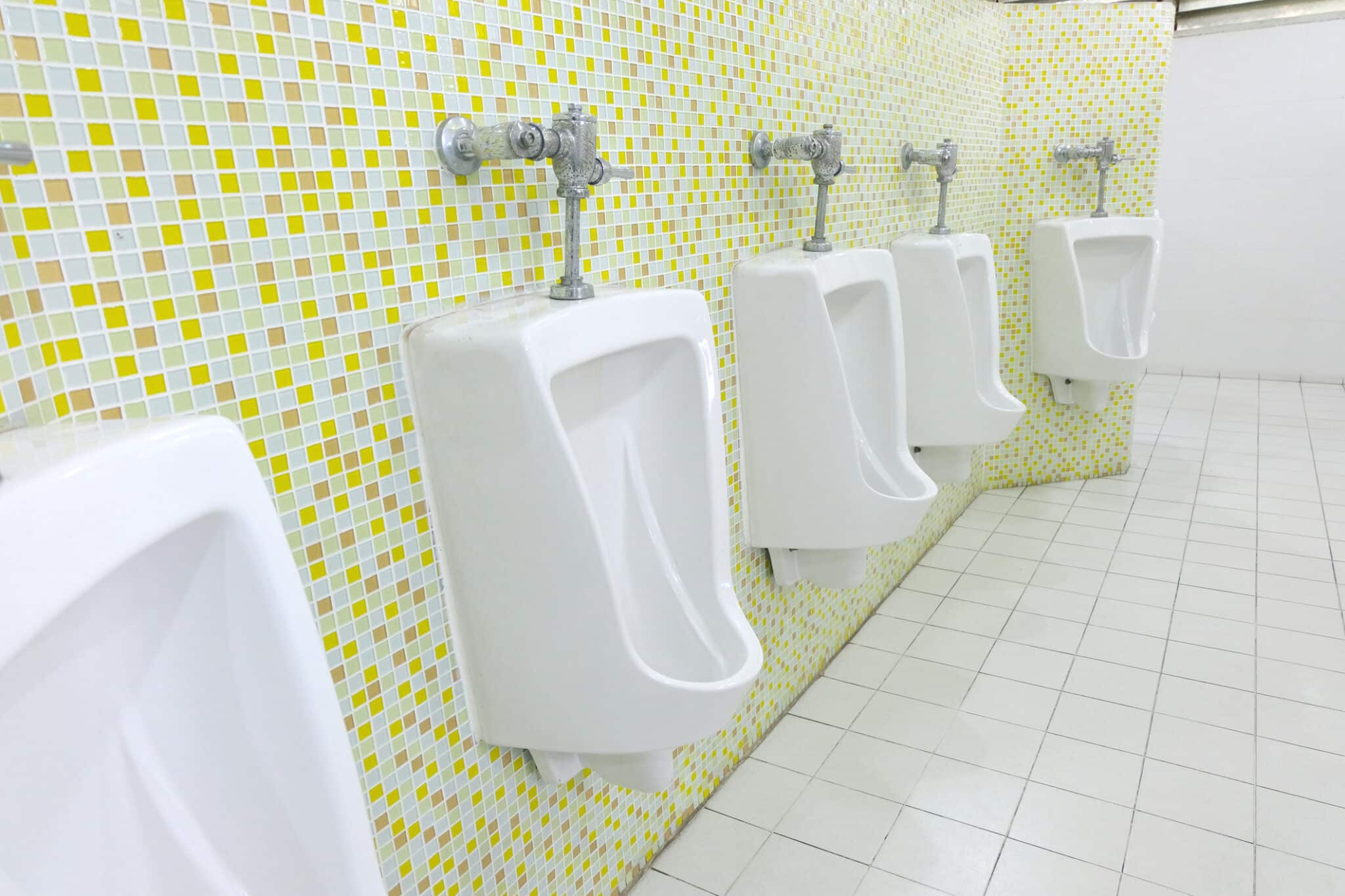
Every day, thousands litres of urine end up beside the urinal. This isn’t an exaggeration: between splashes, poor aim, and archaic design, public toilets are often real battlegrounds of bacteria. But a team of scientists believes they’ve found the solution. Their secret weapon? Two new revolutionary urinal models capable of reducing splashes to almost nothing. And their implications go far beyond hygiene.
The Invisible (and Odorous) Problem of Urinals
Urinals are ubiquitous in public spaces, from train stations to stadiums, but their design has changed little in more than a century. As a result, with every use, tiny droplets of urine are projected onto the floor, walls, and sometimes even the user. This phenomenon not only creates odors but also much more.
A recent study published in the PNAS Nexus highlights that these splashes are far more than a mere nuisance. Indeed, surfaces around urinals show bacterial concentrations far higher than those found in conventional toilets. These projections also require complex maintenance and lead to massive water waste for cleaning. On a larger scale, the health, environmental, and economic costs are enormous.
A Solution from the Labs… and Fluid Dynamics
To tackle this problem, scientists have developed a rigorous approach that blends fluid dynamics modeling with laboratory experiments. They notably used a “pseudo-urethral nozzle” that faithfully reproduces the behavior of a human urine jet, and tested different impact angles on various surfaces.
The key discovery: when the jet strikes the surface at an angle of less than 30 degrees, splashes are almost eliminated. By adjusting the angle and the shape of the wall, projections can be reduced to as little as 1.4% of those generated by a traditional urinal.
Two Futuristic Models: Cornucopia and Nautilus
Building on these results, researchers designed two new types of urinals: Cornucopia and Nautilus.
-
The Cornucopia, with its inverted-cone shape, resembles a horn of plenty (hence the name). It is the most effective at reducing splashes.
-
The Nautilus, more compact and stylish, is designed for accessibility: it can be used comfortably by children or people in wheelchairs. Its wide opening also makes it easy to clean, and its shape naturally limits misaiming.
Massive Water Savings at Stake
The issue isn’t only hygienic. These new urinals could also save millions of litres of water. The researchers estimate that replacing the 56 million public urinals in the United States with the Nautilus model would prevent about one million litres of spilled urine each day. And since cleaning that urine typically requires about ten times as much water, nearly 10 million litres of fresh water could be saved… every day.
Toilets of the 21st Century, at Last?
Adopting these models could mark a real turning point. Not only are they more hygienic, but they reduce cleaning costs, conserve resources, improve accessibility, and lessen the environmental impact of public restrooms. In short, a win across the board.
It has taken more than a hundred years to rethink something as mundane as a urinal. But if the Cornucopia and Nautilus models find places in airports, schools, or stadiums, the next toilet revolution could begin with a single drop of urine that finally lands in the right place.
Source: Splash-free urinals for global sustainability and accessibility: Design through physics and differential equations (ncbi.nlm.nih.gov)
