
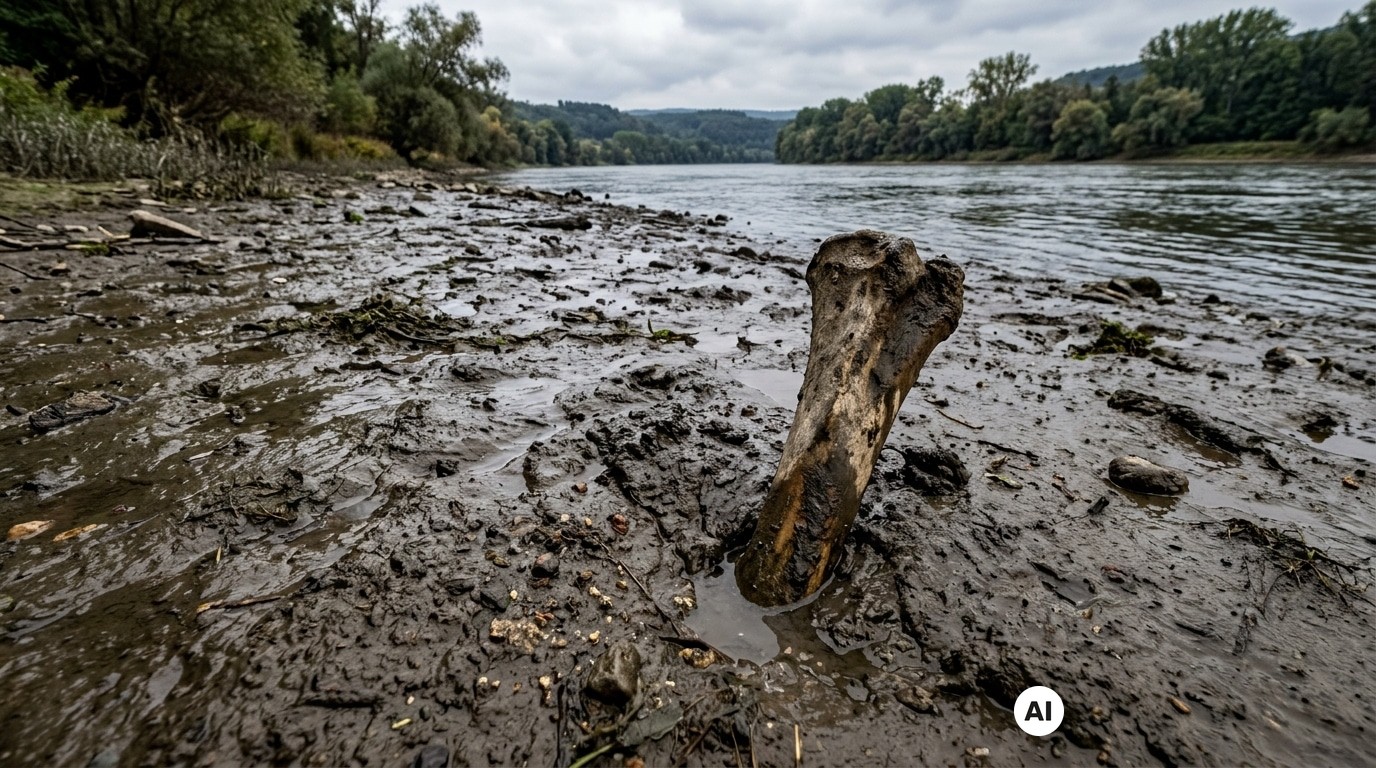
It’s hard to imagine, while strolling along a riverbank, placing a foot on a fragment of an animal that disappeared thousands of years ago. Yet this is precisely what has happened in Bulgaria. Where, as a rule, one of Europe’s great rivers flowed, there remain here and there only a slender ribbon of water set within a cracked riverbed. And it is precisely in this bare mud that the glacial past has resurfaced. A resident of the small village of Ryahovo, simply by walking, stumbled upon bones dating back millennia. A jawbone, fragments of tusks, a femur: the verdict was unequivocal, it is a mammoth. The 2026 drought has just opened, almost by accident, a spectacular window onto the Ice Age, in the middle of a Danube bled dry.
The discovery no one was looking for
There was no organized excavation, nor a field team on site. Just a resident of Ryahovo, in the commune of Slivo Pole, about thirty kilometers from the town of Rousse, in northern Bulgaria. While tracing the river’s dried banks, he noticed unusual remnants poking up from the riverbed. The news quickly reached the Rousse Regional History Museum, whose specialists moved to recover the artifacts and inspect them.
The museum’s director, Nikolay Nenov, does not mince words: it is “100% a mammoth.” Most likely a Woolly Mammoth from the glacial period, and more precisely a juvenile specimen. A find all the more remarkable because it required no dedicated prospecting: the retreating river did all the work.
What the bones tell about the young mammoth from Rousse
The experts were able to identify several very specific parts of the animal: a jawbone, fragments of tusks, part of a shoulder blade, and a femur with its articular head. By fitting these pieces together, they sketch the portrait of a creature long gone. A key point is that the bones are in good condition and concentrated in the same place. This clue is far from trivial: it suggests that all these remains belong to a single individual, making the discovery coherent and particularly valuable.
Another detail that intrigues specialists is the dark coloration of the bones. It could indicate a long sojourn in a marshy environment, an setting that would have helped preserve these remains over the millennia. This remains a working hypothesis, but it aligns with the image of a river that long buried its treasures under the mud. Let us recall that the Woolly Mammoth, emblematic figure of the Ice Age and a close relative of today’s elephants, went extinct about 4,000 years ago. In other words, this young animal has traversed an eternity before resurfacing.
When drought becomes an archaeologist, albeit involuntarily
If these bones were able to surface, it is due to a phenomenon far from joyful. Since spring, Europe has been struck by extreme heat and prolonged deficits in precipitation. The Danube, the continent’s second-longest river at roughly 2,850 kilometers winding from the Black Forest in Germany to the Black Sea, is paying a heavy price. June was particularly dry, with average precipitation of only 12.2 millimeters, or barely 17% of the thirty-year average.
Result: the river stands at historically low levels. It has never been so weak in Hungary, where Budapest recorded a level of only 23 centimeters, below the previous low of 33 centimeters set in 2018. In Romania and Slovakia, conditions not seen for thirty years. In Bulgaria, a fisherman even claims that one can now reach Romania on foot. The drought, worsened by human-caused climate change, has thus become an involuntary digger.
The Danube in drought, an open book of what might still surface
The river’s retreat does not merely exhume mammoths. It also reveals sandbanks, rocky rapids, and even sunken wrecks that had lain buried beneath the riverbed for decades. The Danube suddenly reads like a vast open book, its pages turning one by one. Given this potential, a new survey of the area is planned, for the drop in water level could well uncover further traces.
But the backdrop remains worrying. Merchant ships, in Slovakia as in Bulgaria, can no longer be loaded to capacity and navigation has slowed. Romania and Hungary have had to cut back production at their nuclear plants, which draw cooling water from the river to operate their reactors. Some ferries between Romania and Bulgaria have even been temporarily suspended for lack of sufficient draft.
Here lies the paradox of this discovery: the same drought offers history enthusiasts an unexpected window onto the Ice Age, while, page after page in this dried riverbed, reminding us of how fragile our rivers are. The young mammoth of Rousse waited for millennia in the mud before reappearing.
Sources: Mammoth Remains Discovered near Ruse Village Due to Low Danube Water Level (bta.bg) | Mammoth remains found in Danube near Ryahovo (bnrnews.bg)
Article prepared with the help of AI · Our method
