
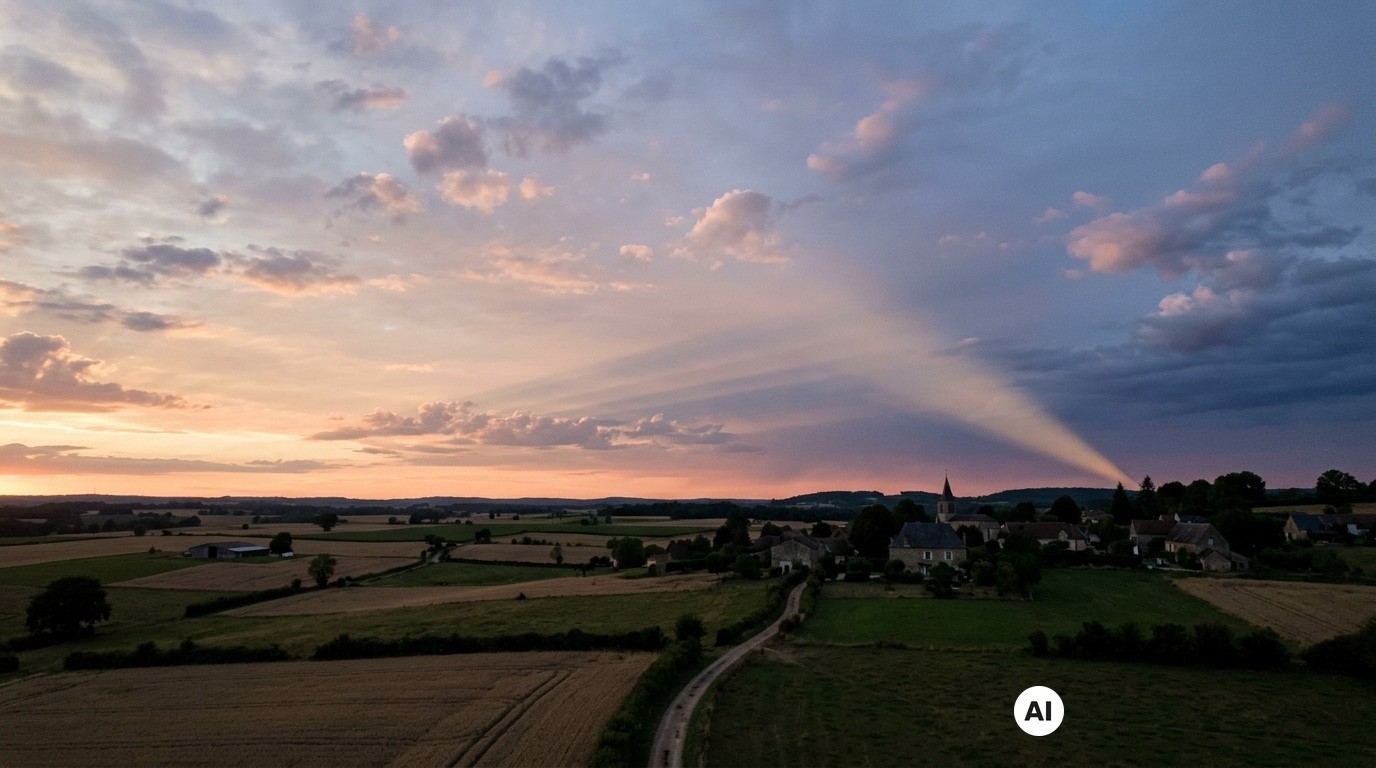
We often imagine that the sun’s rays at sunset can only come from one place: the horizon where the star disappears. Yet the sky sometimes holds a surprise exactly opposite to this ingrained image. Tonight, by looking up at the right moment, it is possible to observe beams of light that seem to spring forth not from the west but from the east.
Tonight, the sky plays a trick on our eyes trained to the setting sun
Everyone knows the scene: the sun sinks toward the horizon, and broad rays seem to spill from it like a fan of light. This image is so familiar that we forget it is only part of the spectacle. For at the very moment those twilight rays illuminate the western sky, a twin phenomenon can appear on the opposite side, on the eastern side. The common mistake is to believe that the sunset light can manifest only where the sun sets. In reality, the entire sky participates in the show, and that is precisely what makes observing twilight so rich for anyone who takes the time to look in all directions.
How distant clouds draw shadows that traverse the whole sky
To understand this atmospheric magic, we must look at the clouds. When a cloud sits between the sun and us, it blocks part of the light and creates a shadow. But this shadow does not stay fixed near the cloud: it is projected across the entire atmosphere, made visible by the particles present in the air. The result is an alternating pattern of bright bands and dark zones that can stretch across a large portion of the sky. An important thing to note: these clouds do not need to be directly overhead. Distant cumulonimbus clouds can cast their shadow over long distances. MeteoSwiss reports an episode observed on August 11, 2023, where cumulonimbus in eastern France produced shadows visible from Switzerland, a phenomenon confirmed by satellite imagery from that time. A concrete example that illustrates how this spectacle can unfold at great distance, without any direct weather link to the observation location.
Why these rays seem to originate at the sun’s opposite horizon
When clouds intercept part of the sunlight, they can produce an alternating series of bright bands and shadowed areas made visible by the particles in the air. These bands sometimes extend across the sky and seem to converge at the horizon opposite the sun: these are anticrepuscular rays. The key point to understand is that these beams are actually nearly parallel to each other, even though they give the impression of spreading near the sun and then meeting far away. MeteoSwiss compares this effect to railroad tracks that appear to converge at the horizon even though they stay strictly parallel along their entire length. It is simply a perspective effect, the same illusion that plays tricks on us with any straight line receding from our gaze. A good move if you want to try observing it is to turn east just after sunset and look for that convergence point.
This ballet of light and shadow remains, above all, a visual delight, not a forecasting tool. These rays do not, on their own, allow predicting tomorrow’s weather; so one should not rely on them to anticipate a weather change. But next time the sky blazes at sunset, consider turning to look behind you: the opposite horizon can sometimes have something to show you as well.
Sources: Crepuscular rays (cloudatlas.wmo.int) | Advent Calendar 2023 – MeteoSwiss – admin.ch (meteosuisse.admin.ch)
Article prepared with the help of AI · Our method
