
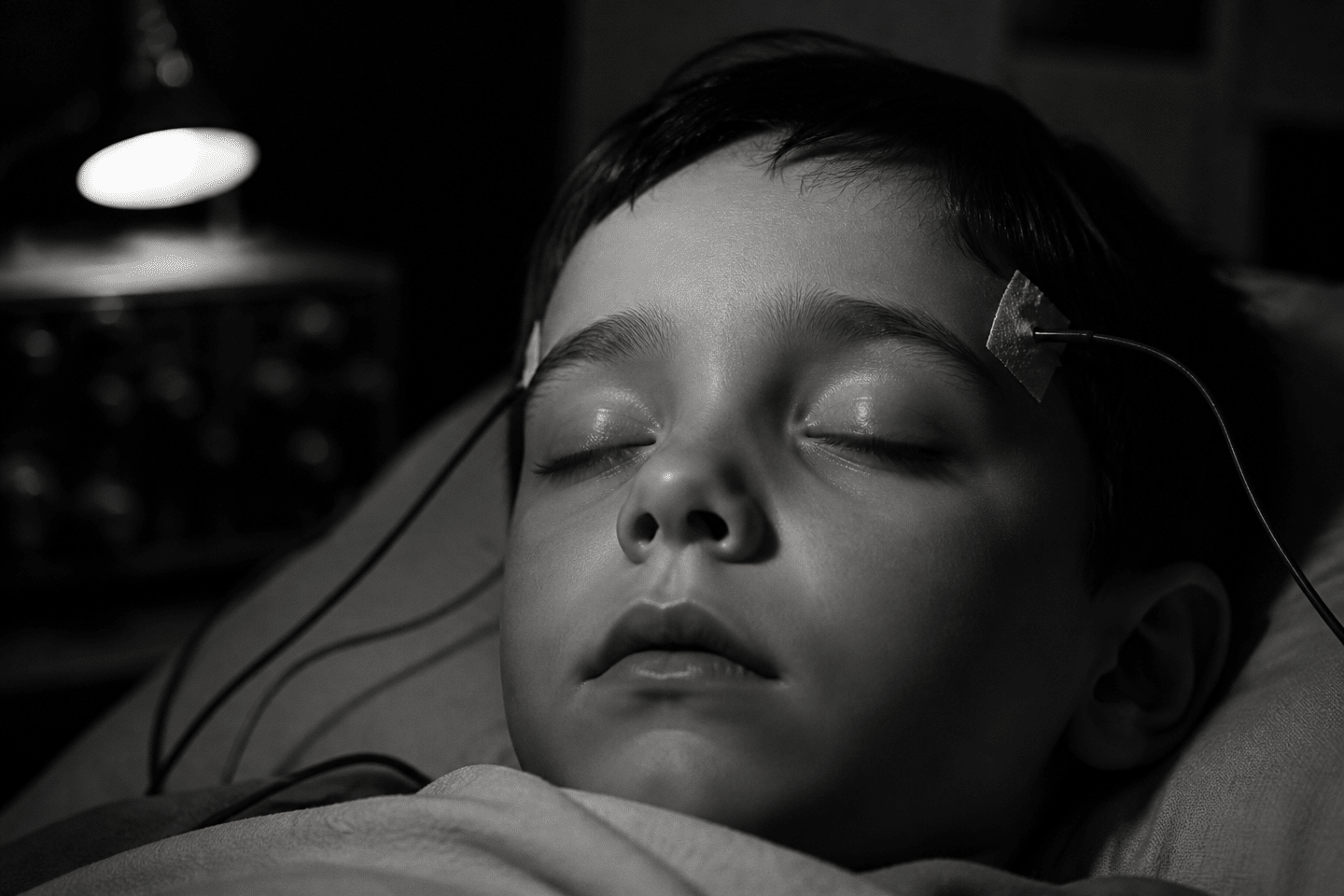
In December 1951, at the University of Chicago, physiologist Eugene Aserinsky attached electrodes around the eyes of his eight-year-old son Armond and installed an old electroencephalograph hauled up from the basement. While the child slept, the stylets flickered: his eyes moved rapidly beneath the closed lids. Two years later, Aserinsky and his thesis advisor, Nathaniel Kleitman, published in Science a description of this phase of sleep, now known as “paradoxical sleep.”
December 1951: An old device and an eight-year-old boy
Eugene Aserinsky was then a PhD student in physiology at the University of Chicago, under the supervision of Nathaniel Kleitman, a pioneer in sleep research. He was not aiming to study dreams; his interest lay in attention in children and in eyelid movements as sleep began. His equipment was far from modern. It was an old electroencephalograph, an Offner Dynograph, which he hauled up from the basement of the building to install in a physiology laboratory on the second floor of Abbott Hall.
One December evening in 1951, his son Armond lay on a camp bed. Aserinsky cleaned the skin with acetone, fixed the electrodes around the eyes and on the scalp, then moved to a neighboring room to monitor the recording. A few hours later, the stylets began to oscillate, as if the child were gazing around. Yet, when his father entered the room, Armond was sleeping soundly.
The same oscillations recurred throughout the night. Aserinsky realized that these episodes were not measurement artifacts, but a regular phenomenon of sleep. To confirm it, he needed more sleepers, and above all, corroborating accounts.
1953: Twenty adults and a two-page article
Aserinsky then extended the experiment to twenty adults. According to the article published in Science on September 4, 1953, the researchers awakened sleepers, sometimes during the eye movements, sometimes outside them, and asked whether they had dreamed. These awakenings thus involved adults, not Armond, who had served only as the initial observation.
The results were clear but not absolute. Of 27 awakenings during rapid eye movements, 20 yielded reports of a detailed dream, often visual, roughly three out of four. The remaining seven produced no memory or only the impression that a dream had occurred. Conversely, of 23 awakenings outside these episodes, 19 yielded no dream memory.
The article, co-signed by Kleitman, fits on about one and a half pages. It describes eye movements that are “rapid, jerky, and symmetric” which recur at regular intervals. It shows that sleep is not a uniform state, but a succession of phases. The authors concluded that dreaming occurs during light sleep, an idea later corrected by subsequent research. The French term “sommeil paradoxal” (paradoxical sleep) came later from neurophysiologist Michel Jouvet.
What 2026 research has added
Paradoxical sleep today accounts for roughly 20 to 25% of adult sleep time. Several studies published in 2026 clarify its role. In PLOS Biology (March), Giulio Bernardi’s team in Lucca woke 44 adults during non-REM sleep: the more immersive their dreams, the deeper they rated their sleep to be. At Northwestern (Neuroscience of Consciousness, February), diffuse sounds played during REM sleep steered dreams toward unsolved puzzles. Seventy-five percent of participants dreamed fragments of these puzzles, and those that appeared in dreams were solved more often (42% versus 17%).
On the physiological side, researchers at Tohoku University (Communications Biology, July) observed in mice that cerebral blood volume rises about 50 seconds before REM sleep, while neuronal ATP decreases. A study in PLOS Medicine (September), conducted on 95,559 British adults, linked more REM sleep to a lower risk of 83 diseases. This is an association, not proof of causality.
Finally, AP-HP launched in February 2026 the Sompark study, tracking 550 people: 300 Parkinson’s patients, 200 individuals with an isolated REM sleep behavior disorder, a possible precursor to the disease, and 50 healthy controls. And the Brain Institute (Cell Reports, April) showed that dream-like mental states also appear in waking and in the transition to sleep.
Sources :
- Regularly occurring periods of eye motility, and concomitant phenomena, during sleep – Science, 1953 (PubMed)
- The Stubborn Scientist Who Unraveled a Mystery of the Night – Smithsonian Magazine
- Aserinsky Discovers REM Sleep – EBSCO Research Starters
- Fifty years of REM sleep – Psychiatric News
- Michel Jouvet et la découverte du sommeil paradoxal – Grand Lyon
- Les mystères du sommeil – Sciences Ouest (Espace des sciences)
- Vivid dreaming makes sleep feel deeper – PLOS Biology, 24 March 2026 (EurekAlert)
- Dream engineering can help solve “puzzling” questions – Northwestern University, February 2026
- Dreams drain energy: the REM sleep paradox – Tohoku University, Communications Biology, July 2026 (EurekAlert)
- More REM sleep linked to lower risk of 83 diseases – PLOS Medicine, September 2026 (ScienceDaily)
- Troubles du sommeil et maladie de Parkinson : lancement d’une étude – AP-HP
- Dreaming while awake: dream-like states are not confined to sleep – Brain Institute, Cell Reports, April 2026
Article prepared with the help of AI · Our method
