
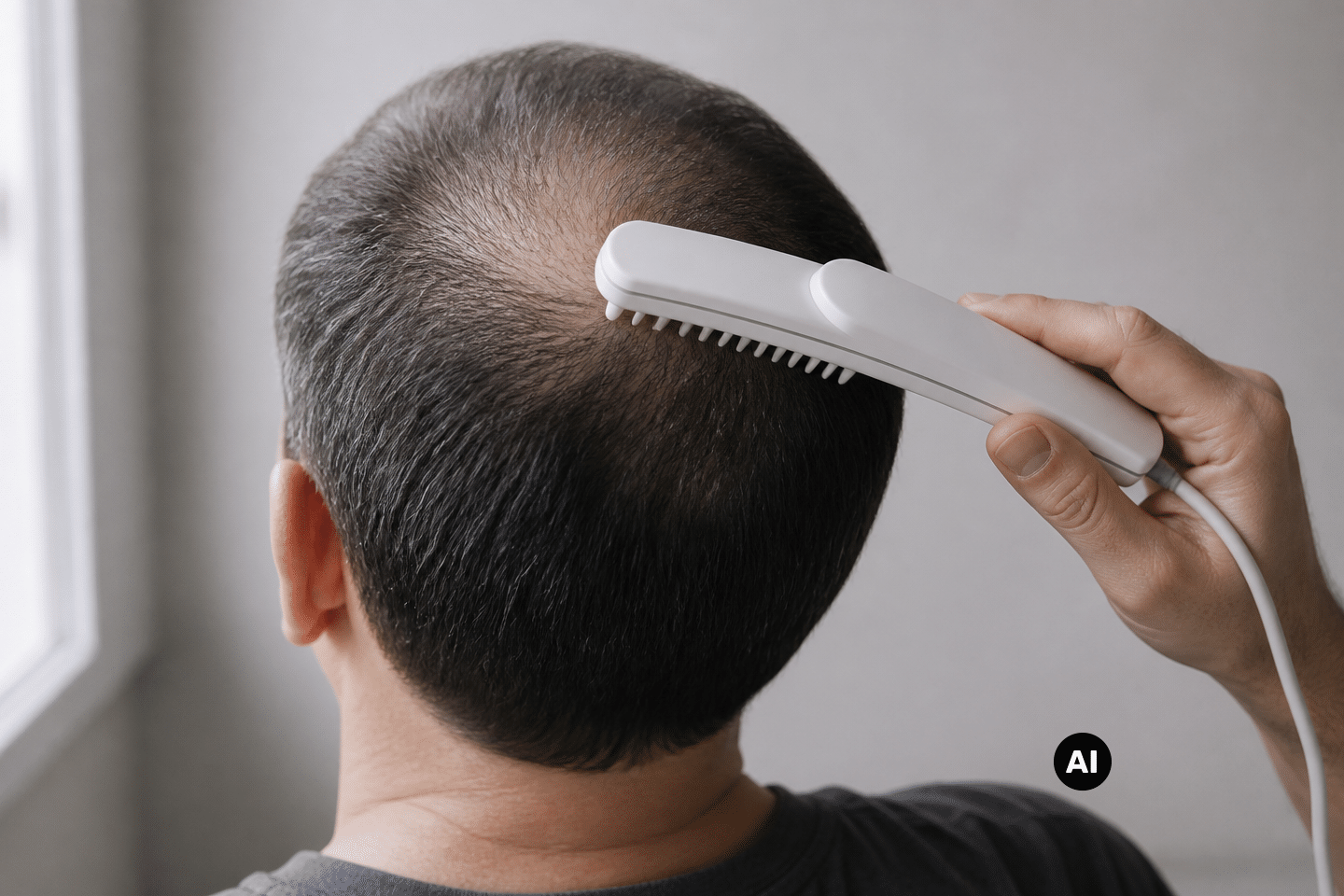
Against hair loss, existing treatments struggle to convince. Chinese researchers have just unveiled a comb-shaped device that achieved almost total hair regrowth, though so far only in mice.
This device, named Detangle, was developed by a team at Beihang University in China. It arrives at a moment when modern treatments are not a panacea. Minoxidil, finasteride, hair transplants: these methods show variable results depending on individuals.
Baldness, after all, is nothing new. For millennia, men and women have searched for solutions to stop their hair loss.
A comb that lifts the skin to better treat
The teeth of Detangle each incorporate electrodes capable of delivering tiny electrical impulses directly to the scalp. At first glance, the device still resembles a simple comb.
Some teeth also house small compartments. Their role: diffuse therapeutic molecules intended to stimulate hair growth.
As it travels over the skin, the teeth gently lift it. This gesture creates a stronger electric field that penetrates deeper into the skin. The active molecules can thus reach the cells of the hair follicle, where regrowth actually takes place.
Two molecules, a double attack against baldness
The researchers selected two distinct molecules, each targeting a different mechanism of androgenetic alopecia, rather than betting on a single weapon.
The first, a VEGFA plasmid, works on blood supply. It stimulates the growth of new vessels around hair follicles, thereby improving their blood supply.
The second, an siRNA targeting SRD5A2, goes after a well-known foe of bald individuals: dihydrotestosterone, or DHT. This hormone tends to shrink hair follicles, causing progressive thinning of the hair. By reducing its production, the researchers hope to break this vicious cycle.
More effective than minoxidil, according to mouse tests
The device was evaluated on mice with experimentally induced androgenetic alopecia. The comb, impregnated with both molecules, was applied to the shaved backs of the rodents every three days for twenty-eight days.
In animals treated with Detangle, hair regrowth covered almost the entire shaved area. These results were compared with those obtained using conventional treatments, minoxidil and finasteride, administered to other groups of mice. The mice treated with minoxidil, in contrast, showed only about 70% regrowth. The device also proved more effective than finasteride.
Additional examinations confirmed the trend: the number of hair follicles increased, as did blood flow in the treated area. For the study’s authors, this deeper penetration of the molecules into the skin would be the key to success. As they themselves summarize, “a safe and effective administration remains the key to the success of treating androgenetic alopecia”.
Detangle has not yet been tested on humans, and nothing guarantees that the results observed in mice will translate to humans. Before considering any clinical application, we must therefore be patient, waiting for more extensive trials to confirm, or not, the promises glimpsed in this Chinese laboratory.
Source : Combing-triggered electrostimulation synchronizing deep delivery for rapid hair regrowth in androgenetic alopecia (nature.com)
Article prepared with the help of AI · Our method
