
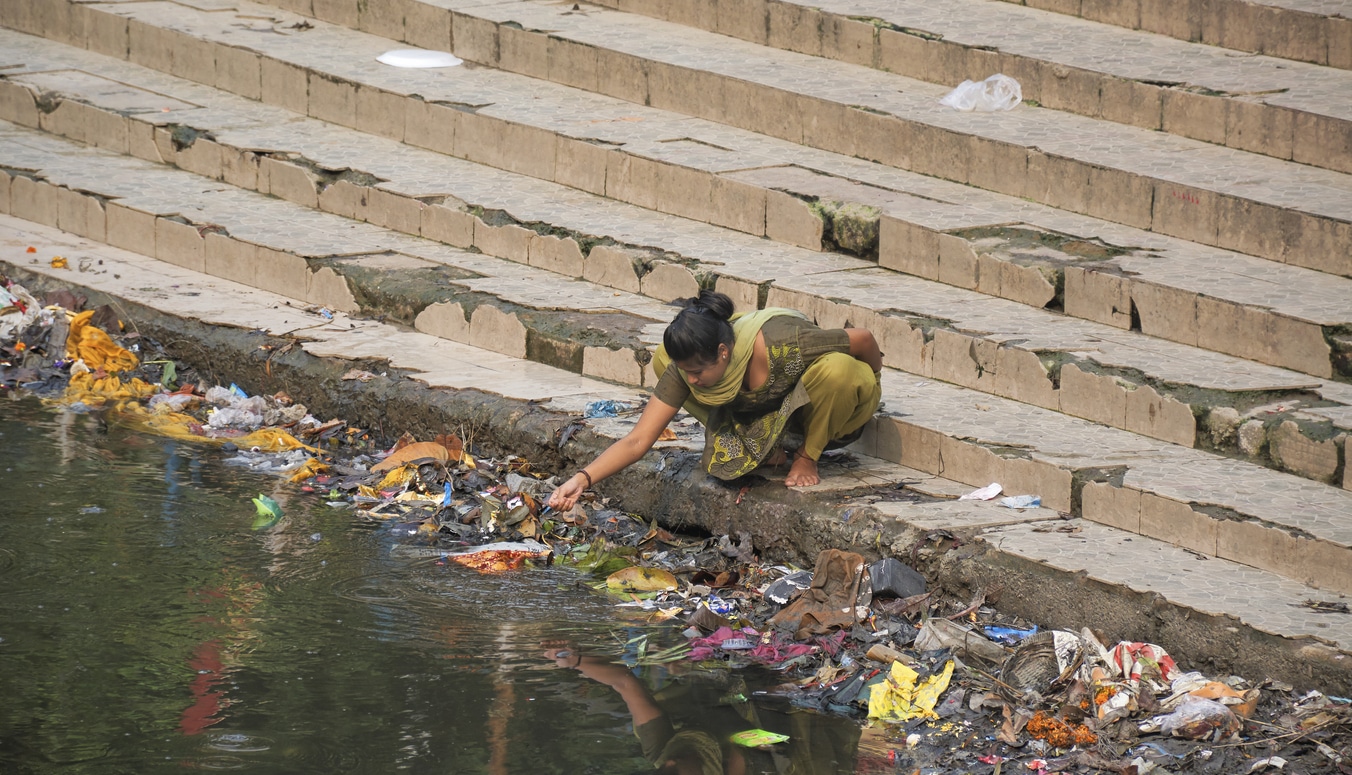
The seven sacred rivers of Hindu culture are the Yamunā, the Sarasvatī, the Indus, the Godāvarī, the Narmadā, the Kāverī, and of course the ever-present Ganges. The latter nourishes about a third of India’s population, and countless pilgrims make their way there every year. Yet this river is one of the most polluted in the world.
A Sacred and Useful River, Yet Heavily Polluted
Spanning a basin of no less than 907,000 km², the Ganges is a river in northern India whose length ranges between 2,500 and 3,000 km. With its many tributaries, this river supplies roughly 600 million people and contributes about 40% to the country’s GDP. The Ganges is extensively used in agriculture (for irrigation), but it also serves as a crucial resource for generating hydroelectric power. Regarded as sacred by Hindus, the river is chiefly seen as “the ultimate truth,” in other words the ultimate reality in a spiritual sense. And for good reason: legend holds that the god Shiva holds the source of the river in his hair. By immersing themselves in its waters, pilgrims seek to free themselves from their sins.
Unfortunately, the Ganges is also marked by massive pollution, as explained by the United Nations in a publication by the Initiatives for the Future of the Great Rivers (IAGF). Counted among the ten most-threatened rivers in the world, the Ganges faces substantial ecological pressures. The river harbors an immeasurable quantity of plastic waste, industrial refuse, pesticide discharges, and human excreta, to such an extent that in some areas, no flora or fauna can survive. The pollution of the Ganges also jeopardizes human health: high infant mortality, cholera, typhoid, and hepatitis A—illnesses affecting more than 30 million people each year.
India Aims to Save the Ganges
In April 2023, India became the most populous country in the world, surpassing China. Yet, the country’s sanitation systems did not wait for this new status to expose a glaring lag. Shortly after taking office in 2014, Prime Minister Narendra Modi launched a broad infrastructure program aimed at cleaning the Ganges: Namami Gange. However, doubts persist, because successive governments since 1980 have each undertaken similar schemes. None, in fact, has truly succeeded due to mismanagement and potential corruption allegations.
The Namami Gange project has so far cost nearly four billion dollars for actions including the sacred city of Varanasi, where two tributaries of the Ganges flow—the Assi and the Varuna. In total, the government project is expected to build 5,211 km of sewer mains and 170 new wastewater treatment facilities scattered around the river.
The Namami Gange project cannot stand alone. Other actions are therefore undertaken, such as public announcements and advertising campaigns to raise awareness among the population about river pollution and open-air defecation. There are also the adoption of laws banning certain plastics or compelling the construction of hundreds of public toilets connected to the new sewer systems.
