
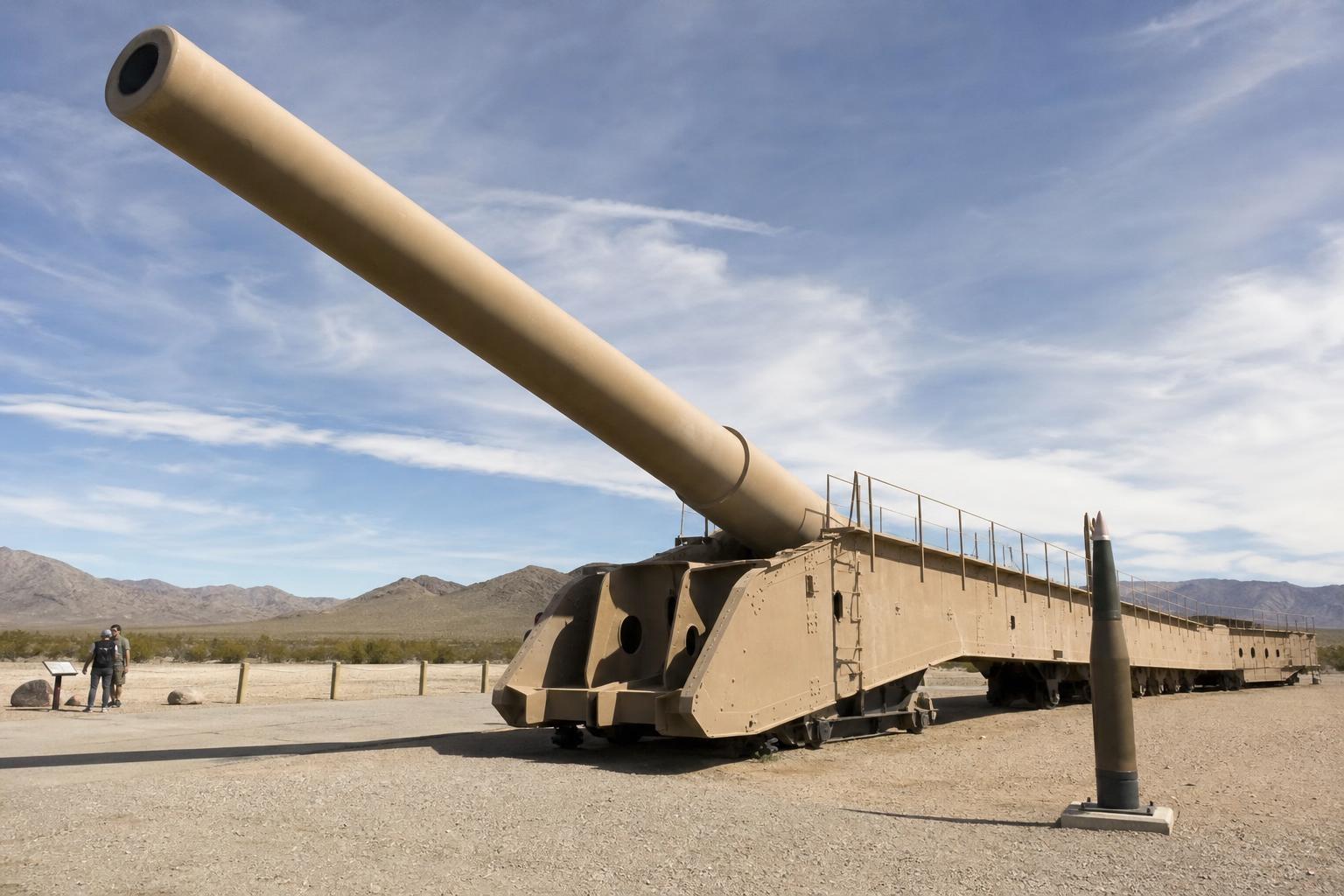
Dawn broke over the Nevada desert with an engineer’s calm and a showman’s flair. On a dry lakebed, soldiers tended to a machine that seemed equal parts myth and machinery—a cannon so vast it looked like it should have arrived by railway rather than road. Cameras hummed. Brass watched. The United States had built a new way to throw thunder across the horizon, and on this morning, it would do exactly that.
Building a cannon for the nuclear age
The weapon was the M65, a 280 mm behemoth the troops nicknamed “Atomic Annie.” Weighing about 85 tons, it rode to the range on two specially designed tractors, then unfolded into a battlefield statement. Its purpose was plain: bring nuclear firepower to where armies fight, not just where bombers fly.
It was a blend of industrial confidence and Cold War urgency. Big wheels, big barrel, big ambition. The pitch was simple enough to fit on a staff officer’s notecard: if a division can move, it should be able to deter.
The shot called “Grable”
On May 25, 1953, beneath a crystalline sky, the Army fired a live nuclear shell during Operation Upshot–Knothole. The projectile arced about seven miles, then detonated as an airburst roughly 524 feet above the desert floor—right where the planners wanted it.
The device, known as the W9, yielded about 15 kilotons—a blast in the same neighborhood as the weapon that destroyed Hiroshima. The shock front rolled out like a drumbeat, dust lifting from the flats as if the earth had taken a sharp breath. “Day turned to white,” one witness later said, “and the desert found a new voice.”
For all the spectacle, the core message was procedural: a nuclear round could be loaded, aimed, and fired within the rhythms of artillery practice. That single shot made the idea feel less like rhetoric and more like doctrine.
What the test really proved
Beyond the fireball, planners were measuring friction. Could the convoy deploy under time pressure? Could command and control hold steady through the countdown? Would the shell behave like a normal round, only with consequences that were not at all normal?
The answers were mostly yes. In practical terms, Grable demonstrated:
- Reliable ballistics and predictable airburst effects for a nuclear artillery shell
- Feasible setup and firing under field conditions
- The need for tighter coordination across engineering, logistics, and security
- A glimpse of battlefield-scale nuclear warfare that was, even then, hard to stomach
Why it never became routine
On paper, tactical nuclear artillery promised flexibility. In reality, it raised a canyon of risks. Any use could trigger strategic escalation, dragging a local fight into a nuclear exchange. The logistical footprint was heavy, the crews exposed, and the political costs potentially catastrophic.
At the same time, alternatives matured. Air-delivered weapons stayed faster and further. Missiles grew more accurate and more survivable. Recoilless systems and short-range rockets flirted with small nuclear warheads, but each brought its own paradoxes. As one planner might put it, “Everything is possible until you demand it be safe.”
The result was a quiet pivot. The cannon proved a point, not a path. Nuclear fire support moved toward delivery systems that were harder to target and easier to control.
Symbols outlasting steel
The machine itself had a cinematic presence. It toured like a celebrity, rolled through parades, and posed for reporters who loved its unapologetic scale. Over time, surviving units found their way into museums, where they sit today—a mix of steel memory and strategic warning.
Stand near one and you feel the project’s original logic and its durable awkwardness. This was a weapon built to make the unthinkable feel routine, and in that effort it succeeded just enough to alarm.
What endures from that morning
The test left a legacy larger than its blast radius. It hardened the idea that nuclear weapons could be technically tactical while remaining morally and politically strategic. It taught commanders that speed, dispersion, and discipline matter even more when the margin for error becomes zero.
Today, the echoes of that gunshot live in quiet doctrine and loud taboos. Precision conventional weapons now do much of what the planners then wanted, without crossing the nuclear threshold. Still, the lesson remains as sharp as the cannon’s silhouette against the desert: “You can build a bridge to the unthinkable—but crossing it is another matter.”
