
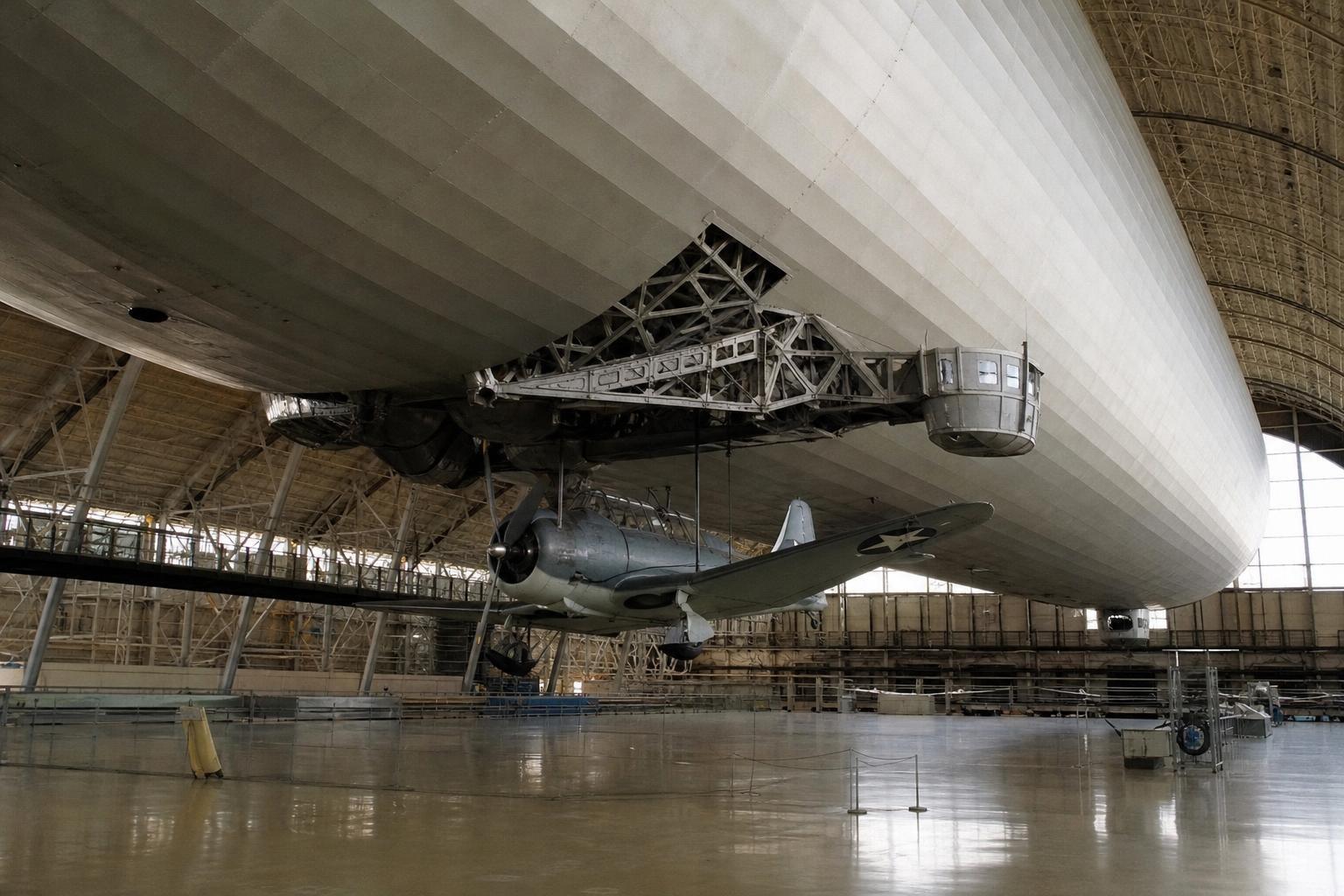
It sounded impossible at the time: a gargantuan airship acting as an airborne carrier, launching and retrieving nimble fighters without ever touching the ground. Yet for a brief, audacious window in the early 1930s, the U.S. Navy proved it could be done. Two rigid giants, USS Akron and USS Macon, each about 239 meters long, turned the sky into a hangar and the clouds into a runway.
A hangar inside a hull
Inside their silver hulls stretched a cathedral-like space, a steel-lattice skeleton wrapped in doped fabric and buoyed by vast helium cells. The designers tucked a compact hangar within, plus workshops, radio rooms, and crew berths. These ships carried up to five F9C Sparrowhawk biplanes, tiny scouts with a special hook above the wings.
Crews numbered around eighty, living for days among humming motors and the faint aroma of dope and oil. Every corridor felt like a keel, every step a reminder this was a ship that sailed the air.
The “flying trapeze”
At the heart of the system hung a retractable trapeze, a steel spar lowered beneath the keel. A Sparrowhawk would sidle in under the airship, nose pointed like a sword, matching speed around 60–70 mph. The pilot would reach up, “stab” the hook onto the bar, and instantly become cargo again.
Takeoffs inverted the theater: the plane dangled in the wind, engine growling, then released cleanly into a widening sky. Sailors called the whole dance the “hook-on,” a crisp phrase for a nerve-testing act.
Why do this at all?
The Navy needed long-range eyes, not short-range fists. Battleships and carriers craved scouting over thousands of miles, and radio reports from high altitude meant early warning and better decisions. An airship—quiet, enduring, and high—could spread a net of lookouts wider than a surface screen ever could.
This airborne carrier blended reach and flexibility. It conserved fuel for the small fighters, kept them dry and maintained, and flung them into the search pattern right where they were needed.
What made these giants different
- A vast internal hangar for up to five Sparrowhawk fighters, stored, serviced, and launched in flight
- A helium lift system—safer than hydrogen, but with tighter weight margins
- Endurance measured in days, not hours, with range into the thousands of miles
- A trapeze “skyhook” enabling launch and mid-air recovery, even over open ocean
- A doctrine focused on scouting first, combat a distant second
Daily life and daring work
Life aboard mixed methodical routine with spikes of pure adrenaline. In calm air, crew tracked weather and navigation like a religion, listening to radios, tending engines, trimming ballast. Then the call would crackle—“Launch one”—and the belly doors slid open.
The little biplanes, some stripped of heavy landing gear, clung to the trapeze like swallows under a bridge. Mechanics worked shoulder-to-shoulder in a space that was both hangar and hull. One wrong gust could turn poise into panic.
Storm lessons written in grief
Helium kept these ships from the specter of fire, but the real enemy was weather. Akron was lost off New Jersey in a savage storm in 1933, with more than seventy lives taken, including Rear Admiral William A. Moffett. Training, equipment, and rescue coordination all showed painful gaps.
Macon fell in 1935 off California after tail-structure damage compounded by turbulent winds. This time, better gear and procedures saved nearly everyone—only two souls were lost. Each tragedy carved hard lessons about structural margins, storm avoidance, and the ruthless math of lift versus weight.
The edge of possibility
These ships lived at the boundary of what was aerodynamically and operationally possible. Helium limited payload; every pound of steel, fuel, or airplane shaved precious lift. The long, elegant hulls were sensitive to gusts that mocked human plans. And meanwhile, conventional carriers were racing ahead with tougher decks, faster aircraft, and proven launch-and-recovery routines.
“Airborne aircraft carrier” wasn’t just a catchy phrase—it was a bold hypothesis. For a while, it worked startlingly well. But the system demanded near-perfect weather, meticulous discipline, and luck that war rarely grants.
Echoes you can still see
You can still walk beneath Hangar One at Moffett Field, a cavernous shell that once sheltered these leviathans. You can find recovered Sparrowhawks in museums, delicate reminders of metal daring and disciplined improvisation. Their DNA shows up in modern concepts too: drone motherships, aerial refueling, and high-endurance ISR platforms that extend a fleet’s reach.
The big lesson endures: mobility plus persistence wins reconnaissance. The Navy’s giant airships made the sky a workshop, turned flight into logistics, and proved that bold ideas can be both “too early” and still right. For a brief span, a 239‑meter vessel hovered above the ocean, catching its own fighters in mid-air—an improbable ballet that history still watches in awe.
