
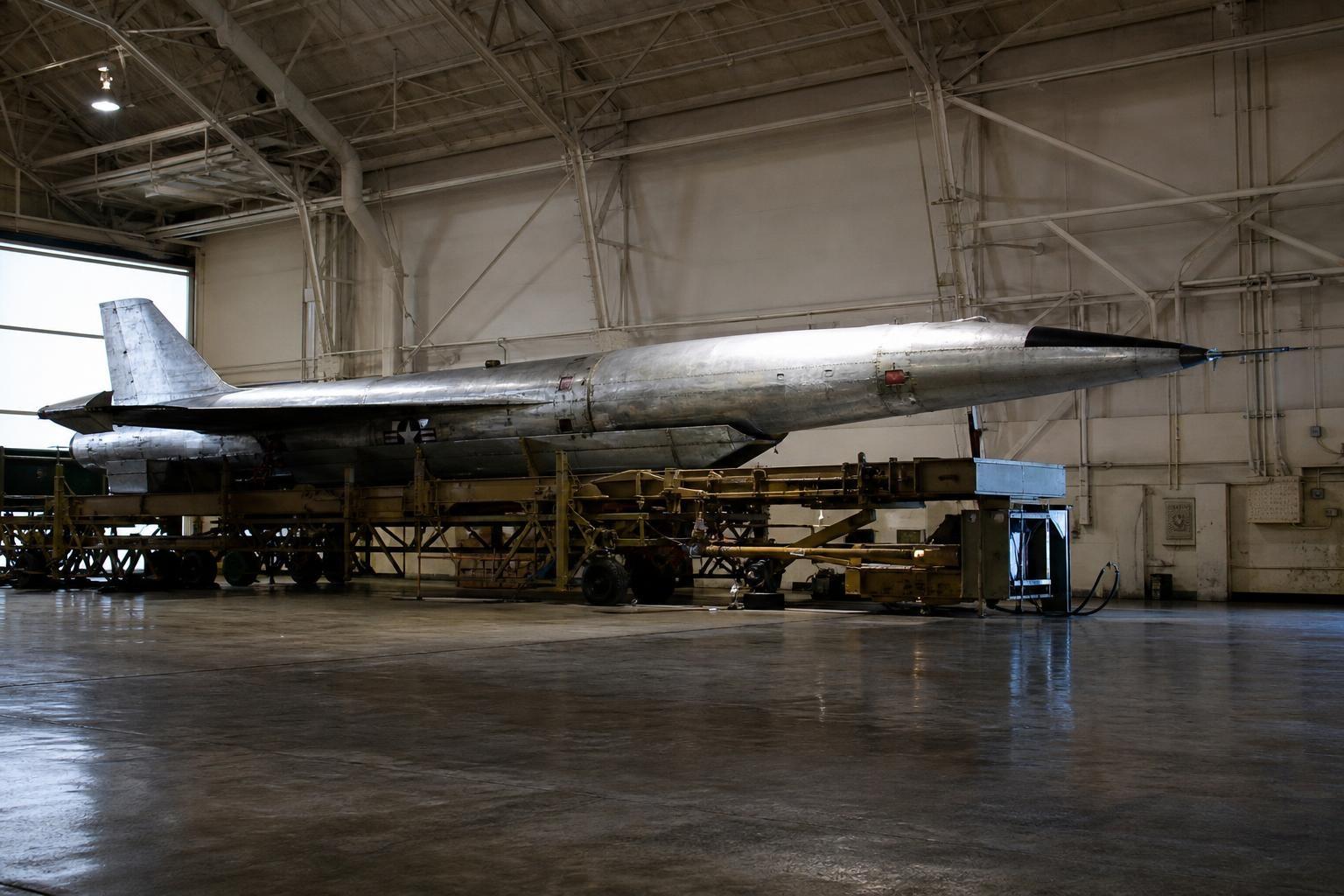
On a blazing day in the Nevada desert in 1964, an experimental reactor roared to life on a remote slab of concrete and steel. It wasn’t inside a power plant or submarine. It was the beating heart of a missile—an engine meant to gulp air, heat it directly with a nuclear core, and push a supersonic machine across continents. Engineers called the idea bold. Detractors called it unthinkable. Everyone agreed it was new.
Audacity at treetop level
The plan was a low-flying, Mach-3 cruise missile that could skim just above the trees, ducking radar behind hills and valleys. Propelled by a nuclear ramjet, it wouldn’t carry fuel in the usual sense; the reactor would heat the incoming air, turning the sky itself into propellant. With range limited mainly by materials endurance, the missile could wander for weeks, zigzagging past defenses before dropping multiple warheads on targets.
Engineers nicknamed it the “flying crowbar,” a stark nod to its raw, battering philosophy of deterrence. At low altitude and supersonic speed, the shockwaves alone would wreak havoc, a continuous, roaring presence over enemy territory.
How a nuclear ramjet works
A conventional ramjet compresses air through sheer speed, then adds fuel and burns it. A nuclear ramjet does something more direct: it elbows fuel aside and pipes the airstream through a superheated reactor core. The air expands and blasts out the back, generating thrust—no flame required.
This approach promised endurance. Without chemical fuel, the limiting factors became metallurgy, radiation damage, lubrication, and guidance electronics withstanding a brutal, vibrating ride. Designers projected Mach 3+ cruise at very low altitude, taking advantage of ground clutter to evade radar and complicate interception.
Jackass Flats and the Tory reactors
All of this was more than theory. At Jackass Flats in the Nevada Test Site, engineers built the Tory series of reactors—testbed engines placed on a railroad-like carriage behind thick shielding, fed by a high-speed stream of compressed air.
- Tory-IIA, a smaller prototype, proved the concept in 1961 by achieving nuclear-powered airflow at significant power.
- Tory-IIC, bigger and closer to flight relevance, lit off in 1964 and ran at full throttle for minutes, producing on the order of hundreds of megawatts of heat.
The spectacle was startling: a deafening, high-velocity hurricane of air, heated by a bare reactor core, roaring into the desert. As one engineer joked, such a machine would “fry chickens” along its route—a dark quip about shock, noise, and radioactivity in the wake of the exhaust stream.
What made it unprecedented
For a few brief years, the program showed that a nuclear ramjet was not only thinkable but buildable. Its uniqueness came down to a handful of startling attributes:
- Practically unlimited range, with endurance projected in weeks or even months.
- High-speed, low-altitude routing to twist through radar shadows.
- Enormous payload capacity for multiple, independently targeted warheads.
- A psychological dimension: constant sonic terror and a radioactive wake.
The idea fused Cold War logic with engineering ferocity: if you can’t stop it, you must deter it.
The physics was possible, the politics impossible
From a purely technical stance, the tests worked. The Tory-IIC ran. The data flowed. Materials held together long enough to suggest a feasible, if nightmarish, flight profile. But strategic reality was shifting. Intercontinental ballistic missiles were growing faster, cheaper, and simpler to deploy. Defenses designed to swat low-flying cruise systems were improving, and nuclear test moratoria sharpened public sensitivity to radiological risk.
Then there was the unsolvable problem: testing a flying, air-breathing nuclear engine meant spewing fission fragments along any route you chose. Where could you aim such a test and call it safe? Over the ocean? Over a remote desert? Nowhere truly counted as acceptable, not for an engine that breathed atmosphere and exhaled radioactivity.
By mid-1964, after a successful full-power run, the program was canceled. The physics did not fail. The premise did—on moral, environmental, and strategic grounds.
What remains in the wake
The nuclear ramjet sits in the pantheon of ideas that were “too good” at the wrong things. It promised dominance through endurance, speed, and fear, but it also embodied an escalation without a clean off-ramp. Today, its legacy survives in a few durable lessons:
- Ambition can outpace acceptability. An elegant machine may still be the wrong answer.
- Flight at treetop altitude is a guidance and materials gauntlet; solving it rewrote low-level navigation playbooks.
- Heat management at extreme power densities informs modern hypersonics, reactor safety, and advanced propulsion research.
Engineers remember the test stands, the slamming air, the spectacle of an open-cycle reactor flexing its muscle. Strategists remember the uneasy truth that capability and wisdom do not always align. As one often-heard refrain has it, “we proved we could—then we asked whether we should.” In that pause, the desert grew quiet, and the future chose a different path.
