
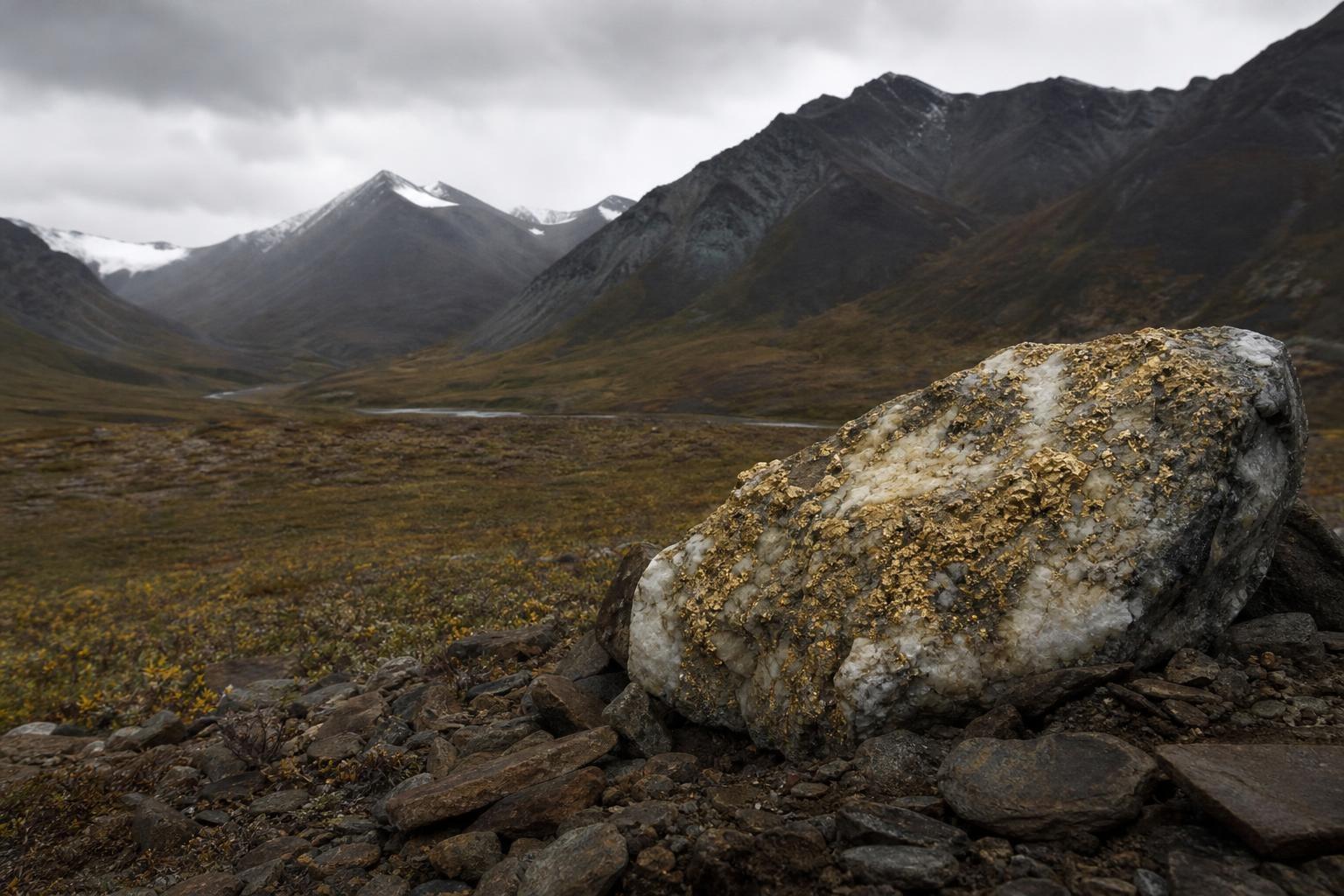
The wind moves low across the tundra, lifting ice crystals like sparks from a blacksmith’s wheel. Beneath that quiet, a metallic story waits: a hoard measured in tens of millions of ounces, sealed in permafrost and patience.
Gold asleep under a cold sky
The deposit stretches under muskeg and spruce, a buried constellation of veins and breccias stitched into ancient rock. Prospectors first followed glacial clues and river sediments, then drills mapped a body big enough to redraw ledgers and test consciences.
“The ground keeps its own time,” said one geologist, “and it rarely hurries for us.”
Here, winter is a gatekeeper, and summer is a brief permission. The land asks you to move lightly, to leave the least possible mark, even when the prize is heavy beyond ordinary reckoning.
What 39 million ounces really means
In raw arithmetic, it’s roughly 39 million ounces of gold still in place, a figure that would swell any corporate report. At today’s prices, the implied value can send models into orbit, but ore in rock is not cash in hand.
The deposit’s scale suggests decades of work, fleets of machines, and an economy that spirals outward into jobs, roads, airstrips, and fuel depots. Yet every projection has a shadow: capex that chews through assumptions, and opex that swells with remoteness and cold.
“Gold is a mirror,” an analyst once quipped. “It shows you what you want to see—until the invoice arrives.”
The ecological calculus
Tundra is a tapestry of wetlands and permafrost, stitched by lichens, sedges, and migratory paths. Disturb it, and water finds new routes; thaw it, and the ground can liquefy into difficult mess.
Engineers now speak of dry-stack tailings, lined facilities, and water treatment loops designed to operate like sealed aquariums. The promise is containment and control; the fear is time and entropy. Mines have closures; rivers have centuries.
“The cold is our ally until it isn’t,” one hydrologist warned. “When ice melts, memory in the landscape can be short.”
People of the river
Along the Kuskokwim and its tributaries, salmon remain both food and identity. A gold district upstream doesn’t just change employment; it touches ceremony, pantry, and calendar.
Some see a pathway out of precarity—training, health clinics, cash to fund schools. Others see a bargain written in footprints that fade too slowly. Local governance, tribal voices, and state law meet in hearings that feel like both progress and stalemate.
“Respect is measured in who gets to decide,” a community member said. “Not in how polite the slides look.”
Logistics at the edge of maps
Every bolt, blade, and bearing must be flown, shipped, or dragged across distance that resists shortcuts. Fuel becomes an idea as much as a liquid, and spare parts are a kind of insurance policy.
Permafrost demands counterintuitive design: foundations that cool, pads that float, and schedules that chase seasonal windows. Even data is seasonal—drones lose lift in cold, batteries drain early, and metal snaps where textbooks said it bends.
Why waiting can be a strategy
Markets turn like weather. A year of macro panic can make marginal ounces suddenly viable; a year of calm can push them back under. Companies bank permits, build alliances, and wait for the ratio of risk to reward to shift their way with quiet force.
The deposit doesn’t move, but everything around it does: currency, law, climate, and public patience. Sometimes the smartest shovel is a calendar.
What’s really at stake
- Cultural continuity for villages tied to fish and seasonal cycles, set against the pull of wage work and regional investment.
Technology, humility, and gold
New tools promise precision: machine-learning on cores, real-time geochem, and autonomous haul fleets that sip rather than guzzle. But every algorithm hits the same moraine: geology that refuses neat averages and weather that turns plans into footnotes.
“The smartest thing we carry up here is our exit plan,” a project manager joked, with a seriousness you could taste. Time is part of the design, and so is the option to walk away if the trade no longer honors the place.
The long view
There is a version of the future where careful mining funds schools, protects water, and leaves a smaller, safer footprint than the skeptics fear. There is another where cost overruns, thaw, and luck create headlines no one wants to read.
Between those stories is the tundra itself—older than our ambitions, patient beyond our deadlines. The ore will wait for our best arguments, our best engineering, and our best manners. It has already been here far longer than we have, and it will still be here when the last helicopter lifts into the cold, blue quiet.
